
A tiered discount is a promotional pricing model where the discount increases when a customer meets higher spend, quantity, or product thresholds. It gives shoppers a clear reason to add more to their basket while giving retailers more control over margin than a flat discount. Common examples include "spend £50 get 10% off, spend £100 get 15% off" or "buy 2 save 10%, buy 3 save 20%."
A tiered discount rewards customers progressively as they meet defined conditions. Instead of offering one blanket discount to every shopper, the brand creates a discount ladder based on basket value, item count, product mix, customer segment, or loyalty status.
For enterprise retailers, tiered discounts work best when they link directly to a commercial goal. That goal may be increasing average order value, clearing selected stock, encouraging bundle purchases, or giving high-value customers a stronger reason to convert.
A tiered discount turns a promotion into a set of rules. Each tier has a condition and a reward. When the customer meets the condition, they qualify for the relevant discount.
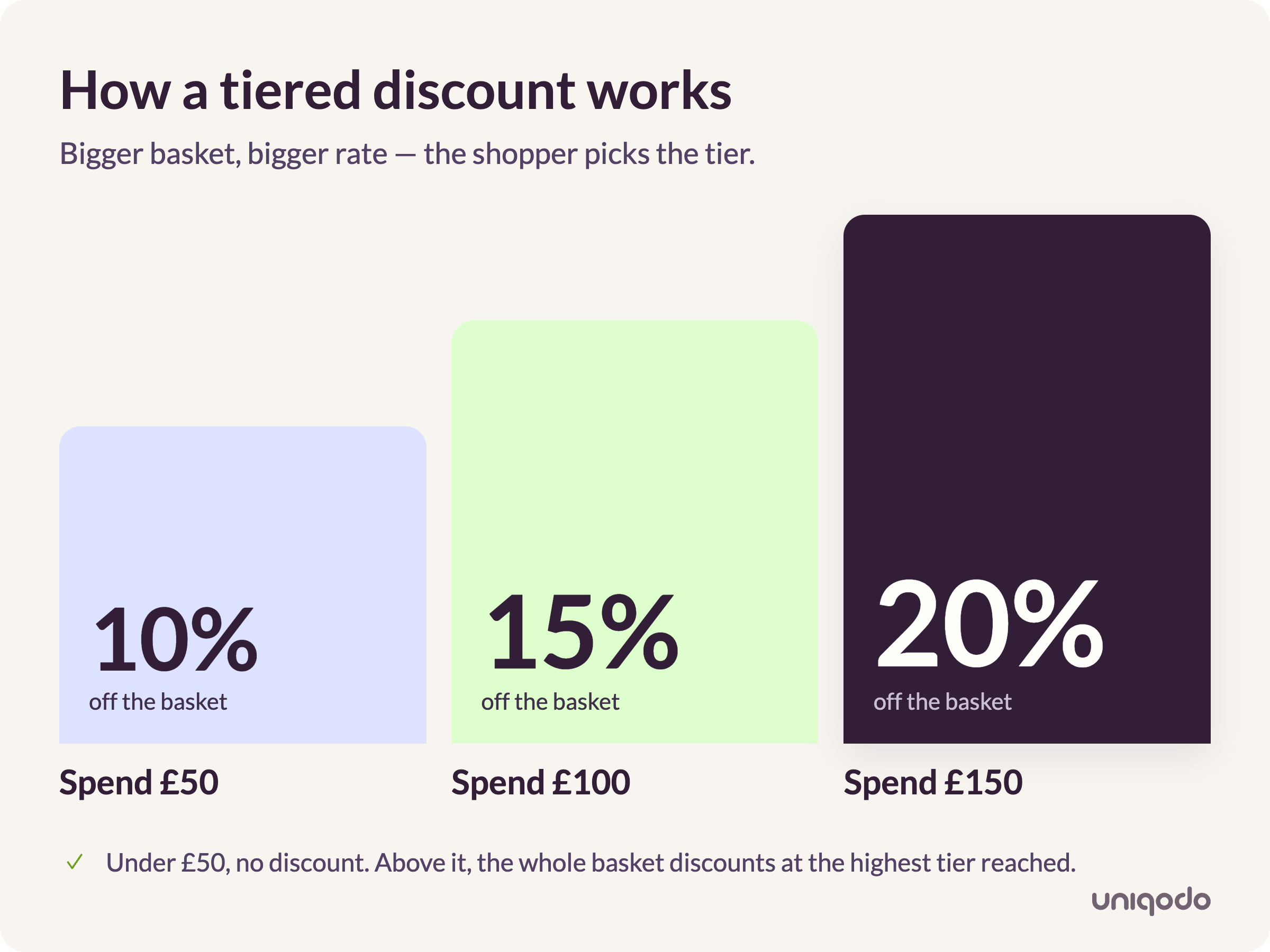
A simple spend-based tiered discount example looks like this:
A quantity-based tiered discount example works differently:
The same principle applies to product bundles, loyalty promotions, referral rewards, partner campaigns, or member-only offers. The brand defines the threshold, the discount, and the rules that control how the offer applies.
A tiered discount differs from a flat discount because the reward scales with customer behaviour. A flat 20% discount gives the same value to a customer spending £30 and a customer spending £300. A tiered discount gives the retailer more control by encouraging the next valuable action, such as adding one more product or crossing a higher basket threshold.
This makes tiered discounting useful for conversion and margin management. The shopper sees a clear benefit, while the business can set each threshold around commercial targets, stock needs, and profitability.
Tiered discounts can support several promotion strategies. The best format depends on what the retailer wants the customer to do next.
Spend-based tiers reward customers when their basket reaches a set value. These promotions often help retailers increase average order value.
Example:
This model works well when the brand has clear basket value targets. It also helps customers justify adding another item when they are close to the next threshold.
Quantity tiers reward customers for buying more units. Retailers use them to increase volume, move seasonal stock, or encourage multi-pack purchases.
Example:
This type suits categories where customers naturally buy multiples, such as beauty, fashion basics, pet supplies, homeware, or accessories.
Product-based tiers apply when customers buy specific items or combinations. They often support product bundling, cross-sell campaigns, and category growth.
Example:
These promotions help retailers guide customers toward higher-value combinations without discounting the full basket.
Customer-based tiers change the offer based on the shopper's status, behaviour, or segment. Loyalty members, students, employees, VIP customers, or referred shoppers may receive different discount ladders.
Example:
This approach works when the brand wants to reward valuable customers without exposing the same discount to everyone.
Tiered discounts matter because they connect promotion mechanics to shopper behaviour. A well-built discount ladder gives customers a visible reason to increase spend while helping the retailer protect margin.
For ecommerce and marketing teams, the main benefits include:
Tiered discounts also create a stronger onsite experience. Messages such as "Spend £12 more to save 15%" give the shopper a clear next step. This works better than asking customers to interpret offer terms hidden in promotion copy.

The risk comes from poor rule design. If thresholds sit too low, the brand gives away margin without changing customer behaviour. If thresholds sit too high, customers ignore the offer. If the terms are unclear, support queries and basket abandonment rise.
Fraud and code leakage also matter. A high-value tiered discount can spread beyond its intended audience if the retailer uses generic codes or weak validation rules. That can turn a targeted promotion into an uncontrolled margin cost.
Uniqodo helps enterprise teams manage these risks. The Promotion Engine handles tiered qualification rules, code validation, and eligibility controls. Onsite Experiences delivers progress messaging such as threshold nudges and basket banners. Code Distribution ensures that tiered promotions shared through publisher and affiliate partners stay attributed and controlled. Marketers configure all three without requiring engineering involvement for each new campaign.
Brands should design tiered discounts around customer behaviour, product economics, and the desired business outcome. The right discount structure starts with the question: what action should this offer encourage?
A practical setup process includes:
A tiered discount should feel simple to the customer, even if the rule logic behind it is complex. "Spend £20 more to save £15" is easier to act on than a long list of conditions.
For larger retailers, the challenge sits in execution. Campaigns often involve multiple markets, products, codes, partners, exclusions, and customer groups. Uniqodo gives marketers a single platform to build those rules, control distribution, and measure each tier's commercial impact without queuing engineering work for every campaign change.
Tiered discounting works best when it becomes part of a planned promotion strategy, not a reaction to weak sales. The strongest programmes use discount tiers to shape profitable behaviour, then connect them with loyalty, referral, partner, and onsite experiences to make each offer more relevant.
A tiered discount increases the reward as the customer meets higher thresholds, whether based on spend, quantity, product mix, or customer status. A volume discount typically offers a single reduced price when the customer buys above a set quantity. Tiered discounts create multiple levels of reward, giving the retailer more control over how the promotion scales with customer behaviour.
Most retailers use three to four tiers. Fewer than three and the promotion feels like a flat discount with a minimum spend. More than four and the structure becomes difficult for customers to follow. The right number depends on the spread between your average basket value and your target basket value, with each tier placed to encourage a meaningful step up in spend or quantity.
Yes. A tiered discount can be activated through a unique single-use code, a generic code with qualification rules, or applied automatically when the customer's basket meets the tier conditions. Using unique codes adds control over who can access each tier and prevents the promotion from leaking to unintended audiences.

Stop code leakage. Replace shareable generic codes with high-entropy unique strings. Protect your margins by ensuring discounts only apply to the intended audience under specific, validated conditions.

Execute complex campaigns. Move beyond basic discounts with multi-tiered rewards, product bundles, and discounts, all managed without waiting for a developer to clear your roadmap.

Convert with intent. Use real-time data to trigger onsite nudges or referral loops exactly when they matter. Create a unified journey that turns browsing interest into confirmed sales.

Scale partner sales. Automate the delivery of unique codes to thousands of partners instantly. Replace manual spreadsheets and CSV exports with secure, trackable API distribution.




We'll show you exactly how Uniqodo handles your use case - fraud controls, mechanic complexity, and ROI attribution included.