
A unique code, or unique coupon code, is a discount code generated for one customer, order, partner or campaign rather than shared publicly. Each code works under defined rules, usually a single redemption, so retailers can control who uses an offer and see which channel drove each sale.
A unique coupon code is a promotional code created for a specific person, order, channel or campaign, so no two recipients hold the same code. It usually looks like a random or semi-random string, such as WELCOME-8K4P2, and the retailer's promotion engine checks it against the campaign rules at checkout. Retailers also call these unique codes, unique promo codes, unique voucher codes or single-use codes.
Unique codes are one type of coupon code. A generic code such as SAVE10 works for anyone who finds it, while each unique code can be redeemed once, or only by the customer it was issued to.
Instead of publishing SAVE10 across a website, a retailer creates thousands of individual codes, each assigned to a person, partner or promotion.
For example, a fashion retailer might send a lapsed customer the code ELLA-15-X9F2, valid for 15% off one order over £75 and expiring in seven days. Another customer receives a different code with the same discount rules, and if the campaign links each code to an account or email address, neither can use the other's code.
Retailers use unique codes wherever an offer needs to stay with the person it was sent to.
A generic code spreads easily through coupon sites, forums, browser extensions and social media, a problem known as coupon code leakage. A unique coupon code loses most of that sharing value because the retailer can restrict it to one person, one use or one checkout session.
Unique coupon codes work through three connected layers: generation, distribution and validation. The customer only sees the code field at checkout, but the business rules behind that field decide whether the promotion applies.
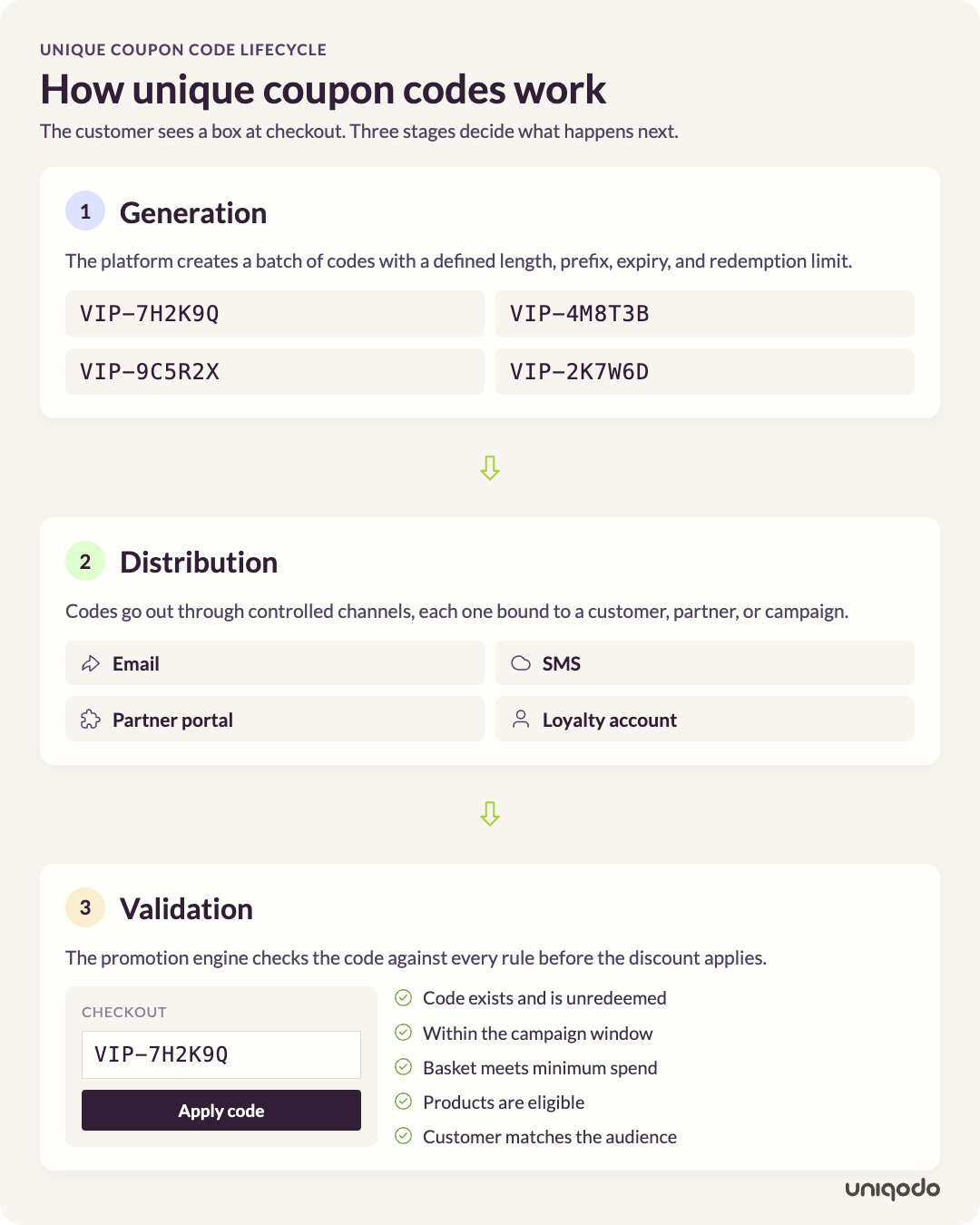
A promotion platform, ecommerce system or coupon management tool creates a batch of codes. Each code needs enough randomness to avoid guessing while still fitting the brand's operational needs, and six settings control that balance.
A code that customers mistype at checkout creates friction, and a code that is too predictable invites abuse, so a good format balances security, readability and reporting.
.png)
Retailers distribute unique coupon codes through controlled channels. Email, SMS, push notifications, direct mail, partner portals and loyalty accounts all support personal code delivery.
The distribution method affects how tightly the retailer can bind the code to a customer. An email campaign can assign a code to a customer ID, while a printed insert may only link the code to a campaign batch. Both count as unique codes, but the first gives stronger identity-level control.
At checkout, the promotion engine checks the code against its qualification rules. A typical validation run asks eight questions.
If the code passes every check, the discount applies. If it fails, the customer sees an error message, and the wording matters, because a vague "invalid code" message increases support contacts and checkout drop-off.
Uniqodo's Promotion Engine runs these checks in real time for every unique code it generates, so redemption limits, audience criteria and basket conditions are enforced at the moment of checkout.
Unique coupon codes give ecommerce and CRM teams more precision than generic discounts, so they can use incentives to drive conversion and retention while protecting margin.
A private offer stays private. A retailer can decide that a code works once, only for the intended recipient and only within a narrow time window. That stops a private retention offer becoming a public sitewide discount.
Every redemption traces back to its source. If each influencer, partner, email segment or customer cohort gets a distinct code set, the retailer can see which source drove each redemption. Code Distribution delivers those code sets to partners and publishers through controlled, attributed channels, so codes do not travel by spreadsheet or open link.
Shared codes stop working after one use. Promotion abuse often comes from code sharing, repeated account creation, stacking offers or using discounts outside their intended context. A single-use code tied to a customer removes the sharing route, because a shared code only works once.
Service teams can give goodwill safely. A support agent can issue a one-time code after a failed delivery or service problem without opening the door to unlimited redemptions.
Finance can see the maximum cost in advance. A campaign with 20,000 unique codes and a one-use redemption cap has a clear maximum discount exposure, which makes it easy for finance and trading teams to forecast. A generic code posted publicly has a much less predictable cost.
The difference between a unique and a generic coupon code is who can redeem it: a unique code is limited to one recipient or one use, while a generic code works for anyone who has it.
Generic codes still have a place. They work well for simple public campaigns, such as a seasonal sale where the brand wants reach and ease of use, though public codes often spread beyond the planned audience.
.png)
Unique coupon codes suit campaigns where margin, eligibility, attribution or abuse risk matters. Most mature promotion strategies use both, with generic codes for broad acquisition and unique codes for targeted lifecycle campaigns. As a rule, use a generic code when reach matters more than control, and a unique coupon code when the offer needs to stay tied to a specific customer, campaign or commercial limit.
In promotions, a unique code means a discount code that exists only once, issued to one customer, order or partner rather than shared publicly. Outside promotions the term can mean any one-off identifier, such as a product or account code, but in ecommerce it usually refers to a single-use discount code.
Most retailers use between 8 and 12 characters, because shorter codes are easier to type but more predictable, while longer codes resist guessing but cause more entry errors. A recognisable prefix such as VIP- or BF- helps customers identify the campaign without adding much length.
Most unique codes are set to single use and deactivate after one redemption, but some retailers allow a small number of uses per code, such as three, to cover multi-device purchasing or household sharing. Each code is still tracked individually, which is what separates it from a generic code shared publicly.
The terms overlap: in the UK, "voucher code" often means a code with a fixed monetary value, such as £10 off, while "coupon code" can cover percentage discounts, free shipping and other rewards. A unique voucher code and a unique coupon code work the same way mechanically, so the distinction that matters is unique versus generic.
Binding a code to a customer account or email address stops anyone else redeeming it, and a single-use limit deactivates it after one transaction. Short expiry windows and channel or basket restrictions add further protection, because a shared code still only works when the original eligibility criteria are met.

Stop code leakage. Replace shareable generic codes with high-entropy unique strings. Protect your margins by ensuring discounts only apply to the intended audience under specific, validated conditions.

Execute complex campaigns. Move beyond basic discounts with multi-tiered rewards, product bundles, and discounts, all managed without waiting for a developer to clear your roadmap.

Convert with intent. Use real-time data to trigger onsite nudges or referral loops exactly when they matter. Create a unified journey that turns browsing interest into confirmed sales.

Scale partner sales. Automate the delivery of unique codes to thousands of partners instantly. Replace manual spreadsheets and CSV exports with secure, trackable API distribution.




We'll show you exactly how Uniqodo handles your use case - fraud controls, mechanic complexity, and ROI attribution included.