
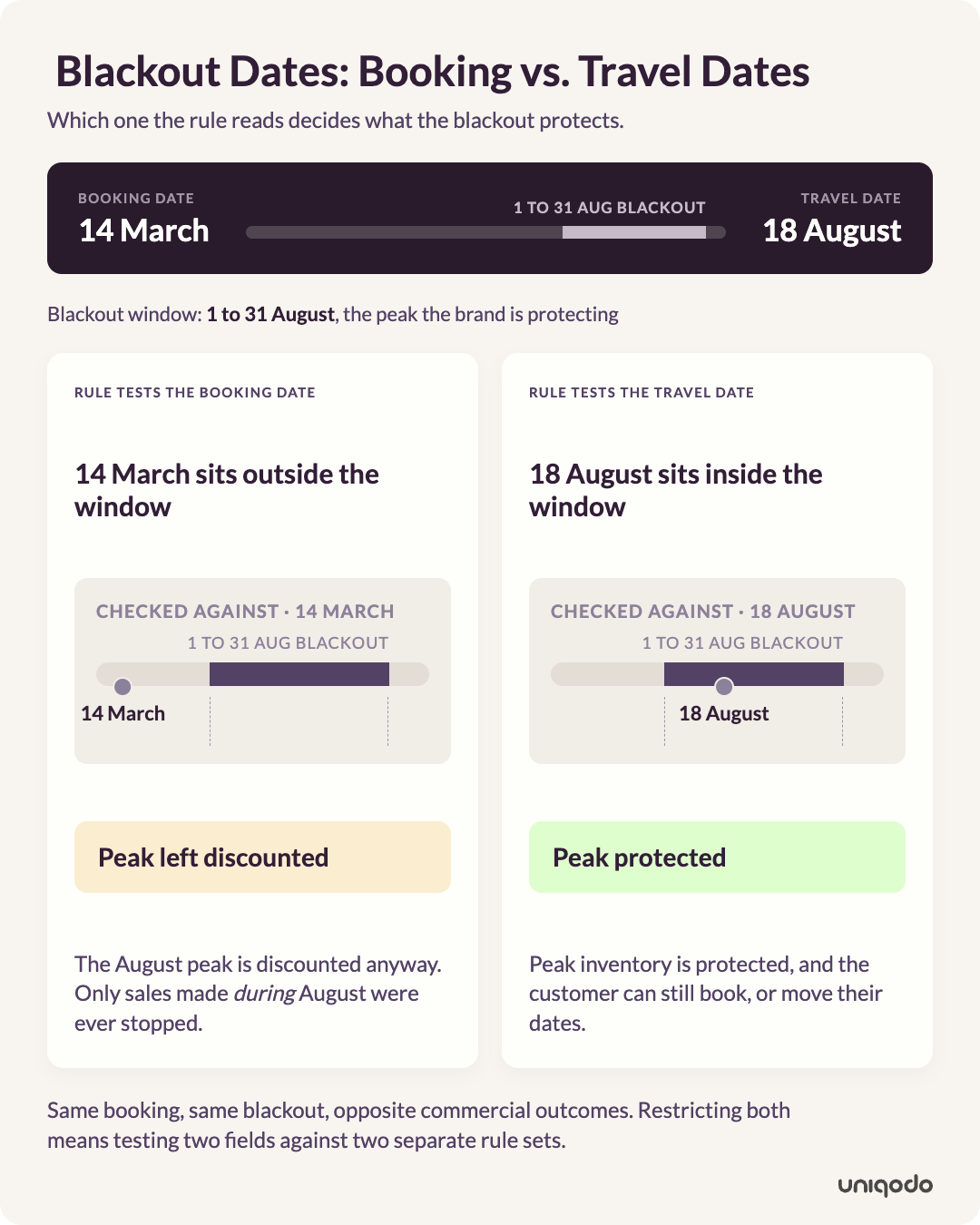
Blackout dates are periods when a travel brand blocks discounts, promo codes and reward redemptions, even though the offer is otherwise live. They protect peak seasons, school holidays and major events, when rooms and seats sell at full price. The rule can test the booking date, the travel date or both.
Blackout dates are periods when a brand deliberately makes a promotional offer unavailable for redemption, despite the promotion running before and after those dates. They act as an exclusion layer on top of a promotion's standard validity window, blocking redemption on days when discounting would erode profit without driving incremental sales.
The concept originated in travel and hospitality, where airlines and hotels blocked reward redemptions and discounted fares during peak seasons. It has since become standard practice across e-commerce, retail, subscription services, and ticketing, anywhere demand fluctuates enough that a discount makes sense on some days and destroys margin on others.
A booking carries more than one date a rule could read, and the choice determines what the blackout actually protects.
The two are frequently confused because the rule looks the same in both cases. Only the field it reads is different.
The exclusion rarely applies to a single offer type. One blacked-out range can block promotional codes, negotiated corporate or group rates, loyalty point and award redemptions, and package add-ons at once, depending on how the programme is configured.
What happens at the point of refusal matters just as much. A customer told clearly that their dates fall outside the offer can adjust their booking. A customer who sees a generic error, or nothing at all, calls the contact centre or leaves.
A discount only earns its cost when it changes what someone does. On a fully booked August weekend, it adds nothing as the user would have converted anyway. All the discount has done is lower the potential margin.
That is why the exclusion tends to fall on the same handful of windows:
Blacking out the peak is what makes the rest of the calendar affordable. The same budget goes to the dates that need it: the shoulder weeks, the midweek gaps, the routes and properties running below forecast. This is the mirror image of distressed inventory. Blackout dates protect the dates that sell themselves so the discount lands on the dates that do not.
However blackouts are still a blunt instrument, several major airlines advertise the absence of blackout dates as a reason to choose them, which tells you how customers read the restriction. A wide exclusion removes the offer from everyone, including the customers it was meant to convert. Narrowing it to the specific dates, rates or properties that do not need support protects the same margin at a lower cost to the offer.
An expiry date ends a promotion permanently. Whereas, a blackout date pauses it temporarily. Teams often confuse the two, and the confusion has real consequences: expiring a code and reissuing it later means new distribution, new partner communications, and broken links, while a blackout rule keeps the same code live and simply blocks a defined window.
Blackout dates are also confused with restrictions that look similar but do different jobs:
For enterprise teams, the blackout approach is almost always the better option because it preserves the promotion's tracking, attribution, and partner relationships intact across the excluded period.
One promotion with one exclusion calendar is straightforward. The problem is that no enterprise travel brand has one promotion.
A single brand can be running affiliate codes, closed user group offers, CRM campaigns, onsite recovery offers and a loyalty scheme at the same time, each with its own exclusion calendar, and each of those calendars changing as the trading year moves. Three things make that harder in travel than elsewhere:
One missed exclusion on a high-traffic partner code across a peak week can cost more margin than the campaign it belonged to ever generated.
Uniqodo's Promotion Engine holds blackout dates as qualification rules inside each promotion's conditions, alongside rate, route, property and basket criteria. Once the integration is in place, commercial teams set and move those windows themselves as the trading calendar changes, rather than raising a ticket for each amendment.
Where codes go out through publishers or closed user groups, Uniqodo's Coupon Code & Distribution Tool validates every code against the promotion's criteria at the point of booking. A blackout window can open and close without the code being withdrawn from the partner and reissued afterwards, so the placement and its tracking survive the exclusion.
Treat blackout dates as part of the promotional calendar rather than something added when a peak is already in view. Map them against known demand peaks, partner campaign schedules and finance's spend caps at the start of each quarter. A rule set in advance costs nothing. A discount redeemed against a date that was already full is a margin you do not get back.
For protecting peak inventory, the travel date. Blacking out booking dates stops the offer selling during the blackout while leaving peak departures discounted for anyone who booked earlier. Booking-date exclusions are better suited to pausing a campaign, not protecting a season.
Yes, but codes already in circulation will start being refused, and customers holding them have no way of knowing why. Where the codes sit with publishers or affiliates, the change needs communicating to the partner as well. Setting exclusions when the promotion is built avoids both problems.
The exclusion has to be enforced when the booking is validated, not when the code is issued, because the brand no longer controls where a distributed code appears. Handled that way, the window can open and close while the code stays live with the partner. The alternative is withdrawing and reissuing, which loses the placement and its tracking.
They are separate decisions and are often treated as one by mistake. Excluding point redemptions on peak dates protects the same inventory, but the reputational cost is higher, because members read it as a benefit being withdrawn rather than a discount not applying. Some programmes deliberately keep redemption unrestricted for that reason.
The reason, and ideally the nearest dates that do qualify. A refusal that explains itself lets the customer move their dates, which is a conversion the blackout would otherwise have cost. Generic errors send the same customer to the contact centre or out of the booking flow.

Stop code leakage. Replace shareable generic codes with high-entropy unique strings. Protect your margins by ensuring discounts only apply to the intended audience under specific, validated conditions.

Execute complex campaigns. Move beyond basic discounts with multi-tiered rewards, product bundles, and discounts, all managed without waiting for a developer to clear your roadmap.

Convert with intent. Use real-time data to trigger onsite nudges or referral loops exactly when they matter. Create a unified journey that turns browsing interest into confirmed sales.

Scale partner sales. Automate the delivery of unique codes to thousands of partners instantly. Replace manual spreadsheets and CSV exports with secure, trackable API distribution.




We'll show you exactly how Uniqodo handles your use case - fraud controls, mechanic complexity, and ROI attribution included.