

The best referral program software depends on how much of the programme you want built for you. Uniqodo suits brands that want the referral flow and the codes behind it from one vendor. Mention Me, Soreto and Buyapowa specialise in referral. Extole and Friendbuy cover wider reward programmes, while Talon.One and Voucherify suit developer-led builds.
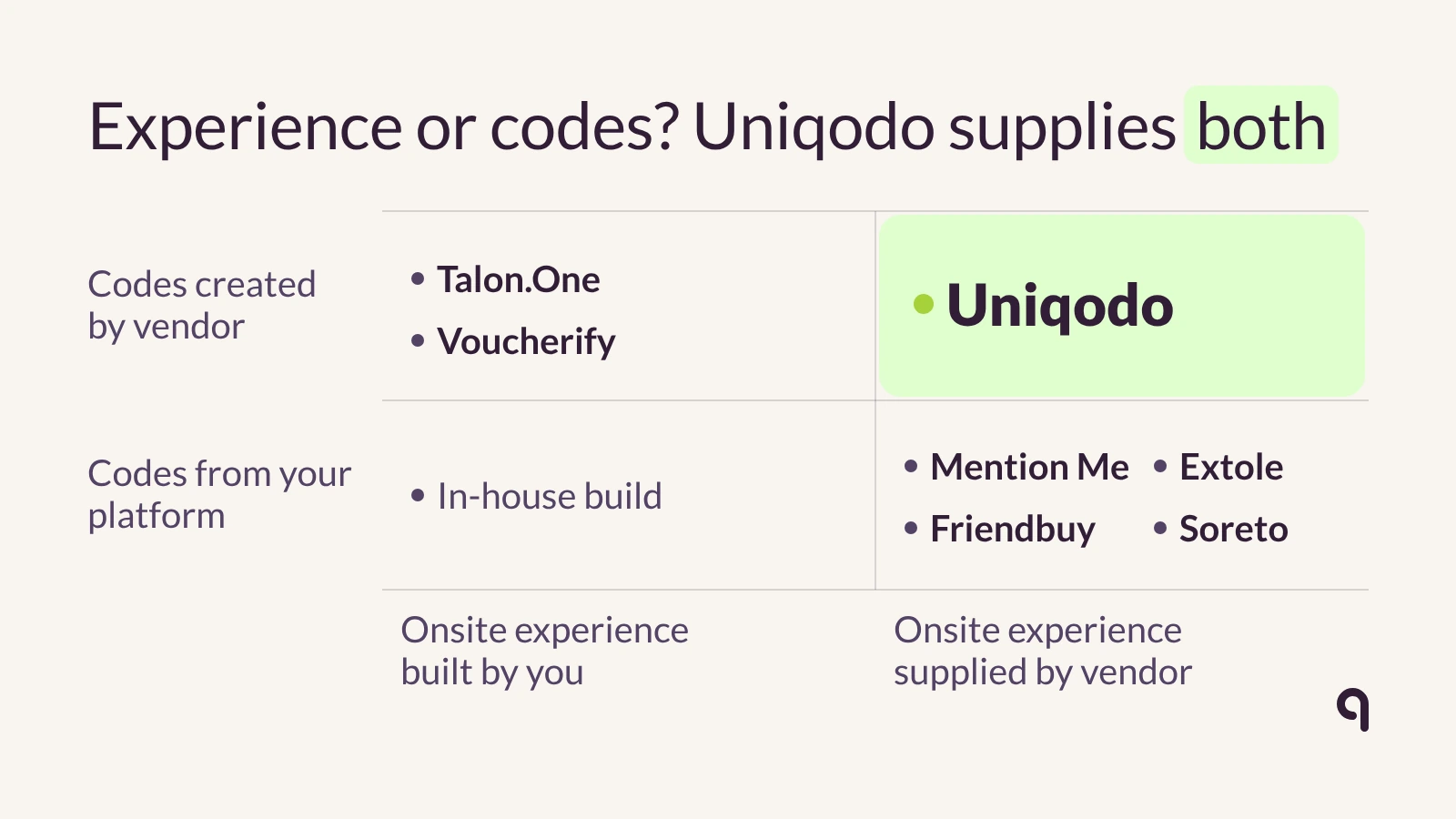
A referral programme has a simple shape: a customer shares, a friend buys and both get a reward. Vendors differ on how much of it they supply: some provide both the onsite experience customers see and the codes behind it. Most referral specialists provide the experience, but the codes still come from your own ecommerce platform. Promotion engines create the codes, but your developers have to build the experience.
They also differ on how they keep referral codes off voucher sites and on how much they do beyond referral. This guide compares eight options for ecommerce brands on those points. If you’re still deciding whether to run a programme at all, start with how a referral program works.
How we chose the best referral program software
We judged each referral program software option on seven things that decide how a programme runs once it’s live.
1. The full referral flow. A programme needs an invite, a way to share, an offer for the friend and a reward that only issues once the friend buys. Some tools provide the onsite overlays, while API-first engines leave the front end to your developers.
2. Code protection. A referral reward is only as safe as the code behind it. A shared code can be copied to voucher sites, while a unique referral code issued to one person can only be used once.
3. Fraud and reward controls. Look for limits on referrals and rewards per customer, new-customer-only offers and checks for self-referrals. Ask which are live today.
4. Set-up route. A JavaScript tag, an API build and a managed set-up ask very different things of your IT team, and they decide who changes the programme afterwards.
5. Reporting and attribution. You need to see which referrer drove which order. Programme-level figures on acquisition cost and return let you compare referral with paid channels.
6. What else the platform runs. Loyalty, onsite promotions, code distribution or influencer programmes on the same platform mean fewer vendors to manage.
7. Fit with your ecommerce platform and email tools. Check how the tool connects to your ecommerce platform, and whether it passes referral events to your email and SMS tools, such as Klaviyo, to trigger welcome and reminder messages. Several referral tools only create codes automatically on Shopify, so brands on other platforms should ask how codes are made and kept in sync.
Which is the best referral program software for ecommerce?
The eight tools below fall into four groups: Uniqodo’s referral product on a wider promotion platform, referral specialists (Mention Me, Soreto and Buyapowa), multi-programme platforms (Extole and Friendbuy) and promotion engines with a referral module (Talon.One and Voucherify).
1. Uniqodo: best for brands that want the referral flow and the codes behind it from one vendor
What it does well: Uniqodo’s Referral Program Software, part of Uniqodo’s Intelligent Promotion Experience Platform, runs the whole referral programme on a JavaScript integration, with no promotion engine required. An onsite overlay invites customers to join, for example straight after they order. Each referrer gets a link to share anywhere or by email, which takes their friend to a branded landing page to claim their own unique, single-use code. Once the friend’s order completes, the referrer receives a reward code of their own.
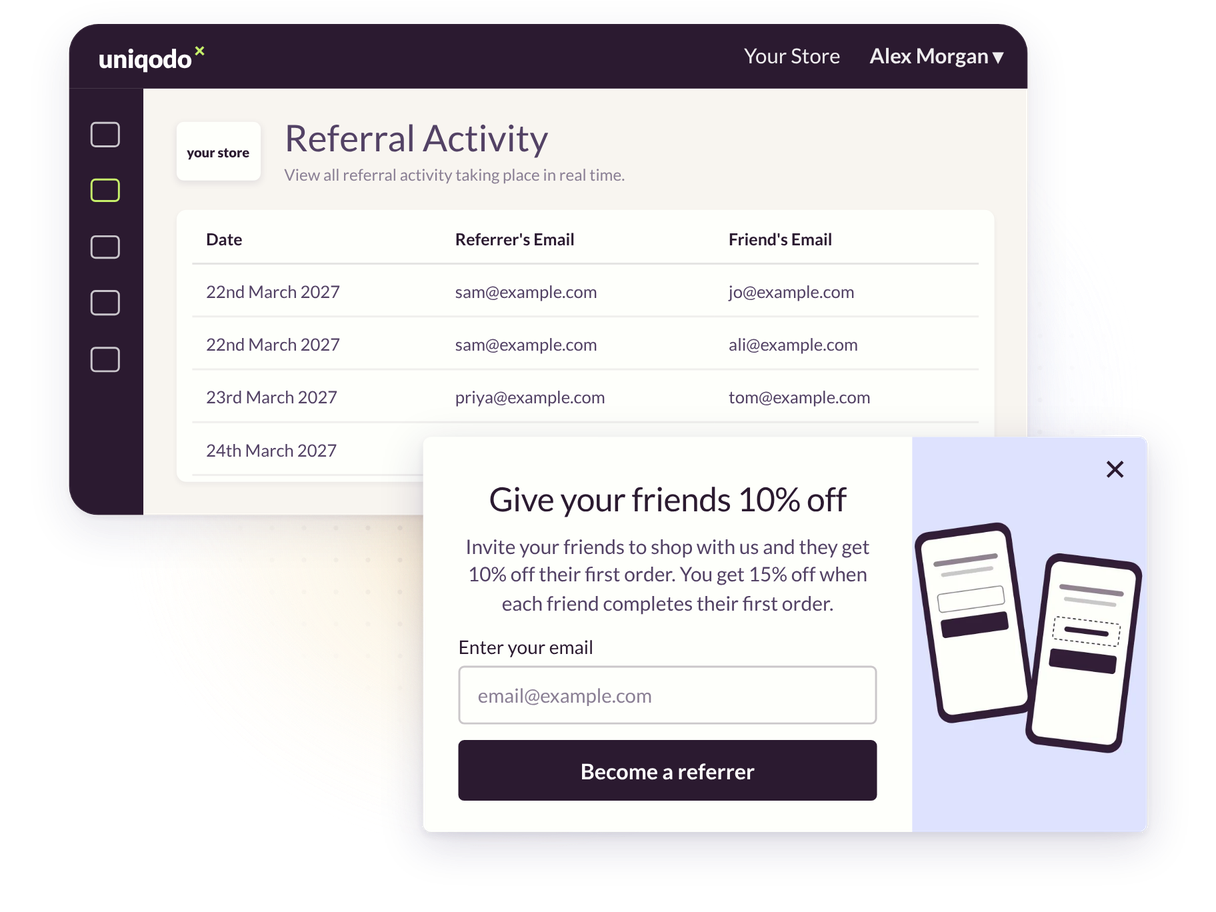
Uniqodo also creates and checks the codes itself. Many referral tools distribute code batches that your team generates and uploads, unless a platform such as Shopify creates them automatically. It issues each friend’s unique code from its own system and expires single-use codes once they’re redeemed, so there are no batches to create, upload or top up. Between January and June 2026, it issued 51.6 million unique codes across its whole platform, for 90 merchants and 4,124 promotions.
Zero discount abuse on Avis’s sign-up offer
Avis Budget Group used Uniqodo’s unique, single-use codes to keep its new-subscriber offer to genuine new subscribers, with zero abuse of the discount. How Avis kept its sign-up offer to new subscribers
Uniqodo’s team builds the friend page from the brand’s logo, imagery and copy and sends the referrer’s reward email, while teams that want to own every screen can use the Referral API instead. Rewards are set up as two promotions, one for the friend and one for the referrer. Controls cover programme dates, daily and overall limits per referrer and a cap on referrer rewards. It integrates with Salesforce Commerce Cloud, Shopify Plus, Magento and commercetools, and the same JavaScript integration connects Onsite Experiences and Code Distribution with no second integration project.
Best for: Retail, travel and telco brands on ecommerce or booking platforms where other referral tools rely on uploaded code batches.
Trade-offs:
- Tiered or milestone rewards, which increase as a referrer brings in more friends, aren’t supported yet.
2. Mention Me: best for DTC brands making referral a main acquisition channel
What it does well: Mention Me is a referral marketing platform built for direct-to-consumer brands, and it says more than 500 brands use it. Its NameShare feature lets a friend give their referrer’s name at checkout instead of a link or code, which captures recommendations made in conversation. An optimisation engine draws on more than 45,000 tests across its network to suggest which incentive, placement and message to run, and benchmarking shows how a programme compares with others in its category.
Mention Me says most brands go live in one to three days. It connects to tools including Klaviyo and Salesforce.
Best for: DTC brands in categories such as fashion, beauty and food where referral is a main acquisition channel, and where the team wants testing, benchmarking and specialist support behind it.
Trade-offs:
- Mention Me doesn’t run a promotion engine or distribute codes to affiliates and publishers. Brands that need those run them on separate systems.
3. Soreto: best for brands whose customers share on WhatsApp and social
What it does well: Soreto is a social referral platform that lets customers share through 12 channels, including WhatsApp, TikTok, Instagram, Snap, Telegram and Viber, as well as a copied link and email. Placements can sit on the site, in emails and in member areas, with flexible rewards, A/B testing and real-time reporting. Referral data can then feed CRM segments, retargeting and lookalike audiences.
Every Soreto plan includes a managed set-up with a dedicated referral specialist. Soreto is also available on Awin’s MasterTag, so Awin advertisers can switch it on with one-click activation.
Best for: Fashion, beauty and tech brands whose customers recommend products on messaging apps and social, especially brands already working with Awin.
Trade-offs:
- Soreto’s edge is the number of sharing channels. That counts for most where customers share on social and messaging apps, and for less where referrals mainly travel by email or a copied link.
4. Buyapowa: best for telecoms, energy and financial services brands
What it does well: Buyapowa is an enterprise referral platform built for complex, regulated industries, including mobile, broadband, energy, banking, insurance and gaming. Beyond customer referral, it runs employee, influencer, partner, installer, call centre and in-store, B2B and broker programmes from one platform. Automated reward fulfilment, a reward catalogue, fraud prevention and multi-programme support come built in. Its homepage features testimonials from people at T-Mobile, Telus, Sky and VOXI by Vodafone.
Best for: Brands where a referral is a contract or account sign-up rather than a basket, and where referrals also come through call centres, stores or brokers.
Trade-offs:
- Buyapowa’s industry pages cover regulated and subscription sectors, not retail. Retailers should check how it handles basket-level rewards and product rules before shortlisting it.
5. Extole: best for enterprise brands running several reward programmes on one system
What it does well: Extole is an enterprise offer management platform that runs refer-a-friend alongside ambassador, welcome offer, reward-for-action, friends and family, drop-a-hint, sweepstakes and loyalty programmes. Every programme shares the same customer data, rules, reward fulfilment and reporting, and rewards can be gift cards, coupons, points or account credit.
Developers connect Extole through REST APIs and SDKs for web and mobile apps. Configurable quality rules and risk signals flag suspicious referral activity for review. Extole works with retail, fintech, banking, telecoms and travel brands.
Best for: Enterprise brands with developer capacity that want referral, loyalty and other reward programmes on one platform, including inside their mobile apps.
Trade-offs:
- Extole says marketers can run programmes without ongoing developer work once the required systems and business events are connected. That connection work comes first, so budget developer time before launch.
6. Friendbuy: best for retail and subscription brands adding loyalty and influencer programmes
What it does well: Friendbuy runs referral, loyalty and influencer programmes on one platform, with wallet passes and notifications for loyalty members. Its onboarding is project-managed: Friendbuy’s team handles programme design, integration and the widget build against a dedicated project board, then runs an ongoing success plan with regular reviews.
Best for: Retail and subscription brands that want referral, loyalty and creator programmes measured in one place, with hands-on support at launch.
Trade-offs:
- Friendbuy describes its programmes as “live in weeks”, with onboarding phased to clear security and IT. Brands that want referral running before a trading peak should plan around that timeline.
7. Talon.One: best for developer-led teams building complex referral rules
What it does well: Talon.One is a promotion and loyalty engine with a referral module, owned by Adyen since July 2026. Its rules reward both sides on success criteria the brand defines, such as a first purchase, an order value, a location or a time limit. Rewards can rise with each successful referral or pay the referrer a share of the friend’s spending, and customer wallets can collect cash or points.
Best for: Engineering-led teams that want tiered and progressive referral logic in the same engine as their other promotions, particularly merchants already processing payments with Adyen.
Trade-offs:
- Referral runs inside Talon.One’s engine, so using it for referral means integrating the engine with your commerce stack. Your developers also build the invite, the sharing screens and the friend’s landing page.
- Since the Adyen acquisition, Talon.One’s roadmap sits inside a payments company. Brands on another payments provider should ask how platform-neutral it will stay.
8. Voucherify: best for engineering teams building their own referral experience
What it does well: Voucherify is an API-first incentive engine that runs referral alongside coupons and loyalty. It supports tiered referral programmes, any reward type and A/B tests on rewards. Its fraud controls include unique link tracking, per-referral limits, velocity caps and custom validation rules, and it flags self-referrals and duplicates before rewards go out. Referral rewards can feed loyalty points or tier upgrades, and pre-built connectors cover Braze, Segment and Shopify.
Best for: Product and engineering teams that want referral logic, fraud controls and loyalty on one API, and plan to design every screen themselves.
Trade-offs:
- Voucherify is white-label by design: it provides the logic, and your team builds every screen, message and landing page the customer sees. That gives full control over the experience and puts the front-end build and its upkeep on your developers.
Four other names come up often in referral software roundups. Talkable runs enterprise referral programmes with post-purchase and drop-a-hint campaigns. ReferralCandy offers referral and affiliate programmes for Shopify stores, with versions for WooCommerce, BigCommerce and Squarespace. Yotpo runs loyalty and referral programmes alongside its reviews product, and Referral Rock focuses on service businesses such as home services, clinics and professional services.
How do you choose referral program software for your ecommerce brand?
Choosing referral program software comes down to who builds the programme and what else the platform needs to do.
Smaller Shopify stores may not need any of the platforms above. A Shopify-focused app such as ReferralCandy is often enough to get a programme started.
Where referral is a main channel and you want specialist testing and benchmarking, Mention Me is built for that. Soreto suits brands whose customers share on messaging apps and social, especially through Awin, and Buyapowa suits telecoms, energy and finance brands with call centre and broker referrals.
Extole and Friendbuy put referral alongside other reward programmes on shared data. Talon.One and Voucherify give engineering teams the rules and APIs to own both the logic and the front end.
Uniqodo is built for brands that want the referral flow and the codes behind it from one vendor, with every reward tied to one person’s code and room to add onsite experiences and code distribution later. Book a Uniqodo demo to see the referral flow from first invite to reward.
FAQs about referral program software
What is referral program software?
Referral program software runs a refer-a-friend programme, also called member-get-member (MGM), from end to end. It gives existing customers a link or code to share, gives their friend an offer, tracks the friend’s first order back to the referrer and rewards the referrer once that order qualifies. Most tools also add fraud controls and reporting on referral sales.
How does referral software prevent fraud?
Referral software prevents fraud with unique, single-use codes tied to each referrer and friend, limits on how many referrals or rewards one customer can earn and new-customer-only offers. Rewards also only issue after the friend’s order completes. Some platforms add checks for self-referrals and unusual activity, so ask each vendor which controls are live today.
Is a refer-a-friend programme GDPR compliant?
A refer-a-friend programme can comply with UK GDPR and PECR, depending on how friends are contacted. The ICO advises against asking customers for friends’ contact details for marketing. On Uniqodo’s hosted friend page, the friend enters their own email to claim their code, so referrers never hand over friends’ details. Check your set-up with your legal team.
Do you need a promotion engine to run a referral programme?
No. Many referral tools issue rewards using the discounts your ecommerce platform already supports, which covers a standard give-and-get offer. A promotion engine matters when you want rewards your platform can’t create, such as product-level discounts, tiered rewards or detailed rules on who qualifies. Uniqodo’s referral product runs with or without its Promotion Engine.
How do you switch referral program software?
Switching referral software is mainly about the referrers sharing your links today. Check whether the old provider’s links keep working after the contract ends, and if not, send active referrers new ones. Pay out rewards already earned. Brands using Uniqodo’s Onsite Experiences or Code Distribution can add its referral product on the same JavaScript integration.
Is Uniqodo a good fit for ecommerce referral programmes?
Uniqodo fits ecommerce brands that want the referral flow and the codes behind it from one vendor. It issues each friend a unique, single-use code and runs the invite, the friend page and the reward email. Programme-level ROI reporting isn’t available yet, so brands that need it from launch should ask about timing.

Jenna Tyler
Director of Customer Operations