
A headless promotion engine runs discount logic, code validation and redemption rules separately from a store's front end and commerce platform. Websites, apps, checkouts and partner journeys call it through APIs, allowing one central rule set to govern promotions wherever customers redeem them.
A headless promotion engine is a standalone service that holds promotion logic, eligibility rules and code validation outside the storefront and core commerce platform. It connects through APIs rather than operating within one platform's checkout, so teams can apply the same rules across a website, app or partner channel without rebuilding them for each one.
In software, headless describes a system with no built-in user interface. It exposes its functions through APIs and leaves other applications to decide how results appear. Headless commerce applies this to online retail, separating the customer-facing "head" (the front end) from the back-end systems that manage products, pricing and orders. A headless promotion engine brings headless architecture to promotions: the engine decides whether an offer applies and what it is worth, while the front end decides how to show that outcome to the shopper.
When a shopper enters a code or builds a basket, the front end sends the relevant details to the engine through an API call. These details typically include basket contents, customer ID, channel and code. The engine checks the request against its active rules and returns a response containing the code's validity, discount value and any message to display. The checkout then applies the result, usually in real time, so the shopper sees the outcome before paying.
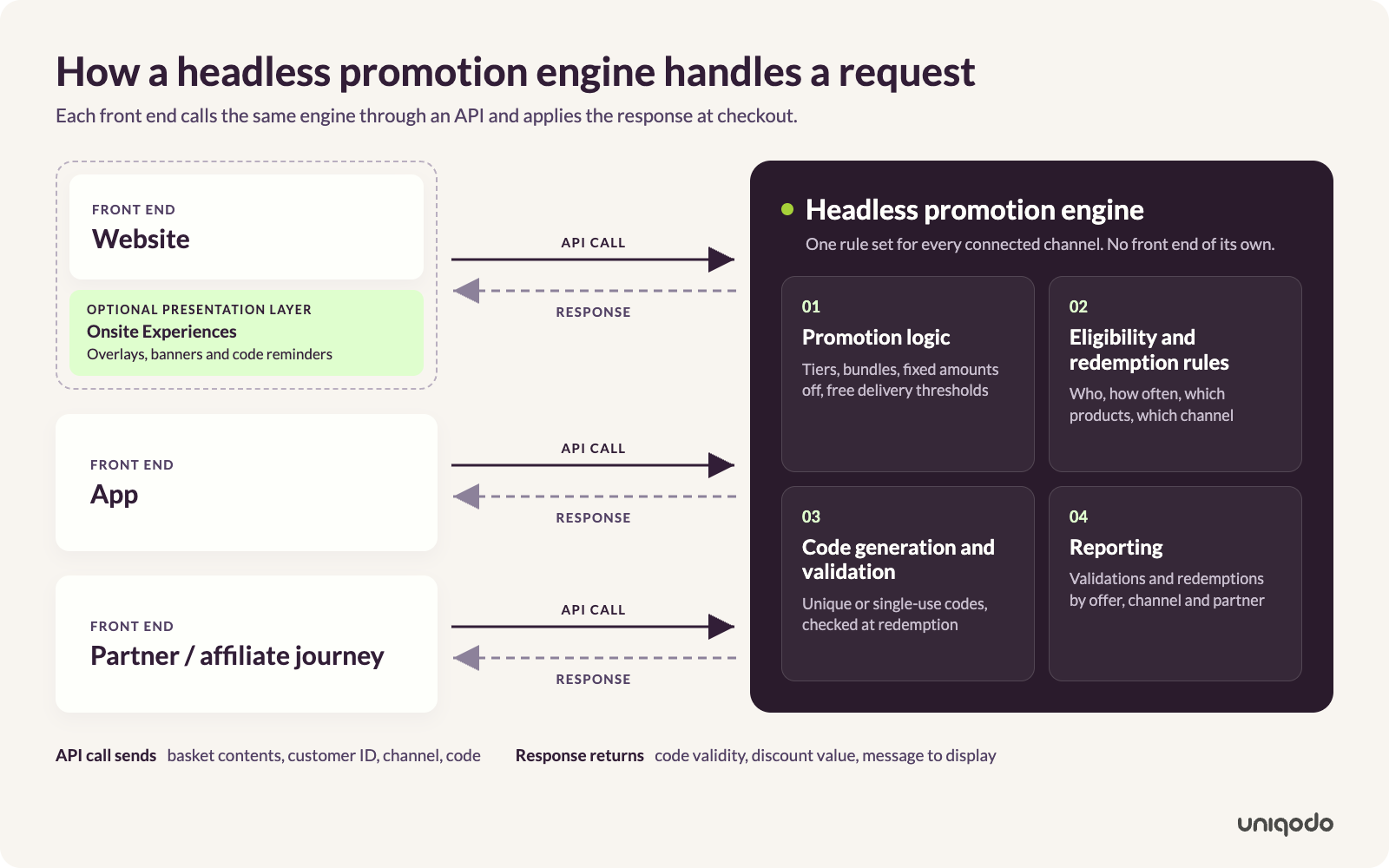
The engine generally handles four jobs:
These jobs do not depend on a particular front end, so one engine can serve several storefronts, brands or markets. A travel booking flow and a retail checkout can call the same service while receiving answers based on different rule sets.
However, as the engine has no front end of its own, something still has to present its decisions to the shopper. Some brands build that layer themselves. Uniqodo pairs its headless Promotion Engine with Onsite Experiences, which displays offers through overlays, banners and code reminders that share the engine's rules, codes and reporting. Marketers set display rules by journey stage in a template builder, so an offer a shopper received by email can reappear on site before they reach checkout.
Many e-commerce platforms include a built-in promotions module. These modules can handle straightforward offers, but their logic remains tied to the platform's checkout and data model. Requirements outside the module's existing capabilities may need development work or a workaround. Examples include stacking rules across channels, per-partner unique codes and multi-condition eligibility. A headless engine separates that logic from the platform.
This separation also changes the replatforming question. A team frustrated by its platform's promotion limits does not necessarily have to migrate its entire commerce stack. It can replace the promotion layer independently, an option that often shapes build or buy decisions about promotion infrastructure. Brands running bespoke storefronts face the same choice and can use headless engines to add advanced promotions to custom platforms.
Enterprise teams often run promotions across several sectors, markets or brands, and a mechanic that works for one may perform differently for another. Across 90 merchants and 4,124 promotions in H1 2026, Uniqodo's coupon code statistics show 36.71% of validated fixed-discount codes converting to redemptions in retail and fashion, against 12.33% in travel. A business trading in both sectors needs to run and adjust different formats side by side. That process can become slow and costly when every change requires work within a native module or an engineering sprint.
Centralised validation also protects margin. The engine checks each code against its rules at the point of redemption and rejects any request that fails them. That control matters most for coupon code leakage, where codes spread to voucher sites or are scraped by browser extensions and the business ends up discounting sales that would likely have happened at full price. Unique, single-use codes close most of that gap, since a leaked code fails validation once it has been redeemed. For affiliate and partner programmes in particular, preventing promotion abuse is often an early use case for a headless engine.
A headless engine is not plug-and-play. The initial connection requires engineering work through an API integration. After setup, marketers can configure and launch promotions themselves, reducing requests for engineers to build promotional features. Uniqodo's Promotion Engine follows this model. It sits above a brand's existing stack, and its rule builder reflects how marketers describe offers instead of how developers write them. The platform has generated more than one billion codes to date.
Engines marketed as headless vary widely in practice.
A side-by-side comparison of promotion engine software shows how the main vendors differ across these areas.
A headless promotion engine handles execution, not strategy. It can support a wide range of mechanics across connected channels, but offer design, audience selection and discount depth still determine whether a promotion earns its margin. As more brands adopt composable commerce, where each capability operates as a separate, replaceable service, they can treat the promotion layer like search or payments: a specialist component chosen on its own merits.
Headless commerce separates the entire storefront from the back-end systems that manage products, pricing and orders. A headless promotion engine applies the same separation to promotion logic alone, so a business can adopt one without the other.
No. A headless promotion engine connects through APIs, so it can sit alongside an all-in-one commerce platform as well as a fully composable stack.
Connecting the engine to checkout and other channels requires an initial API integration, which is engineering work. Once integrated, marketers can configure and launch promotions themselves through the engine's rule builder.

Stop code leakage. Replace shareable generic codes with high-entropy unique strings. Protect your margins by ensuring discounts only apply to the intended audience under specific, validated conditions.

Execute complex campaigns. Move beyond basic discounts with multi-tiered rewards, product bundles, and discounts, all managed without waiting for a developer to clear your roadmap.

Convert with intent. Use real-time data to trigger onsite nudges or referral loops exactly when they matter. Create a unified journey that turns browsing interest into confirmed sales.

Scale partner sales. Automate the delivery of unique codes to thousands of partners instantly. Replace manual spreadsheets and CSV exports with secure, trackable API distribution.




We'll show you exactly how Uniqodo handles your use case - fraud controls, mechanic complexity, and ROI attribution included.