
A promo code is a string of letters or numbers that a shopper enters at checkout to apply a discount, free delivery or other incentive to an order. The checkout validates the code against rules such as expiry date, minimum spend and eligible products before applying the reward.
A promo code is a short alphanumeric string that applies a promotional reward when a customer enters it at checkout or clicks a link that applies it automatically. How a business creates, distributes and validates the code can affect whether it generates incremental revenue or gives margin to customers who would have bought anyway.
Promo code, coupon code, voucher code and discount code all describe the same checkout mechanic. Voucher code is more common in the UK and coupon code in the US, and some businesses reserve "voucher" for codes that carry a fixed monetary value. This guide to coupons vs vouchers vs promo codes covers where teams draw those distinctions in practice.
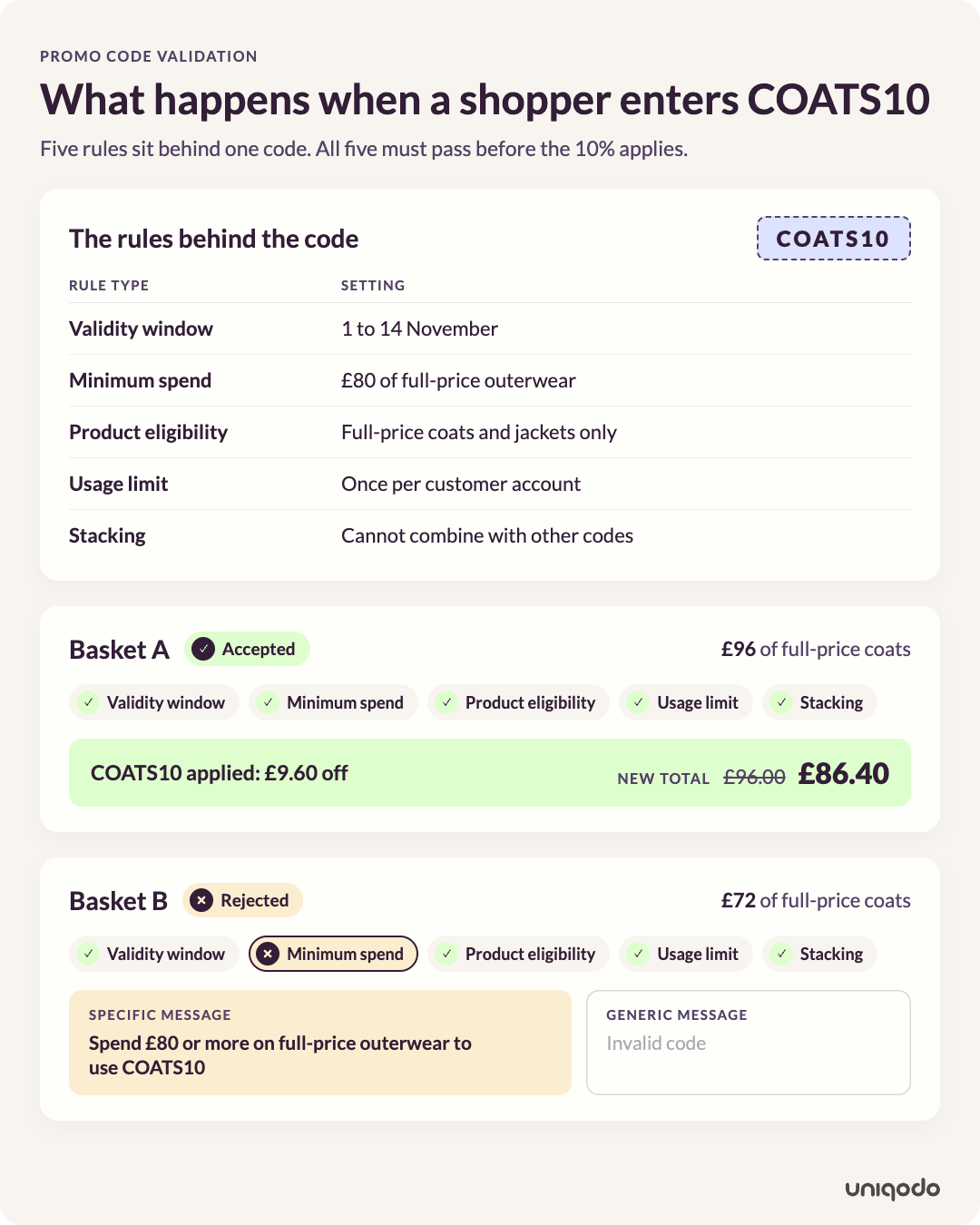
A promo code works by checking the basket and the customer against a set of qualification rules. If every rule passes, the checkout or promotion platform applies the reward. If one fails, it rejects the code, ideally with a message that says which rule the customer missed.
Take COATS10, a code for 10% off full-price coats and jackets. The retailer sets it to run from 1 to 14 November and only when the basket holds at least £80 of full-price outerwear. Each customer account can use it once, and it cannot be combined with another code.
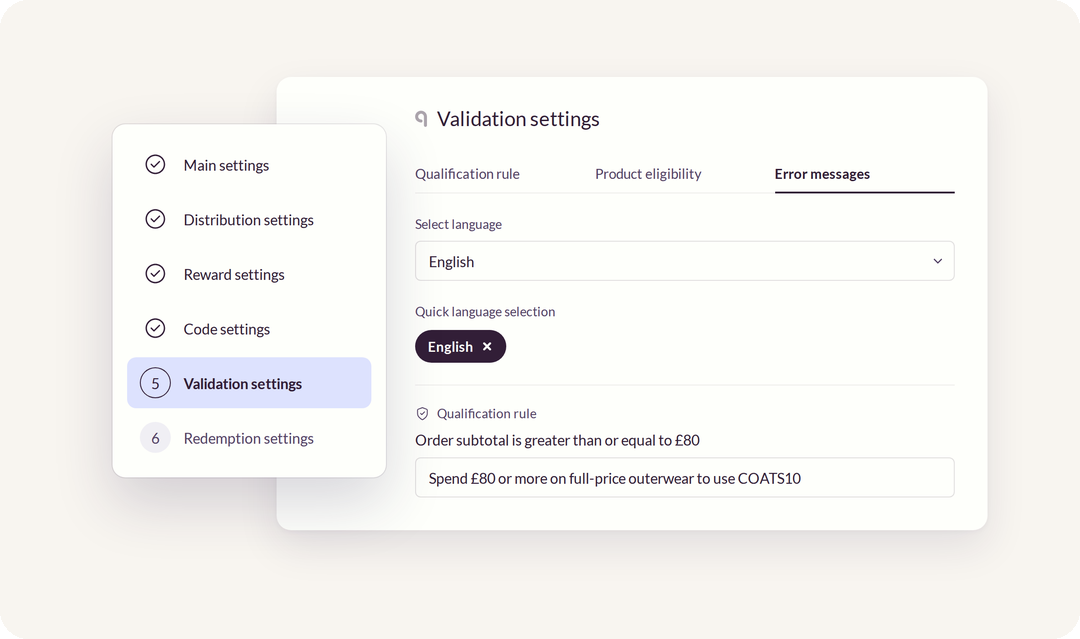
A customer who enters COATS10 with £72 of full-price coats in the basket fails the minimum spend rule. A specific message ("Spend £80 or more on full-price outerwear to use COATS10") tells them what to add. A generic "invalid code" message leaves them guessing, and can send them to another site to look for a code that works.
Between them, those conditions cover most of the rule types a promotion uses: a validity window, minimum spend, product eligibility, usage limits and stacking rules. Customer eligibility, such as new customers only or a specific loyalty tier, is the other common one. The coupon code entry walks through each check in the validation sequence.
E-commerce platforms can handle simple rules natively, such as a flat percentage off above a minimum spend. More specific mechanics often need development work, depending on the platform. Examples include 20% off one brand but not another, or a tiered reward that rises with basket value.
Uniqodo's Promotion Engine sits above the existing stack to handle that validation logic. It needs an initial API integration. Once that is in place, marketers can build and change supported code rules without raising an engineering ticket.
Promo codes differ mainly in who can use them and how many times each one works. That decides how far a code can spread and whether the brand can see who redeemed it.
Generic codes are shared codes such as SUMMER20 that any eligible customer can use. They are quick to set up and easy to remember, which suits broad public promotions. Their weakness is control: a generic code can spread to voucher aggregator sites and reach customers the promotion never targeted. Uniqodo was founded in 2014 to solve this kind of coupon code leakage in the affiliate channel.
Unique codes are generated individually, so a brand can issue thousands or millions of different codes for one promotion and trace each redemption back to a customer, channel or distributor. They suit affiliate partnerships, CRM programmes and acquisition incentives where the brand needs to know who redeemed. The unique coupon code entry covers how they are generated and bound to recipients, and this guide explains how to create unique coupons at scale.
Single-use codes are unique codes set to work once. The code deactivates after one redemption, so a copy that later turns up on a deal forum is worthless. The single-use code entry covers where brands apply them and how they differ from limited-use codes.
When a brand gives codes to affiliates and publishers, each partner needs its own codes so the brand can pay commission accurately. Uniqodo's Code Distribution product issues unique codes through 7 partner platform integrations and 24 publisher integrations and links each redemption back to the partner that supplied the code.
Codes can also reach the checkout without the customer typing anything, through a link or an onsite message. Where no code is involved at all, the promotion is an automatic discount. That removes a step at checkout but gives up some of the attribution a code provides.
An effective promo code pairs a reward that suits the sector with rules that keep it inside the audience it was built for. The reward is a real cost: across 90 merchants and 4,124 promotions on the Uniqodo platform in H1 2026, discount given was equivalent to 7.3% of revenue, according to Uniqodo's H1 2026 coupon code statistics.
Discount depth is the first decision, and the best depth differs by vertical. In the same H1 2026 data, retail and fashion codes converted from validation to redemption best at 5 to 10% off, across 109,061 redemptions at those depths. Deeper retail discounts were associated with a lower share of validated codes converting to redemptions and no increase in basket size. Travel behaved differently: order values peaked at 15% off, a tier covering 292,845 redemptions. This breakdown of the best discount percentage by sector sets out the full figures.
Format matters as well as depth. In retail and fashion, fixed-amount codes converted 36.71% of validated codes to redemptions (114,596 redemptions), against 12.41% for percentage codes (450,794). In travel the order reversed, with percentage codes converting at 15.39% against 12.33% for fixed amounts.
These are observed associations on the Uniqodo platform, not industry benchmarks, and they do not prove that a given depth or format causes a given result. They do show that the deepest discount is not automatically the one that performs best.
Once a code is live, its rules protect the reward. Unique codes suit targeted or partner-led promotions, and generic codes suit campaigns where wide sharing is acceptable. Eligibility rules, caps and exclusions keep the discount off products that do not need it, and they are the practical defence against promotion abuse. Tying redemption data to channel and customer gives the team a basis for judging how much revenue was incremental. Software can enforce those controls, but choosing the incentive and the audience is still the commercial team's call.
In practice, yes. Promo code, coupon code, voucher code and discount code all describe a code a shopper enters at checkout to claim an offer. Voucher code is more common in the UK and coupon code in the US. Some businesses reserve "voucher" for codes with a fixed monetary value, such as a £10 credit.
It depends on the sector. In Uniqodo platform data from H1 2026, retail and fashion codes converted from validation to redemption best at 5 to 10% off, and deeper retail discounts did not increase basket size. Travel order values peaked at 15% off. Test depth against sector and product margin.
A promo code is rejected when the basket or the customer fails one of its rules: the code has expired, the order is below the minimum spend, the products are excluded, the customer is not eligible or the code has hit its usage limit. The most useful rejection messages name the rule that failed.
Only if the brand allows it. Stacking rules decide whether a promo code can combine with other codes or automatic offers in the same basket. Many brands allow one code per order to protect margin, while others permit specific combinations, such as a free delivery code alongside a percentage discount.

Stop code leakage. Replace shareable generic codes with high-entropy unique strings. Protect your margins by ensuring discounts only apply to the intended audience under specific, validated conditions.

Execute complex campaigns. Move beyond basic discounts with multi-tiered rewards, product bundles, and discounts, all managed without waiting for a developer to clear your roadmap.

Convert with intent. Use real-time data to trigger onsite nudges or referral loops exactly when they matter. Create a unified journey that turns browsing interest into confirmed sales.

Scale partner sales. Automate the delivery of unique codes to thousands of partners instantly. Replace manual spreadsheets and CSV exports with secure, trackable API distribution.




We'll show you exactly how Uniqodo handles your use case - fraud controls, mechanic complexity, and ROI attribution included.