
BOGO (buy one, get one) is one of the most recognisable promotional formats in retail, but setting it up correctly in ecommerce takes more thought than the name suggests. The rules behind who qualifies, which products are included, and how the discount applies can make the difference between a campaign that drives real value and one that quietly erodes margin. This definition explains how BOGO works, the formats brands commonly use, and what to watch out for when building these promotions.
Quick Answer: BOGO is a retail promotion where a customer receives a second item free or discounted after buying a qualifying item. In ecommerce, BOGO promotions help brands increase basket size, shift inventory, and acquire customers, but they need clear rules and validation to protect margin. Common BOGO formats include "buy one, get one free", "buy one, get one 50% off", and category-based bundle offers.
BOGO stands for buy one, get one. It describes a promotional mechanic where the purchase of one product triggers a reward on another product, usually a free item or a percentage discount.
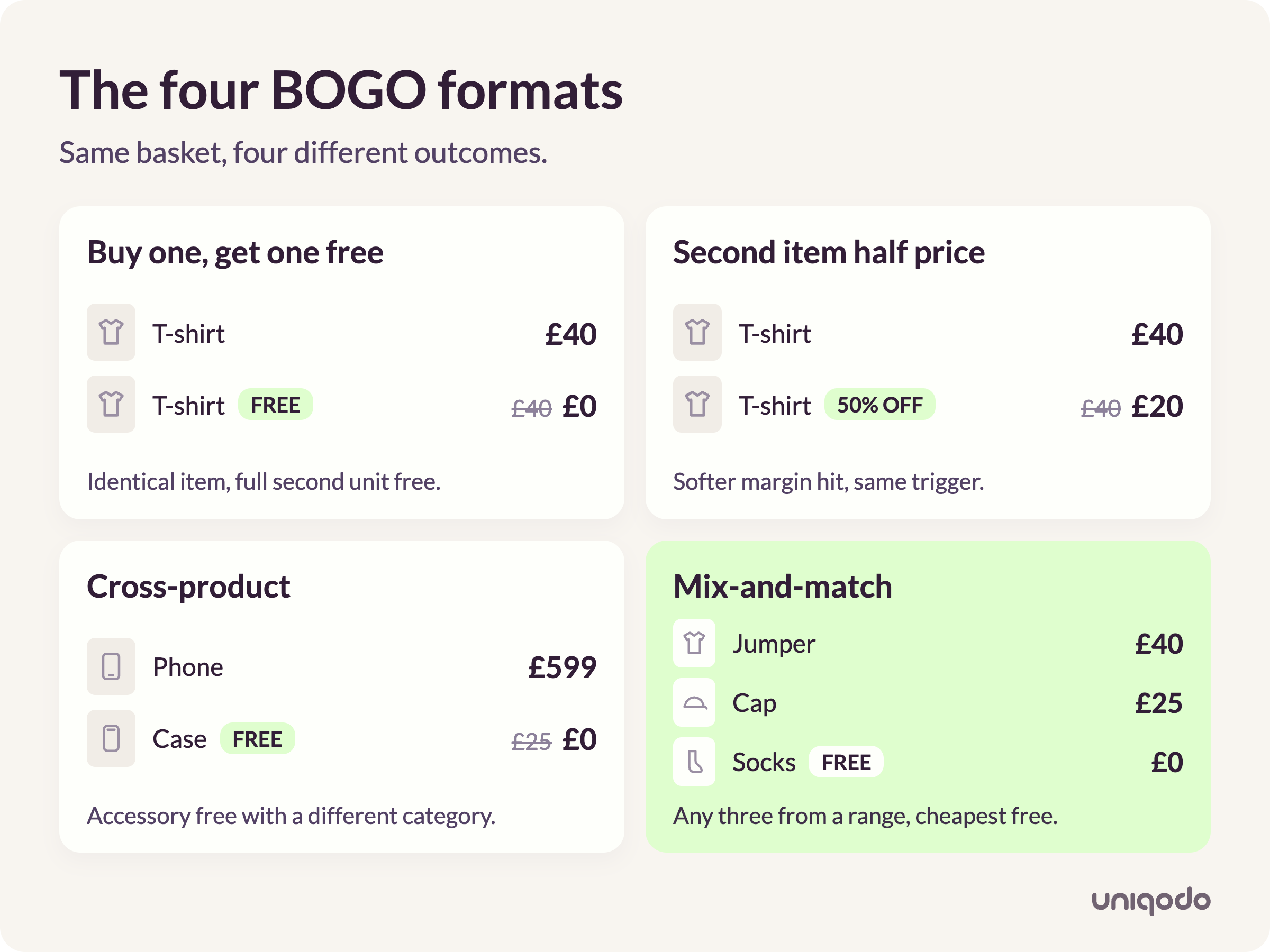
The classic version is BOGOF, meaning "buy one, get one free". For example, a skincare brand may offer "buy one cleanser, get one cleanser free" to encourage customers to buy two units instead of one. A fashion retailer may run "buy one pair of jeans, get the second pair 50% off" to increase average order value without giving away the full second item.
BOGO can apply to identical products, related products, or products within a defined category. The offer can run onsite, through email, in a loyalty programme, via affiliate partners, or through a unique discount code.
In ecommerce, BOGO sits between a discount and a bundle. It gives customers a clear deal, while giving the brand more control over which products, product combinations, channels, and customer segments qualify.
A BOGO promotion works by applying a conditional rule to the basket. The customer must meet a purchase condition before the reward applies.
A simple BOGO rule looks like this:
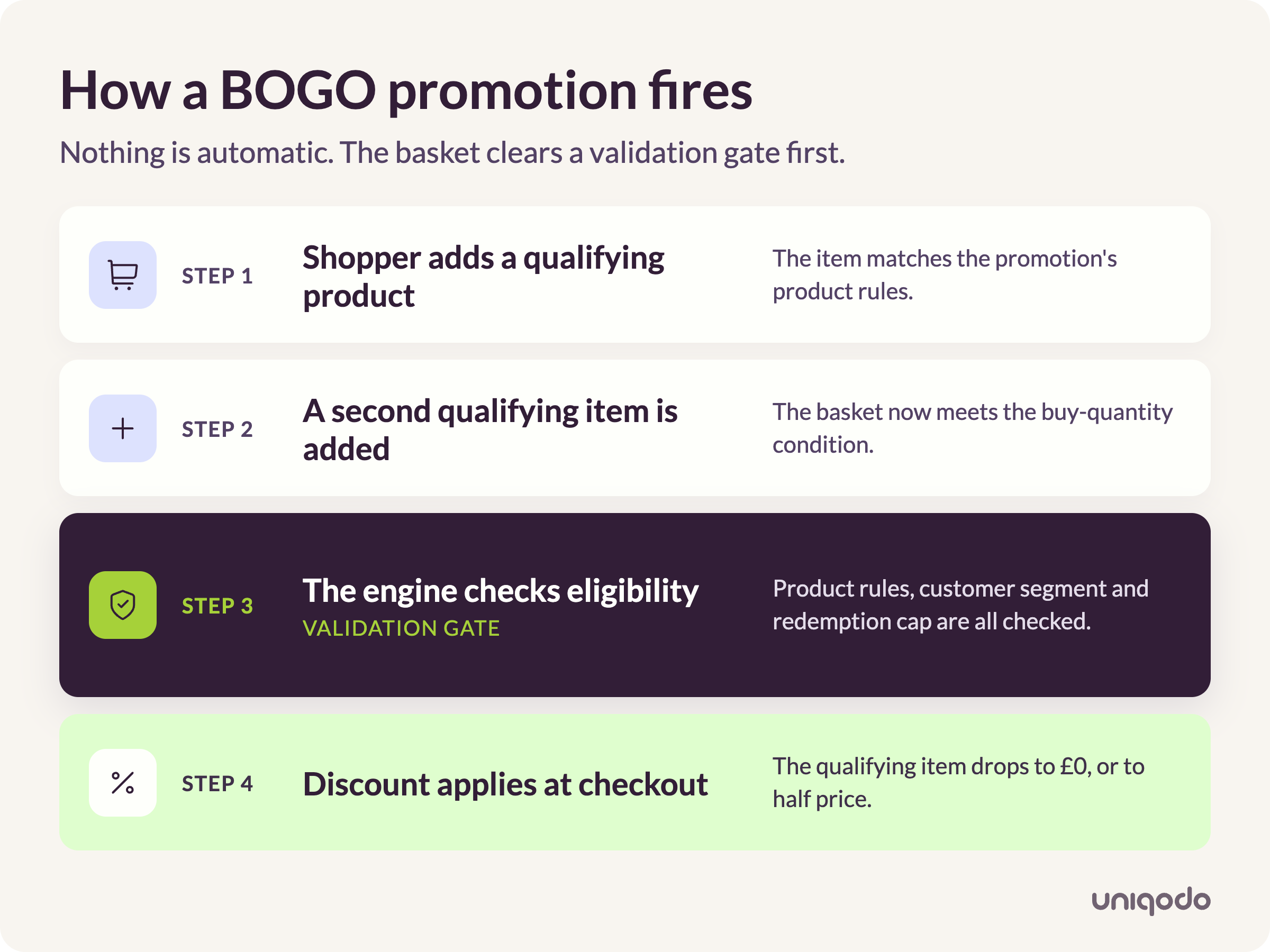
More advanced BOGO promotions add extra conditions. For example, the offer may only apply to full-price items, first-time customers, loyalty members, or shoppers from a specific partner campaign. The rule may also cap the number of redemptions per order or customer.
The most common BOGO formats differ in how the reward applies and which commercial goal they serve.
The more conditions a BOGO promotion carries, the harder it becomes to manage without dedicated tooling. Rules around product eligibility, code activation, customer segments, and redemption caps can quickly outgrow what a native commerce platform handles well.
A promotion engine can manage these rules in one place without requiring developers to hard-code every offer. Uniqodo's Promotion Engine is built for this kind of complexity, giving marketing teams direct control over BOGO rules, validation, and distribution without opening a dev ticket for each campaign.
BOGO matters because it changes customer behaviour without relying on a blanket sitewide discount. A 20% off everything sale gives away margin on every eligible purchase. A BOGO promotion can direct demand toward specific products, basket combinations, or customer segments.
For commercial teams, BOGO supports several goals:
BOGO also gives marketers a simple message. "Buy one, get one free" takes less effort to understand than a complex percentage discount with exclusions. That clarity often helps campaign performance across email, paid social, affiliate, and onsite messaging.
The trade-off sits in margin control. A poorly configured BOGO can discount the wrong item, apply too many times in one basket, or combine with other offers that were never meant to stack. That turns a useful promotion into a costly one.
BOGO promotions need strict rules because customers, affiliates, and deal-sharing communities quickly find weak spots. If the offer logic is too loose, shoppers may trigger discounts on high-margin or premium products that the brand meant to exclude.
The most common BOGO risks include:
Brands can reduce these risks by setting clear eligibility rules before launch. That includes deciding which SKUs qualify, which products receive the discount, whether the offer stacks with other promotions, how many times each customer can redeem it, and whether a code should be single-use, multi-use, or partner-specific.
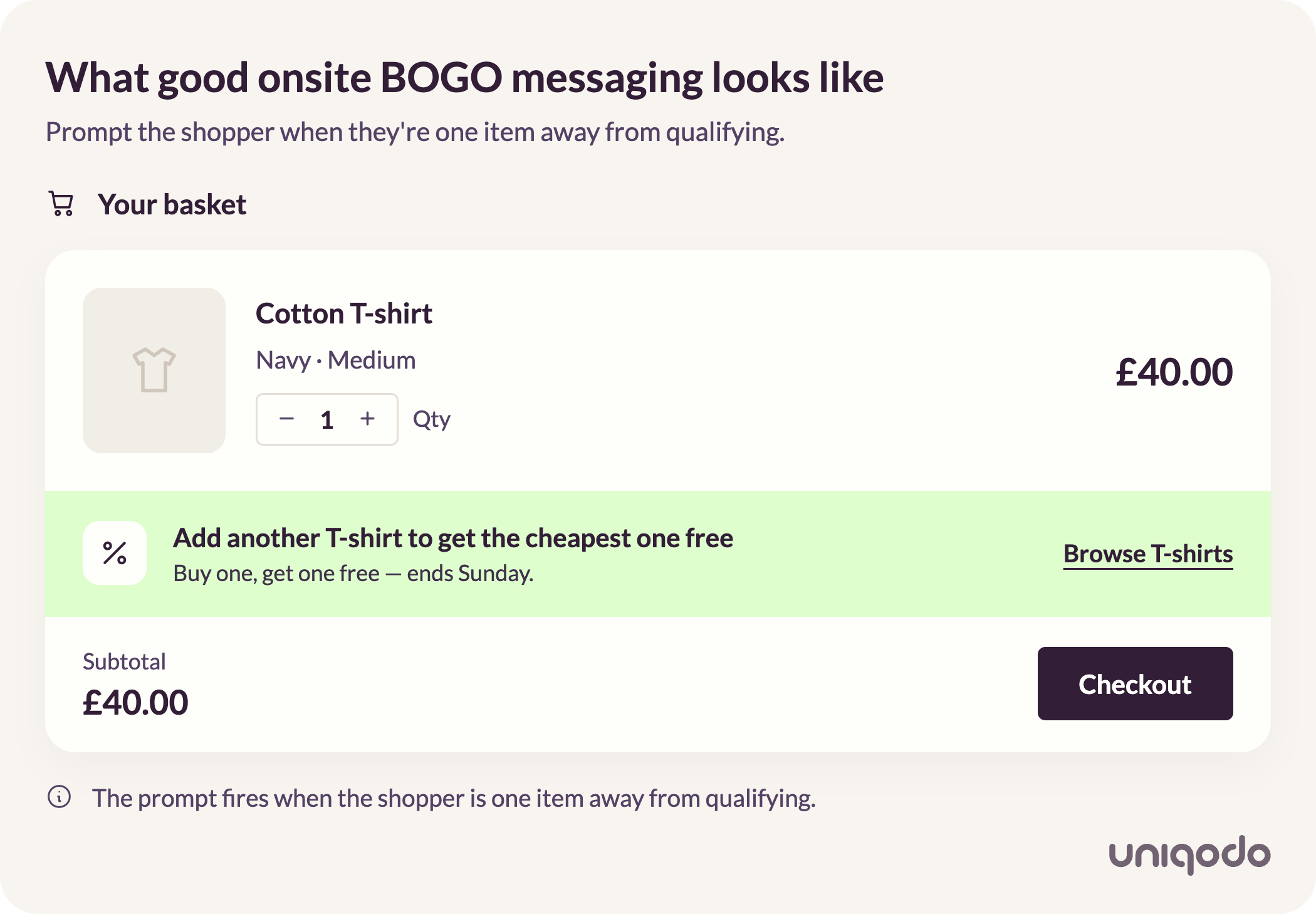
A well-built BOGO campaign also needs clear onsite messaging. If the customer has one qualifying product in the basket, the site can prompt them to add another item to receive the offer. If they choose an excluded item, the basket should explain what qualifies instead of leaving them to guess.
Uniqodo's promotion validation is built for this kind of control, letting brands set the eligibility rules, redemption limits, and stacking logic that BOGO promotions need to protect margin at scale.
BOGO works best when it serves a defined commercial purpose, not when it acts as a generic discount. The next step is to connect the offer to a clear promotion strategy: which product needs support, which audience should receive the incentive, and what basket behaviour the campaign should create.

Stop code leakage. Replace shareable generic codes with high-entropy unique strings. Protect your margins by ensuring discounts only apply to the intended audience under specific, validated conditions.

Execute complex campaigns. Move beyond basic discounts with multi-tiered rewards, product bundles, and discounts, all managed without waiting for a developer to clear your roadmap.

Convert with intent. Use real-time data to trigger onsite nudges or referral loops exactly when they matter. Create a unified journey that turns browsing interest into confirmed sales.

Scale partner sales. Automate the delivery of unique codes to thousands of partners instantly. Replace manual spreadsheets and CSV exports with secure, trackable API distribution.




We'll show you exactly how Uniqodo handles your use case - fraud controls, mechanic complexity, and ROI attribution included.