
There’s huge and undeniable value to promotional marketing and its increase of sales. In fact, promotional code users spend 37% more than other shoppers. Your customers now actually expect you to offer promotions and you could lose their business if you don’t provide the right promotional options.
Offering promotions is crucial for companies looking to remain relevant and meet their customers’ demands. Knowing how to use these different types of promotions will be critical to optimising your promotional marketing strategy. So, the real question is: do you understand the different types of promotions and the best ways to use them?
1. Percentage Discounts
Offers like 50% or 20% off are increasingly popular and successful options. They can be used for specific products or product lines as well as store-wide offers. 50% off discounts have been proven to encourage sales with an impressive 8.6% conversion rate. They’re also preferred by a high 74% of online coupon users!
Percentage discounts back this up in Uniqodo's own H1 2026 promotion data too. Across 90 merchants and 4,124 promotions, they were the platform's largest format, accounting for 50.8% of redemptions and 44.1% of revenue. Performance by sector varies more than the headline number suggests: of validated codes that convert to redemption, travel sits at 15.39%, retail and fashion at 12.41% and telco at 5.47%.
When to use this promotion:
- You’re looking for a promotion that’s simple to deploy.
- You want to use it across your stores.
- On cheaper products.
Advanced tips:
- Keep an eye on your profit margins when choosing which percentage to offer.
- Only discount an item beyond its margin to move stock that would otherwise go to waste.
- Consider gamifying percentage-off discounts with ever-increasing tiered discounts for loyal customers.
- To do this you'll need unique codes tied to individual customer accounts, so the escalating percentage applies only to the customer who earned it.
2. 'X' pounds off
Offering a specific amount of money off a product is an alternative to percentage-off deals. It’s been proven that X pounds off deals can actually be more appealing to customers. For example, a $50 off voucher wins over a 15% off deal.
The same pattern shows up in our own data. Fixed discounts make up 30.1% of platform redemptions but 52.0% of revenue, more than any other format. Conversion swings hard by sector: retail and fashion converts at 36.71% against travel's 12.33%, though a redeemed travel fixed discount is worth £3,114 on average against retail's £112. High-value products can carry the lower conversion rate because each redemption is worth so much more.
When to use this promotion:
- On more expensive products because the higher amount of money off is more appealing to customers.
Advanced tips:
- Remember, if you offer a fixed £10 on any product, don’t expect to sell more expensive products, like those over £100.
- Pay attention to your wording. “Get £10 off” focuses on getting a gain. “Save £10” focuses on avoiding a loss. Test which one works better for your customers and roll with that.
3. BOGO
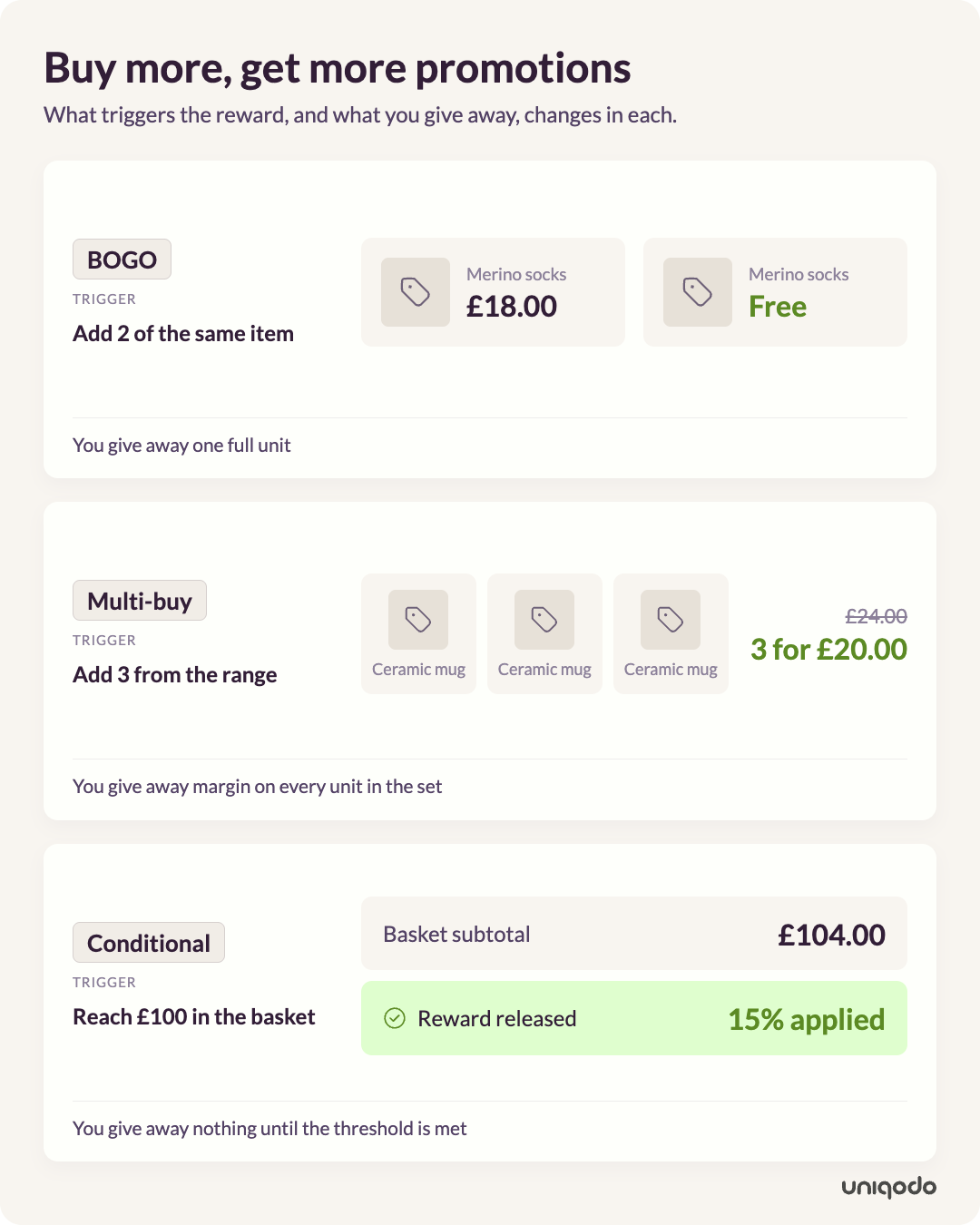
Now for the trusty Buy One Get One Free or Buy One Get One Half Price. 66% of shoppers say that they prefer BOGO to other discount promotions and 93% have taken advantage of BOGO offers at least once. Psychology has a part to play in their success, as customers can feel like they’re getting one item for 100% off, instead of two items for 50%.
When to use this promotion:
- To move inventory when you’ve got a lot of stock to shift.
- To sell edible products with a sell-by date.
- On unit-based and bulk products.
Advanced tips:
- Cater your BOGO promotion to holidays. You can offer “Buy One, We’ll Give to Others on Your Behalf” during the Christmas season as Chronicle Books did.
- Ensure that your BOGO offer is easy for your customers to access. Efficiency amounts to sales.
4. Multi-buys
Multi-buy options focus on deals that require your customers to buy two or more discounted products, like “2 for the price of 1”. It encourages your customers to buy more products in one visit.
When to use this promotion:
- To move inventory.
- On products sold in sets, such as beer or socks.
Advanced tips:
- Use multi-buys on products that are similar — for example on certain product lines organised by brand or type e.g. skincare.
- Clearly display multi-buys where your customers select the quantity of products online.
5. Conditional
Conditional offers involve any promotion that is multi-stepped and that doesn’t fit into other categories. Some examples of these are: “Spend X Amount to Unlock Discounts” and “Spend and Earn Loyalty”.
Multi-tier discounts, the closest match to conditional offers on the platform, cover spend-more-save-more tiers. They convert at 29.28%, one of Uniqodo's best-converting formats, across 283,540 redemptions and 48 promotions. The sample is concentrated though: one merchant accounts for 86% of that volume, so treat it as strong evidence from a proven large-scale implementation rather than a universal benchmark.
When to use this promotion:
- To achieve goals and incentivise specific customer behaviour.
- In partnership with loyalty programmes — 81% of customers say loyalty programmes make them more likely to continue with a brand.
- To increase checkouts and the price of them — discount users spend an average of 46% more at checkouts than regular shoppers.
- To retain control over promotions by instigating conditions.
Advanced tips:
- Offer related products to make the offer matter to your customers.
- Set limits that help you achieve your business goals.
Conditional offers are also where platform-native promotion tools tend to run out of room, since every added condition, whether that's a spend threshold, a product category, a customer segment or a channel, has to be expressed as a rule rather than a fixed discount. Uniqodo's Promotion Engine handles those combinations as qualification rules, so once the API integration is in place your team can build and adjust multi-step offers directly.
6. Free Shipping
If you have an online shop then you want to consider offering free shipping. It has the highest number of discount user attempts and 34% of shoppers believe that free shipping should be mandatory for online shopping.
When to use this promotion:
- To improve shopping cart abandonment.
- To eliminate the stumbling block of shipping costs.
Advanced tips:
- Consider avoiding confusion and disappointment with blanket policies or communicating the offer’s conditions.
- Offer free shipping when customers buy a certain amount e.g. ‘free shipping when you spend over £50’.
- Use social media to offer free shipping, especially if you’re a company that attracts a millennial or younger audience.
- Apply free shipping automatically rather than through a code. If the basket already meets the qualifying spend, asking the shopper to find and enter a code adds a step that can lose the sale.
.png)
How to Use Promotions More Effectively
1. Be clear about your objectives.
Let the first question you ask be: “What do I want to achieve? And who do I want to sell to?”. Your answer could be to get more people into your brick-and-mortar store or to shift more inventory.
The benefits of this include you avoiding wasting money targeting the wrong customers and you can spend your time efficiently.
2. Tie in your customer loyalty programme
Let your second question be: “Which promotion should I use to achieve my goals?”. Offer welcome sales to potential customers. Detect and target your loyal customers with promotional software that has analytics reporting functions. Provide exclusive promos for loyal customers.
Targeting loyal customers means you can decrease customer acquisition costs, saving you money. Loyalty programmes also improve your customer retention — increasing retention by just 5% through customer loyalty programmes can boost revenue by 25- 95%.
3. Gamify your promotions
Make use of the novelty effect of this form of promotional advertising — promotions can lure more customers in if you make them fun. For example, you could use mystery coupons and surprise award codes. Alternatively, interact with your social media followers with questions and competitions.
It’s important that you base gamification on customer data and preferences. Using single-use promo code generator software — like Uniqodo’s promotion engine — can assist in creative gamification strategies that you can experiment with through A/B testing to see what works best.
This technique works as it compels users into the spending mood through natural drives for competition, socialisation and fun. It also helps improve customer retention success — 50% of organisations include gamification in their strategies. These methods nurture brand loyalty and interaction.
4. Create a sense of urgency
Use limited times and limited numbers of offers with a promo code generator software — this will create vouchers that reduce in value over time. Think about setting a time limit on your promotion — a couple of weeks is standard. Never extend your time limit and make the most of the Fear of Missing Out mindset.
You should also think about streamlining the messaging of your sales promotion across all of your channels. This will help drive the sense of urgency home for customers.
This strategy protects profits and prevents customers from taking advantage. It also encourages customers to purchase products faster — 48% of shoppers say that a discount sped up their purchasing decision.
5. Personalise your messaging and promotions
Don’t just personalise your messaging, personalise the promotions themselves — this can be done with auto-generated single-use codes. Remember that personalisation only works if the data is collected and analysed in real time. Advanced promotion software brings with it automation capabilities and analytics reporting functions, making it easier to generate personalised forms of promotions and understand their results. Using themes around holidays or seasons can also work well.
Make the most of the effectiveness of personalisation — 79% of consumers say they are only likely to use a brand’s promotions if the offers are tailored to previous interactions. Do this by using promotion generator software that creates vouchers tied to the purchase history of specific customers.
Avoid losing the 50% of consumers who will likely switch from a brand that doesn’t anticipate their needs or who treats them like a number rather than an individual. Using single-use promo codes reduces the expensive problem of promotion code leakage as it stops your codes from going viral and being used for unintended purposes.
Pick the Right Promotions for Your Customers
There are huge benefits to using the right promotions for the right outcomes.
Choosing the right format is only half of it. The other half is controlling who receives each offer and where it can be redeemed, because a well-chosen promotion still erodes margin if the code spreads beyond the audience it was built for. Uniqodo's code distribution tools issue unique codes to specific partners, publishers and segments, which means the performance you measure against each format reflects the audience you actually targeted.
This kind of software can combine a solution to your challenges with promotional marketing communications as well as allow you to deliver more of a mix of creative, attractive and lucrative outcomes. This means if you offer the right messaging and promotion, your customers are more likely to shop with you, helping you gain business and grow your brand.
Suggested reading: Our blog post guide “How to Measure Promotional Effectiveness at Scale” shows you how to examine how to measure promotional effectiveness at scale, without the limitations of conventional tracking methods. Your promotional codes can provide you with a valid alternative when it comes to achieving accurate, transparent, affiliate reporting.
Want to learn more? Click here to contact us today.
Frequently asked questions about types of promotions
Which type of promotion is most effective?
No single format wins across the board. Percentage discounts drive the most volume but give away the most margin on higher-priced items, while conditional and multi-buy offers cost less per order because the reward is only released once the shopper meets a threshold. Choose the format that matches the objective, whether that is clearing stock, lifting basket value or converting first-time buyers.
Are BOGO offers better than half price discounts?
They cost you differently even when the saving looks similar to the shopper. Buy one get one free gives away a full unit, so the cost scales with the number of units redeemed, whereas half price reduces the margin on every item sold at the discounted rate. BOGO tends to suit stock clearance and unit-based products, while half price is easier to apply across a broad range without managing quantity rules.
What is the difference between a promotion and a discount?
A discount is one mechanic within the wider category of promotions. Promotions also include free shipping, gifts with purchase, bundles, loyalty rewards and conditional offers that release a benefit once a shopper meets a threshold, none of which necessarily reduce the unit price. Treating the two as interchangeable is what leads teams to default to percentage off when another format would cost less.
Can you run different types of promotions at the same time?
Yes, though it needs explicit rules about which offers can combine and which takes priority when more than one applies. Without those rules, shoppers can stack offers in combinations you never intended and the effective discount lands well beyond what was signed off. Most teams set a priority order so the most specific promotion wins.
How long should a promotion run for?
Two to four weeks is a common window for a tactical offer, long enough to gather meaningful data but short enough to preserve urgency. What matters more than the length is holding the end date, because extending a promotion teaches shoppers to wait for the next one rather than buying at full price. Set the expiry when you launch and let it close.
Chris Goud