
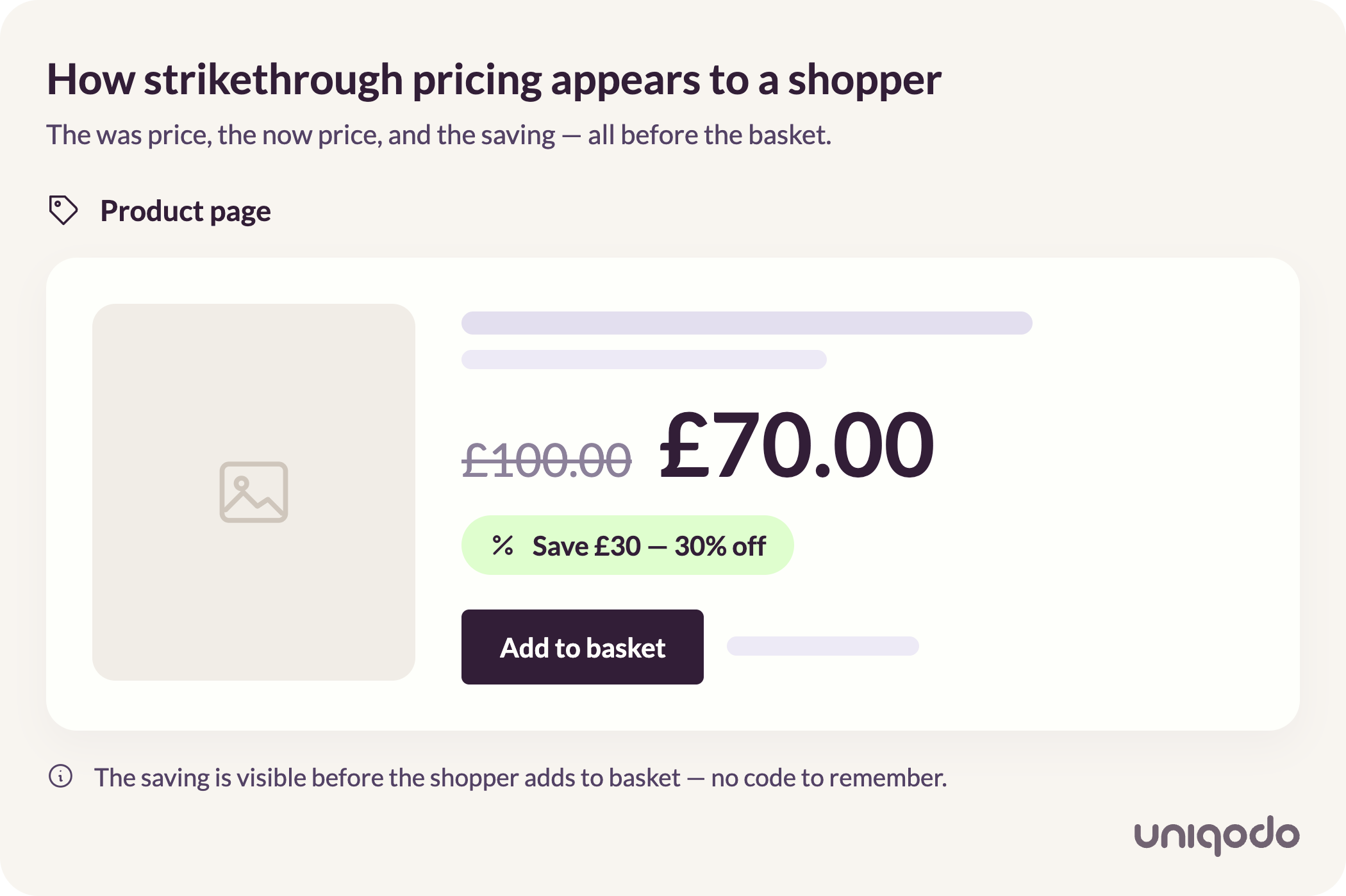
Strikethrough pricing is a merchandising technique where a retailer displays a product's original price crossed out alongside a lower promotional price, for example £100 crossed out to £70. The visual contrast acts as a reference price, showing shoppers the exact saving at the point of decision and making the discount tangible before they reach checkout.
Strikethrough pricing goes by several names in e-commerce, including was/now pricing, reference pricing, and slash pricing, and it appears everywhere from product listing pages to basket summaries. Whatever the label, the mechanic is the same: anchor the shopper on the higher price, then present the lower price as the deal.
Strikethrough is one of the most direct ways to communicate a promotion onsite, but the reference price carries legal obligations that commercial teams need to understand before running it at scale.
Strikethrough pricing draws its effectiveness from price anchoring, the cognitive bias where the first number a shopper sees becomes their reference point for judging value. A £70 price tag on its own is just a number. A £70 price next to a crossed-out £100 is a saving of £30, and the shopper evaluates the second version far more favourably, even though the amount they pay is identical.
In practice, retailers apply strikethrough pricing in three main ways:
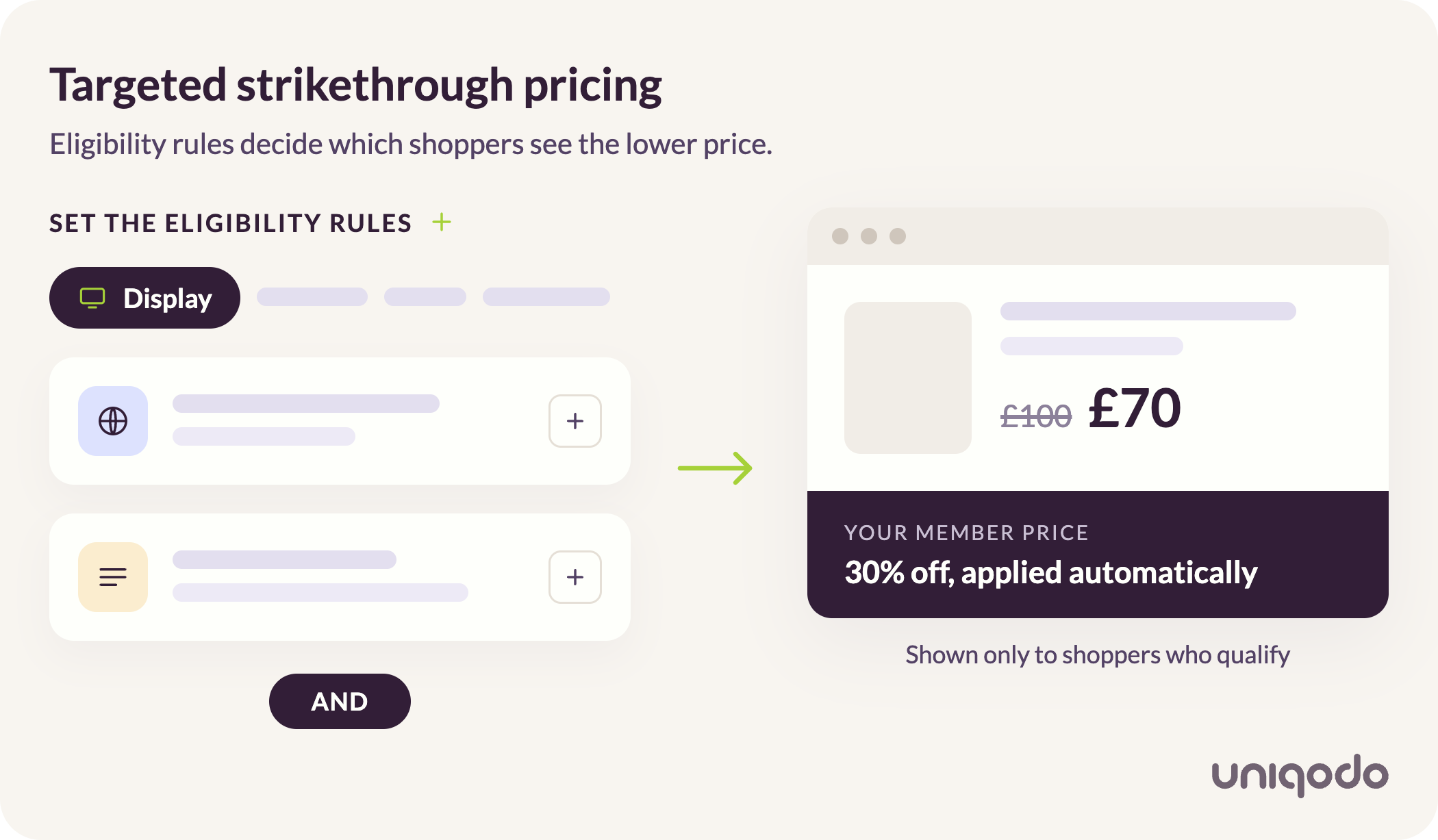
The targeted and automated cases are where implementation gets harder. Showing a personalised strikethrough price to one shopper but not another requires promotion logic that most e-commerce platforms do not handle natively.
Uniqodo's Onsite Experiences product handles this by delivering was/now pricing through overlays or inline messages to eligible shoppers only, controlled by promotion rules that marketing teams configure once the integration is in place.
Displaying the saving directly on the product page removes friction from the purchase decision. The shopper does not need to remember a code, read terms, or trust that a discount will apply at checkout. The value is visible before they click "add to basket," and that visibility is why strikethrough pricing consistently outperforms hidden-at-checkout discounts on conversion.
For enterprise commercial teams, strikethrough pricing also solves a specific attribution and margin problem. Compare two versions of the same 30% offer:
Strikethrough pricing works particularly well when combined with unique, single-use codes or gated eligibility. A partner or affiliate audience lands on the site, the promotion validates their eligibility, and the product pages display was/now pricing for that session only. The shopper gets a clean experience, the brand keeps the discount contained to the intended audience, and the finance team gets a promotion cost that matches the forecast.
This is the part teams most often get wrong. A strikethrough price is a claim, and the claim must be genuine. In the UK, the Competition and Markets Authority (CMA) and the Chartered Trading Standards Institute publish guidance on reference pricing, and misleading was/now claims fall under consumer protection law. Similar rules apply in the EU under the Price Indication Directive and in the US under FTC guidance on former price comparisons.
The core requirements are consistent across jurisdictions:
The EU's 2022 Omnibus Directive tightened this further, requiring that any announced price reduction reference the lowest price applied in the 30 days before the promotion. Retailers running frequent flash sales feel this rule most acutely, because repeated discounting erodes the reference price they are allowed to display.
For enterprise brands, the operational answer is governance. Uniqodo's Promotion Engine logs when promotions were created, which audiences were eligible, what discount was applied, and when the campaign opened and closed, giving commercial teams the audit trail that protects the brand when a regulator or competitor challenges a was/now claim.
Strikethrough pricing is a display mechanic, not a strategy on its own. The strategic questions sit underneath it: who should see the lower price, what margin the promotion can absorb, and how the team will attribute the discount to the channel that drove it.
Brands that treat strikethrough pricing as a blunt sitewide instrument train shoppers to wait for sales and compress margins across the whole catalogue. Brands that treat it as a targeted tool, showing was/now pricing only to specific audiences through gated promotions, unique codes, or partner journeys, get the conversion benefit without the sitewide margin cost.
The operational difference between the two approaches comes down to promotion controls. Targeted strikethrough pricing requires eligibility rules that determine which shoppers see the was/now display, unique codes or session-level validation that prevent the discount from spreading beyond the intended audience, and reporting that attributes each redemption to the channel or partner that drove it. Without those controls, even a well-intentioned targeted promotion drifts toward sitewide exposure over time.
Strikethrough pricing is legal provided the reference price is genuine. The retailer must have sold the product at the higher price for a meaningful period before the discount, and the comparison must be recent and like-for-like. Regulations vary by jurisdiction, but the principle that the crossed-out price cannot be fabricated or inflated applies across the UK, EU, and US.
Sale pricing is a broad term for any reduced price during a promotional period. Strikethrough pricing is a specific display format that shows the original price crossed out next to the lower price, making the saving visible at the point of decision. A sale can run without strikethrough formatting, but strikethrough pricing always implies a sale or markdown.
It works best on products where the shopper already has a sense of the normal price, because the anchoring effect depends on the reference price feeling credible. High-consideration categories like electronics, travel, and fashion tend to see the strongest conversion impact. For low-cost consumables or products with highly variable pricing, the crossed-out figure can feel arbitrary and may reduce rather than build trust.

Stop code leakage. Replace shareable generic codes with high-entropy unique strings. Protect your margins by ensuring discounts only apply to the intended audience under specific, validated conditions.

Execute complex campaigns. Move beyond basic discounts with multi-tiered rewards, product bundles, and discounts, all managed without waiting for a developer to clear your roadmap.

Convert with intent. Use real-time data to trigger onsite nudges or referral loops exactly when they matter. Create a unified journey that turns browsing interest into confirmed sales.

Scale partner sales. Automate the delivery of unique codes to thousands of partners instantly. Replace manual spreadsheets and CSV exports with secure, trackable API distribution.




We'll show you exactly how Uniqodo handles your use case - fraud controls, mechanic complexity, and ROI attribution included.