

Coupon tracking software records which partner, publisher or channel received each coupon code and matches every redemption back to that source. For affiliate and publisher programmes it works best with unique, single-use codes issued per partner, so a code that leaks can be used once at most.
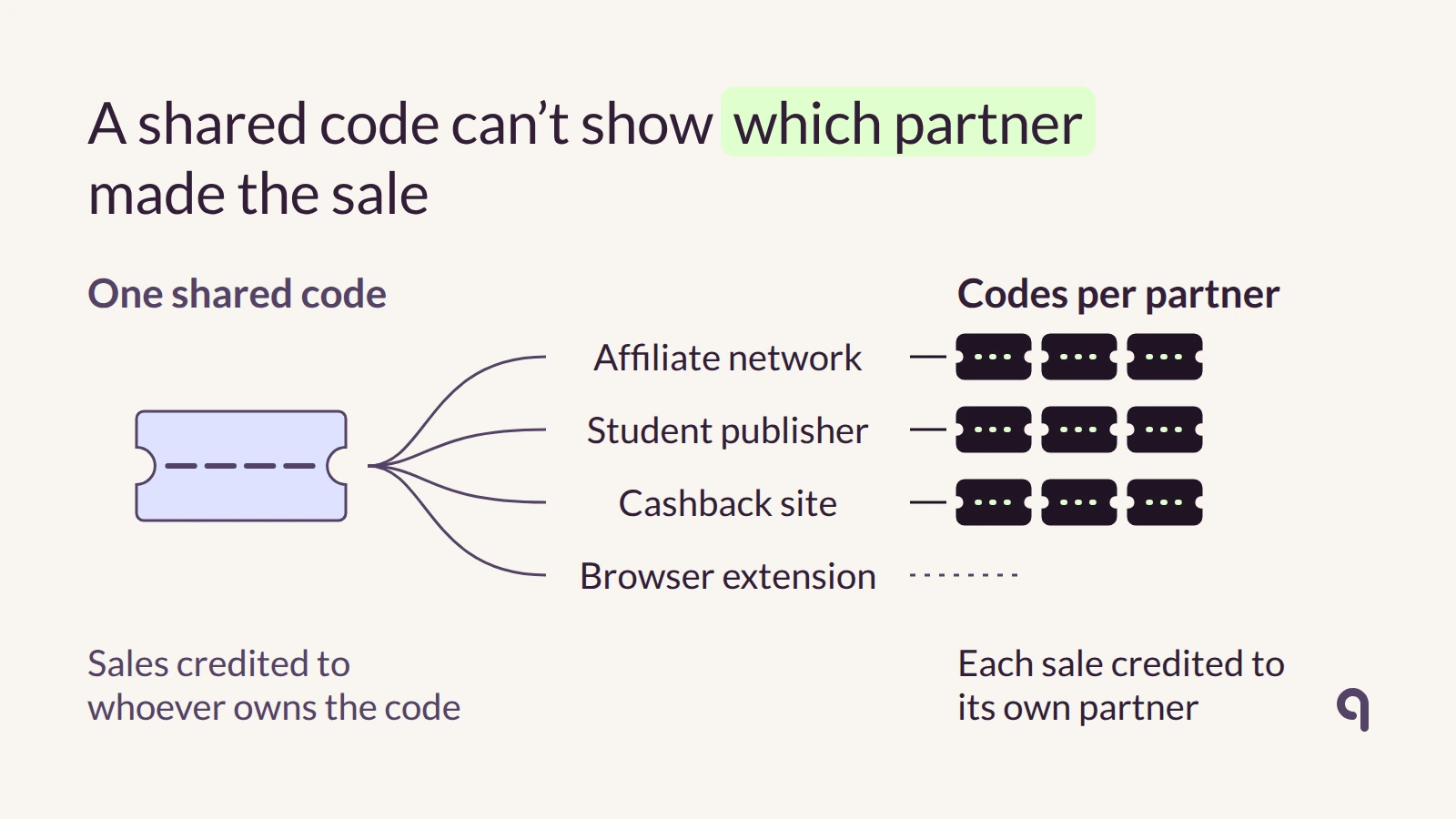
Tracking breaks down when one code serves many people. If many partners share a discount code, or an affiliate’s personal code turns up on a voucher site through coupon code leakage, the redemption data can’t show who drove the sale.
Commission goes to whoever owns the code, whether or not their audience placed the order. The partners doing the work look no better than those who aren’t. For brands sending codes through affiliate networks and closed user groups such as student, key worker and employee benefit schemes, accurate tracking depends on how codes are issued as much as on the software that counts them.
What is coupon tracking software?
Coupon tracking software is a tool that records where each coupon code was sent and reports its redemptions against that source, whether that’s an affiliate, a publisher, an influencer or an email campaign. It tells you which partners and channels produce orders, and what those orders are worth. Two kinds of tool use the name.
- Affiliate coupon tracking tools usually give each affiliate a code of their own and credit them when a customer enters it at checkout. Some create those codes inside a billing provider such as Stripe, which suits subscription businesses paying individual affiliates and creators.
- Promotion platforms such as Uniqodo generate the codes, validate them at checkout and record which partner each one was issued to. They suit brands sending unique codes to large numbers of partners and publishers, where controlling who can redeem a code matters as much as counting redemptions.
Why does coupon redemption tracking matter for partner programmes?
Coupon redemption tracking matters because commission, budget and partner decisions all depend on knowing which source produced an order. When codes are shared or leaked, budget drifts towards partners whose codes circulate widely, whether or not their own audiences are buying. Codes also attribute orders that cookie tracking misses, such as those from shoppers who decline tracking cookies, which makes unique codes useful for affiliate tracking as consent rules tighten.
Up to 3 hours a day saved
Travelodge became better informed about who was using its voucher codes, and estimated that this saved its team up to 3 hours a day on analysis and reporting. How Travelodge monitors code use in real time
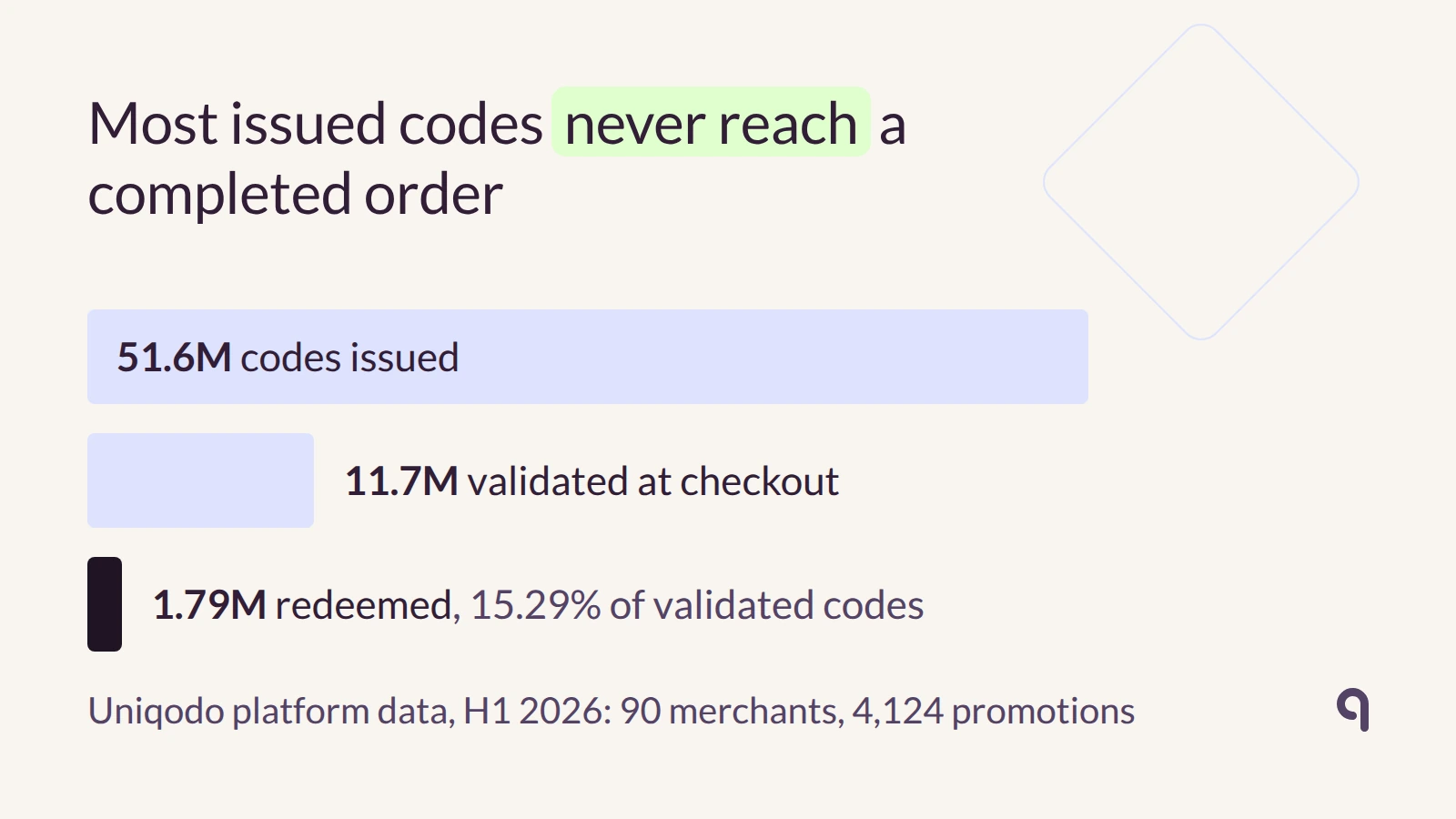
Redemptions are also a small share of the codes a brand issues. Across 90 merchants and 4,124 promotions in H1 2026, only 22.7% of the codes issued were validated at checkout, and only 15.29% of those went on to a completed order, according to Uniqodo’s coupon code statistics. A report that counts only finished orders can’t show where a partner’s codes stall.
Sources perform very differently, too. In the same data, among retail and fashion redemptions where the distribution channel was recorded, codes distributed by API converted 20.54% of validations into redemptions, while email codes converted 7.67%, a gap that disappears in a blended figure.
How to track coupon redemptions by partner and publisher
Tracking coupon redemptions by partner means tying each code to one partner when it’s issued, so the redemption carries its source with it. A code that many sources share can only report against all of them at once.
Give every partner its own pool of codes
Create a separate pool of codes for each affiliate, publisher or campaign source, then decide how fine to go. A pool per publisher is the minimum for partner attribution. A pool per placement within a large publisher shows which placement converts, at the cost of more pools to manage. Agree the level with your partner team before launch, because placement-level data only starts on the day you split a pool.
Make the codes unique and single-use
Unique, single-use codes are what make partner tracking hold up. Each code works for one order, so a code copied to a voucher site or a browser extension can be used once at most, instead of by every shopper who finds it. The catch is volume. Every redemption needs its own code, so codes have to be generated in bulk or on demand, which a spreadsheet exported in advance can’t keep up with at partner scale.
Issue codes through an integration with each partner
Codes sent to partners as CSV files are slow to reconcile, because someone has to work out which codes from which file were used. An API connection or a click-to-reveal button on the partner’s site issues a code at the moment a customer asks for one and records the partner it went to. For affiliate programmes, check that the tool connects to the networks you already use, such as AWIN, CJ Affiliate or Impact, so publishers get codes through relationships you already have.
Record issue, validation and redemption as separate events
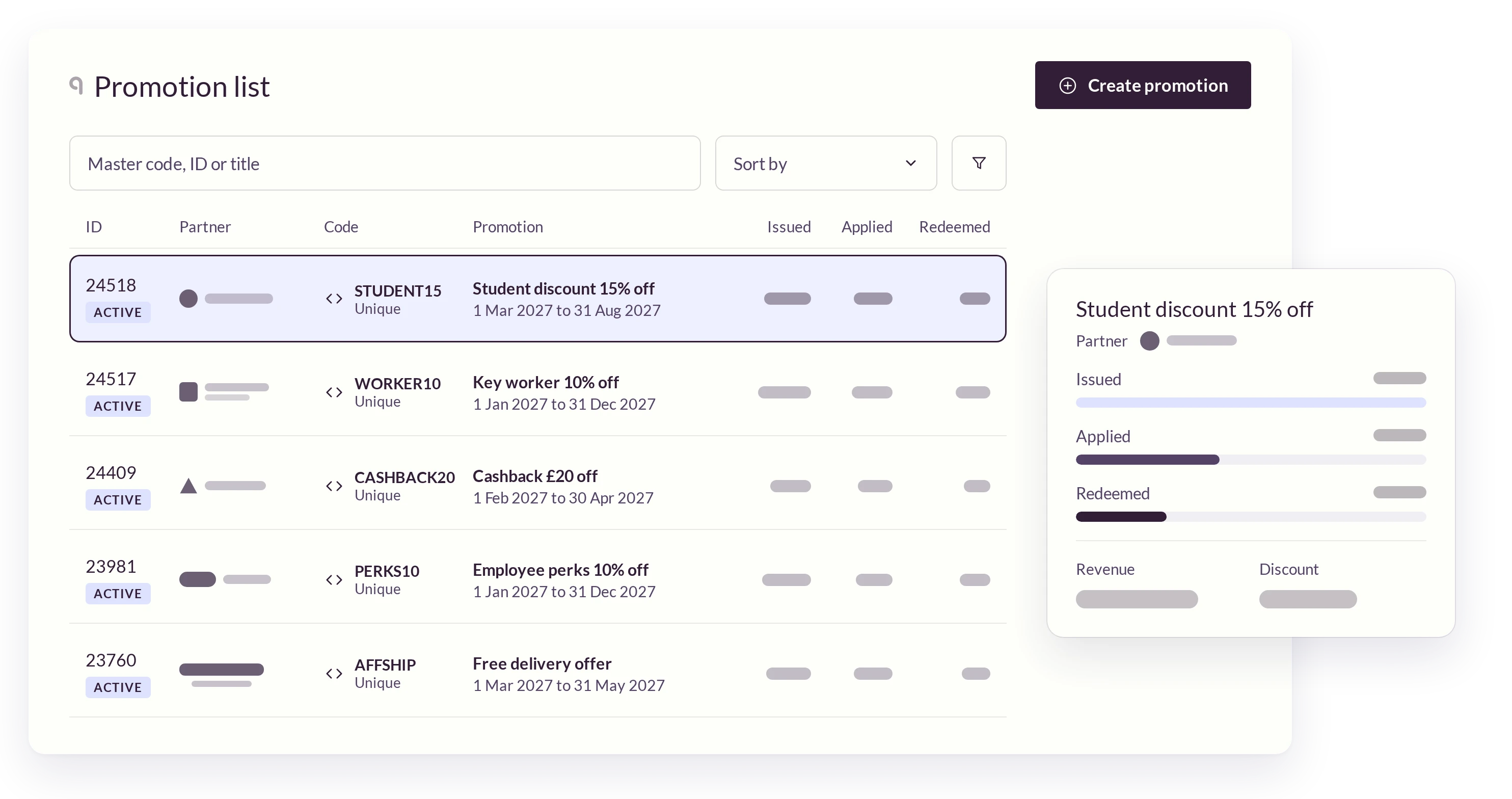
A redemption count on its own can’t tell you whether a partner’s codes aren’t reaching customers, are reaching customers who never try them, or are being tried and rejected at checkout. Track three numbers for each partner: codes issued, codes validated in a basket and codes redeemed in a completed order. High issuance with low validation points to the placement. High validation with low redemption points to eligibility rules or messaging worth checking with the partner.
Reconcile partner reports before paying commission
Affiliate networks and publishers report their own sales. Before approving commission, match their figures against your redemption data at code level, and query any order a partner claims that used a code issued to someone else. When every code is tied to a partner at issue, that check is a straight lookup by code.
What should enterprise brands look for in coupon tracking software?
Enterprise coupon tracking software has to control codes as well as count them, because at partner scale the count is only as reliable as the codes behind it.
- Single-use codes generated in bulk and on demand, as high-entropy strings that can’t be guessed in sequence.
- The partner recorded when each code is created, so attribution doesn’t depend on matching order data afterwards.
- Connections to the affiliate networks and publishers you already work with, so partners keep requesting codes the way they do now.
- Real-time validation at checkout against the promotion’s rules, including redemption limits per customer and per promotion.
- Issued, validated and redeemed codes reported by partner, in a form your finance team can reconcile against network invoices.
If you’re comparing vendors, our roundups of the best coupon distribution platforms and the best coupon management software set the main options side by side.
What are the most common coupon tracking mistakes?
Each of these mistakes makes partner data look more reliable than it is.
Paying commission on a shared personal code
A personal affiliate code that reaches a voucher site keeps earning its owner commission on every order it touches. Unless codes are unique, there’s no way to separate the affiliate’s own customers from shoppers who found the code somewhere else, and you end up paying affiliate commission on stolen codes.
Treating attribution as proof that the partner caused the sale
A redemption shows whose code was used. It can’t show whether the customer would have bought anyway. Attribution decides who gets paid, while incrementality testing against a control group shows whether a partner added sales you wouldn’t otherwise have had.
Mapping codes to channels by hand
When codes are hard-coded into an attribution spreadsheet or tagging rules, every new campaign needs a manual update, and sub-channel tracking breaks the first time someone misses one. Recording the partner at the moment a code is issued removes that step.
Judging partners on conversion rate alone
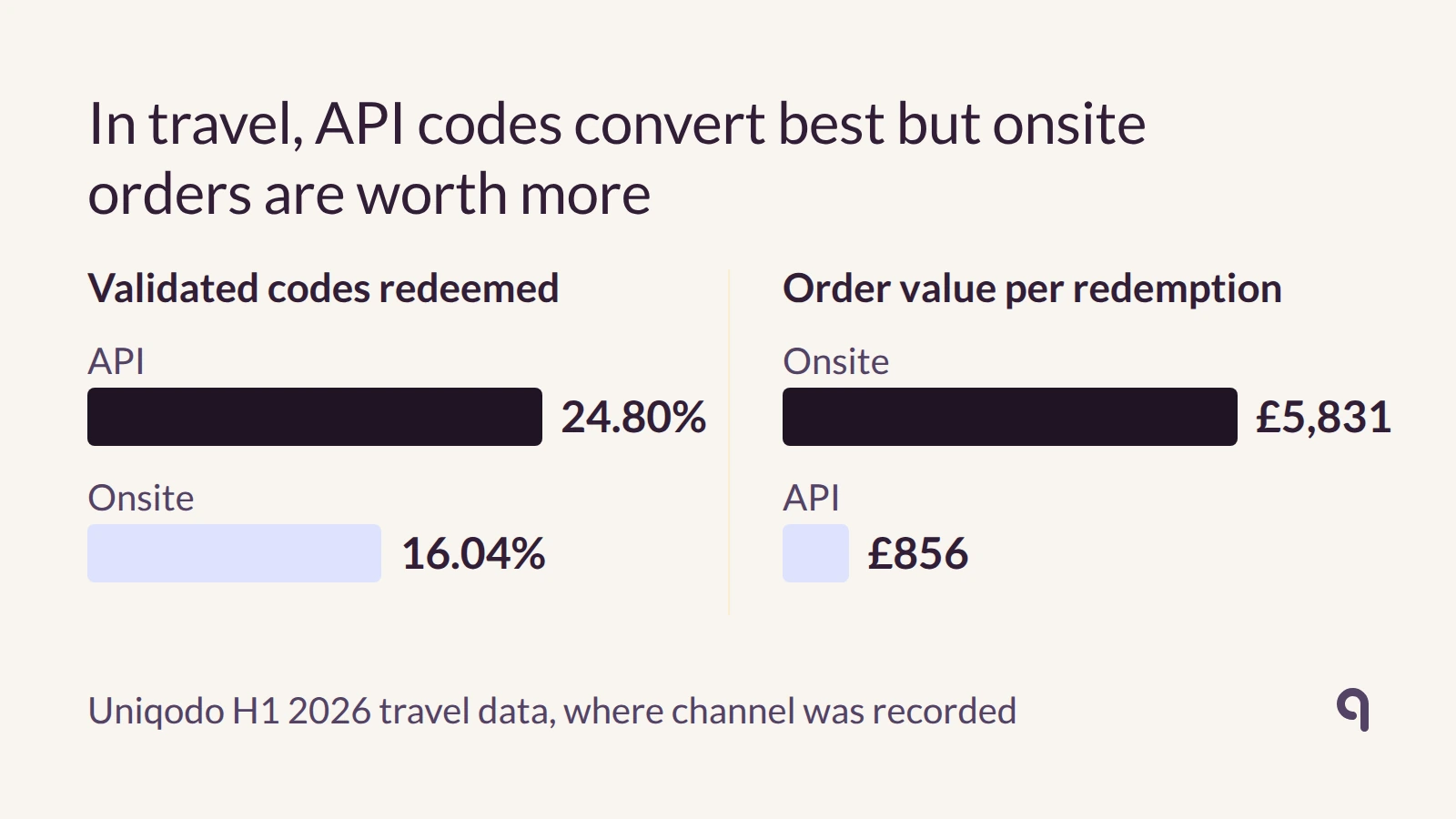
Conversion rate and order value can point in opposite directions. Across travel redemptions where the channel was recorded in Uniqodo’s H1 2026 data, API-distributed promotions converted 24.80% of validated codes against 16.04% for onsite, while onsite promotions returned £5,831 per redemption against £856 for API, so a partner report needs both measures.
How Uniqodo tracks coupon redemptions by partner
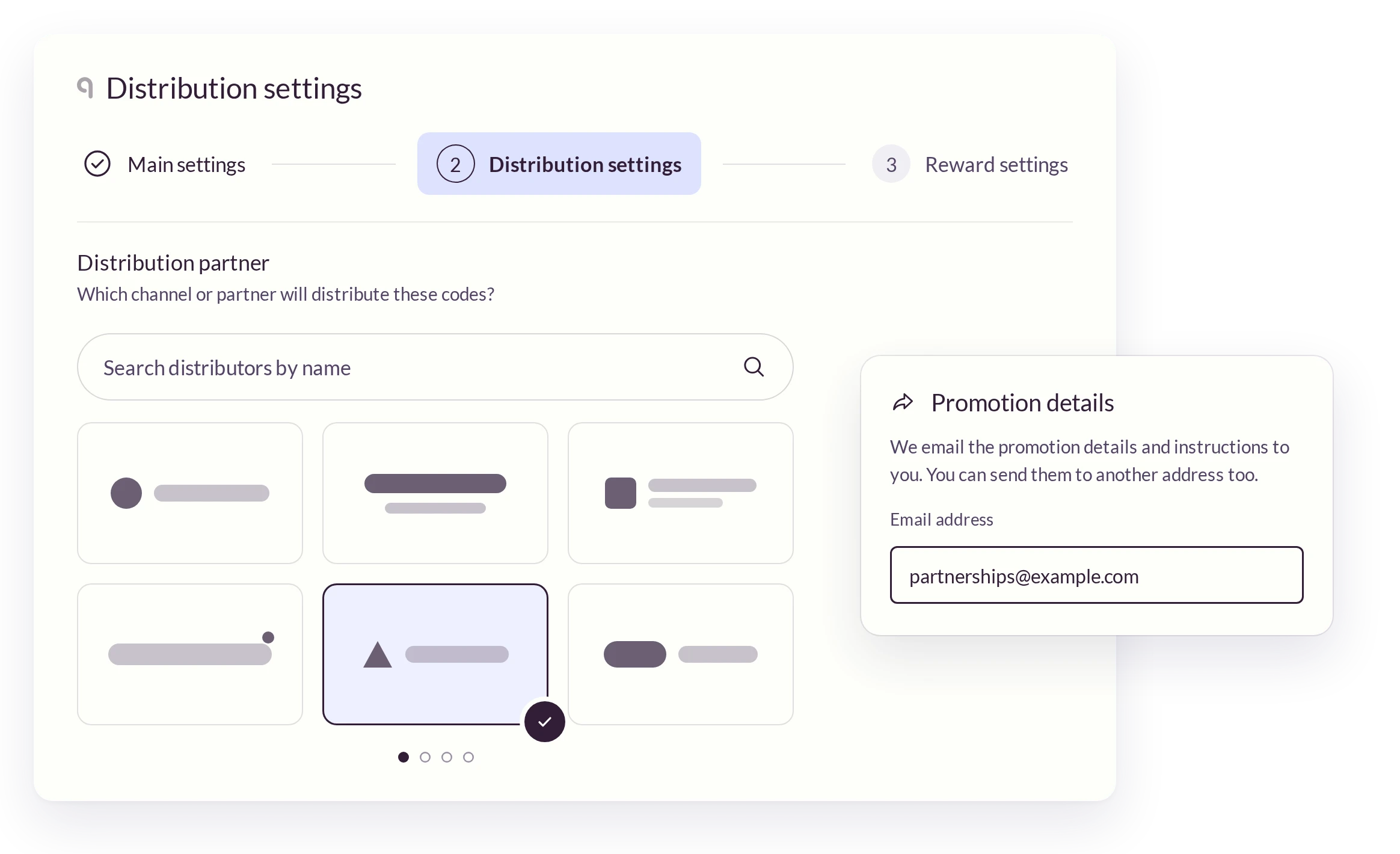
Uniqodo ties each code to the partner it was issued to, so redemptions report against that partner without manual matching. Uniqodo Code Distribution delivers codes to partners through APIs, click-to-reveal buttons on partner sites or CSV exports. It integrates with 7 partner platforms and 24 publishers, from affiliate networks such as AWIN, CJ Affiliate and Impact to publishers such as Blue Light Card, Unidays and Student Beans.
“It’s a no brainer for us, for developing transparent affiliate partnerships with brands and being able to accurately gauge the real value we offer them.”
Chris Johnson, Client Services Director, Vouchercloud
Codes can be single-use, multi-use or repeat-use, and the Uniqodo Promotion Engine validates each one at checkout against the promotion’s rules, including redemption limits per customer and per promotion. Each promotion has its own performance report, showing codes issued, applied and redeemed, total and average order value, total and average discount and conversion rate for any date range, with a daily breakdown and a CSV download. Because the distribution partner is set on the promotion, that report shows how each partner’s codes perform.
Connecting Uniqodo to checkout takes a one-time API integration. Once integrated, marketers set up and launch promotions themselves.
Coupon tracking software FAQs
Is there free coupon tracking software?
Some affiliate tracking tools offer free plans or trials, and a spreadsheet of orders exported with their discount codes can count redemptions by code. Counting is the easy part. The harder problem is a shared code being used by people the partner never reached, which needs unique, single-use codes issued per partner and validated at checkout.
How is coupon tracking different from affiliate link tracking?
Link tracking credits a partner when a customer clicks their link and a cookie records the visit. Coupon tracking credits the partner whose code is entered at checkout, so it works where links don’t, such as podcasts, print, closed-group sites and visits where the customer declined tracking cookies. The two methods can run side by side in the same programme.
Does coupon tracking software replace an affiliate network?
No. An affiliate network recruits publishers, tracks their sales and pays their commission. Coupon tracking software controls the codes those publishers share and reports which ones were redeemed. Uniqodo integrates with networks including AWIN, CJ Affiliate and Impact, so codes reach publishers through the network relationships a brand already has.
What should a coupon tracking report show for each partner?
At minimum, codes issued, codes validated at checkout, codes redeemed in a completed order and the order value of those redemptions. Together they show whether a partner’s codes reach customers, get tried and turn into sales, and whether those sales justify the commission and discount the brand paid for them.

Chris Roye
CEO