

Cart abandonment happens when shoppers add items to their basket but leave before completing a purchase. The most effective ways to reduce it combine checkout friction removal, transparent pricing, and targeted onsite promotions that give hesitant shoppers a reason to complete their purchase now.
Roughly 70% of shoppers who add something to their basket never buy it. That is not a traffic problem. It is a conversion problem, and onsite promotions are one of the most direct tools available to fix it. Below, we cover the main causes of cart abandonment, the promotion-led strategies that address them, and how to recover revenue without eroding your margins.
What Causes Cart Abandonment?
The causes fall into two categories: friction in the checkout process, and a failure to give the shopper enough confidence or incentive to proceed.
The most commonly cited reasons, according to research aggregated by the Baymard Institute, include:
- Unexpected extra costs (shipping, taxes, fees revealed late in checkout)
- Forced account creation before being allowed to pay
- A long or confusing checkout process
- Limited payment options
- Security concerns around entering payment details
- Slow delivery times or unclear delivery windows
Most of these are addressable before the shopper leaves, which is where onsite promotions come in.
How Onsite Promotions Reduce Cart Abandonment Before It Happens
Most cart abandonment guides focus on post-abandonment recovery through emails, retargeting ads, and SMS. Whilst effective, these tactics are reactive. Onsite promotions work at the moment of hesitation, before the shopper has gone.
A well-timed onsite offer removes a specific objection (cost, urgency, uncertainty) and creates a reason to act now rather than later. The key is precision: the right offer, shown to the right shopper, at the right point in their journey.
This is where personalised promotions at scale become the differentiator. A generic sitewide discount shown to every visitor is a margin cost with no targeting logic behind it. A conditional offer shown only to first-time visitors with a basket above a certain threshold is a conversion tool.
Strategies to Reduce Cart Abandonment With Onsite Promotions
Use Exit-Intent Promotions to Catch Shoppers Before They Leave
Exit-intent technology detects when a user's cursor moves toward the browser bar or back button and triggers an overlay at that moment. When that overlay contains a relevant offer (free shipping, a percentage discount, a gift with purchase on orders above a threshold), it gives the shopper a concrete reason to stay.
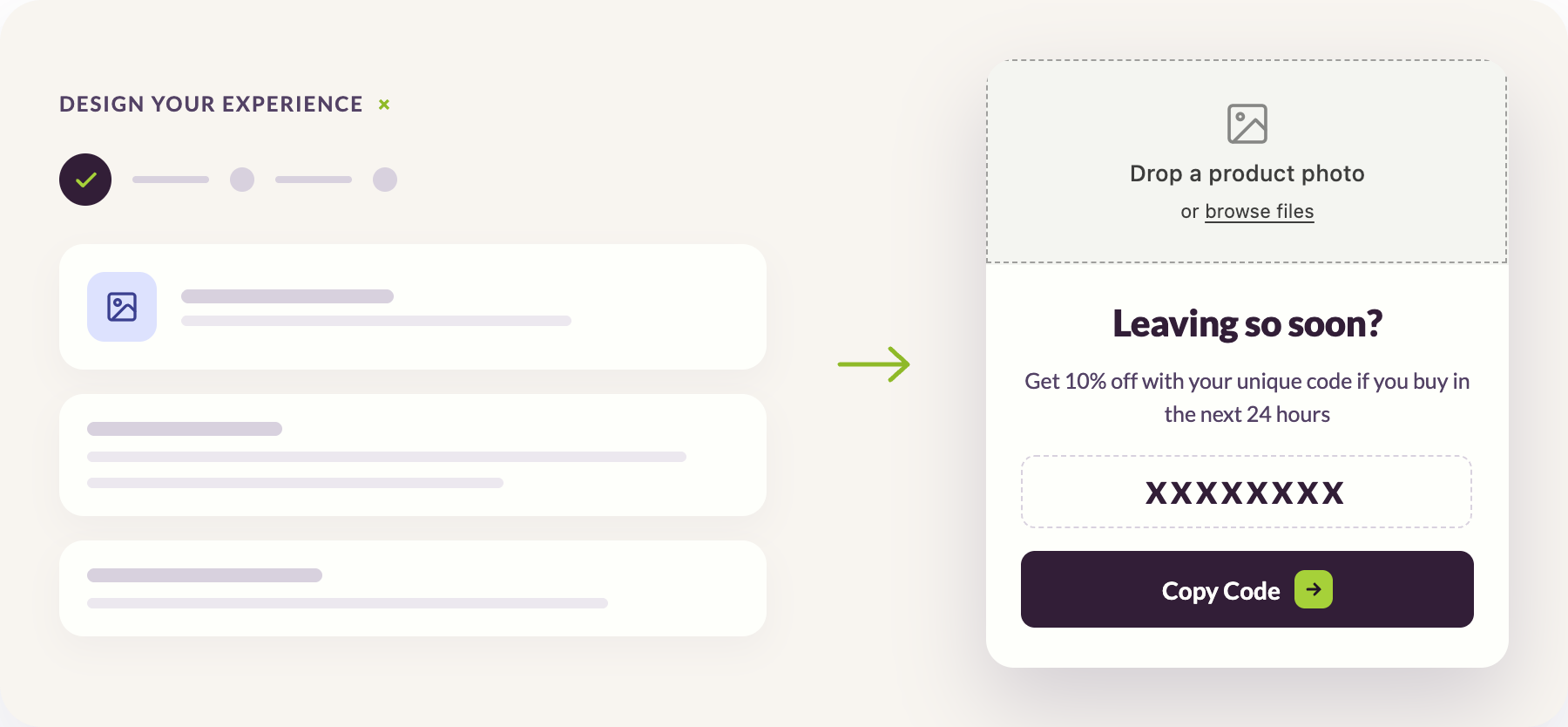
The most effective exit-intent overlays go further than displaying a static message. They automatically inject a unique, time-bound code into the overlay so the shopper receives a personalised offer with a genuine deadline. Unlike a generic sitewide code, this creates a real "use it or lose it" moment because the code expires on its own schedule and cannot be shared or reused.
However, segmentation is key. Showing exit-intent overlays to every visitor on every page will dilute their effectiveness and train shoppers to ignore them. Restrict exit-intent overlays to shoppers who have items in their basket and have not already seen the offer in the current session, and use behavioural triggers such as prolonged inactivity on the basket page or specific basket values hitting a recovery threshold to determine when the overlay fires.
Use Shipping Promotions to Remove the Biggest Abandonment Trigger
Unexpected shipping costs are the single most cited reason for cart abandonment. Shipping promotions address this before it becomes a problem, and the most effective approaches go beyond a flat free shipping threshold.
A tiered shipping reward structure gives shoppers incremental reasons to increase their basket. Free standard delivery when spend reaches £50, free express delivery at £100. Each tier removes a cost objection while nudging the order value upward. A progress bar that updates dynamically as items are added turns the promotion into a visible, in-session incentive.
For brands with loyalty or membership programmes, locking delivery benefits to customer status adds a second layer. Permanent free shipping for VIP customers reduces abandonment among your highest-value segment while giving new shoppers a reason to join.

Boots UK offers details about free shipping threshold to encourage conversion
The important detail is that the thresholds should be set relative to your average order value. Too high and shoppers ignore them. Too low and you are subsidising shipping on orders that would have converted anyway.
Use Custom Error Messages to Convert Failed Code Entries
A shopper enters a promo code at checkout and sees "code invalid." For most ecommerce platforms, that is the end of the interaction. The shopper does not know why the code failed, whether they can fix it, or what to do next, leading them to abandon their purchase.
Custom error messages change that outcome. Instead of a generic rejection, the shopper sees a specific explanation and a path forward: "Spend £2 more to unlock this offer," "This code is valid on full-price items only," or "This promotion starts on Friday — add it to your basket now and come back."
Each failed redemption becomes a conversion opportunity rather than a dead end. The shopper knows exactly what to change, and the message itself acts as an onsite prompt that keeps them in the purchase flow.
This is particularly effective for brands running multiple concurrent promotions with different qualification rules. Without custom messaging, shoppers trying the wrong code on the wrong basket have no way to self-correct.
Target Discounts by Shopper Behaviour to Protect Margin
Not every shopper who abandons needs a discount. Some need reassurance, others need urgency, and only a portion are genuinely price-sensitive. Treating all three the same way costs you margin on the first two groups unnecessarily.
Conditional promotions let you define precise qualification rules. A first-time visitor with a high-value basket gets a different offer than a returning customer who has purchased before, and a shopper who has been on the checkout page for more than 90 seconds gets a different nudge than someone who just arrived.
This kind of segmentation requires a promotion engine that can evaluate customer attributes and basket conditions in real time. A basic discount code field cannot do this.
Trigger Offers at Checkout Drop-Off Points to Re-Engage Hesitant Shoppers
Analytics will tell you where in your checkout flow shoppers are most likely to abandon. Common drop-off points include the delivery options screen, the payment details screen, and the order review page.
Once you know where the drop-off happens, you can trigger targeted interventions at that exact point. A shopper who pauses on the delivery screen for more than 30 seconds might respond to a free shipping offer, while a shopper who reaches the payment screen and hesitates might need a trust signal or a small incentive to proceed.
This requires onsite experience tooling that lets marketing teams configure which messages appear at which journey stage and change them without waiting on a development cycle. The more precisely you can match the offer to the drop-off point, the less margin you give away on shoppers who would have converted without one.
Use Copy and Highlight Triggers to Catch Price-Comparison Shoppers
When a shopper highlights and copies text on your product or basket page, whether that is a product name, a model number or the price, there is a strong chance they are about to paste it into a search engine or a rival site to compare prices or hunt for a voucher. It is one of the clearest behavioural signals that a shopper is about to leave, and unlike exit intent it fires while they are still engaged rather than at the point of departure.
A copy and highlight behavioural trigger lets you intercept that moment. The instant the shopper copies qualifying text, you can fire a short overlay that keeps them on site: "Before you go, here is [offer]." Because the intent behind the action is so specific, the offer can be too. A shopper copying a price is telling you they are price-sensitive, so a small, time-bound incentive or a reminder of a code they already hold is often enough to stop the comparison shop before it starts.
The critical detail is the window. This overlay should be tightly limited, both in how long it stays on screen and how often a shopper can see it, so it reads as a timely nudge rather than an interruption. Fired sparingly against a genuine signal, it recovers a shopper who was seconds from leaving. Fired on every copy action, it becomes noise and trains shoppers to dismiss it.
Use Unique Promo Codes to Stop Code Hunting at Checkout
Generic discount codes (SAVE10, WELCOME20) create a specific problem for cart abandonment: they train shoppers to leave and search for a code before buying. If a shopper sees a promo code field at checkout and does not have a code, the natural behaviour is to open a new tab and look for one. That tab may not close.
Unique, single-use codes distributed directly to specific customers remove this dynamic entirely. There is no publicly available code to search for, so the offer is either in the shopper's possession or it does not exist. This also eliminates the code leakage and affiliate fraud risks that come with generic codes, since each code can only be redeemed once by the intended recipient.
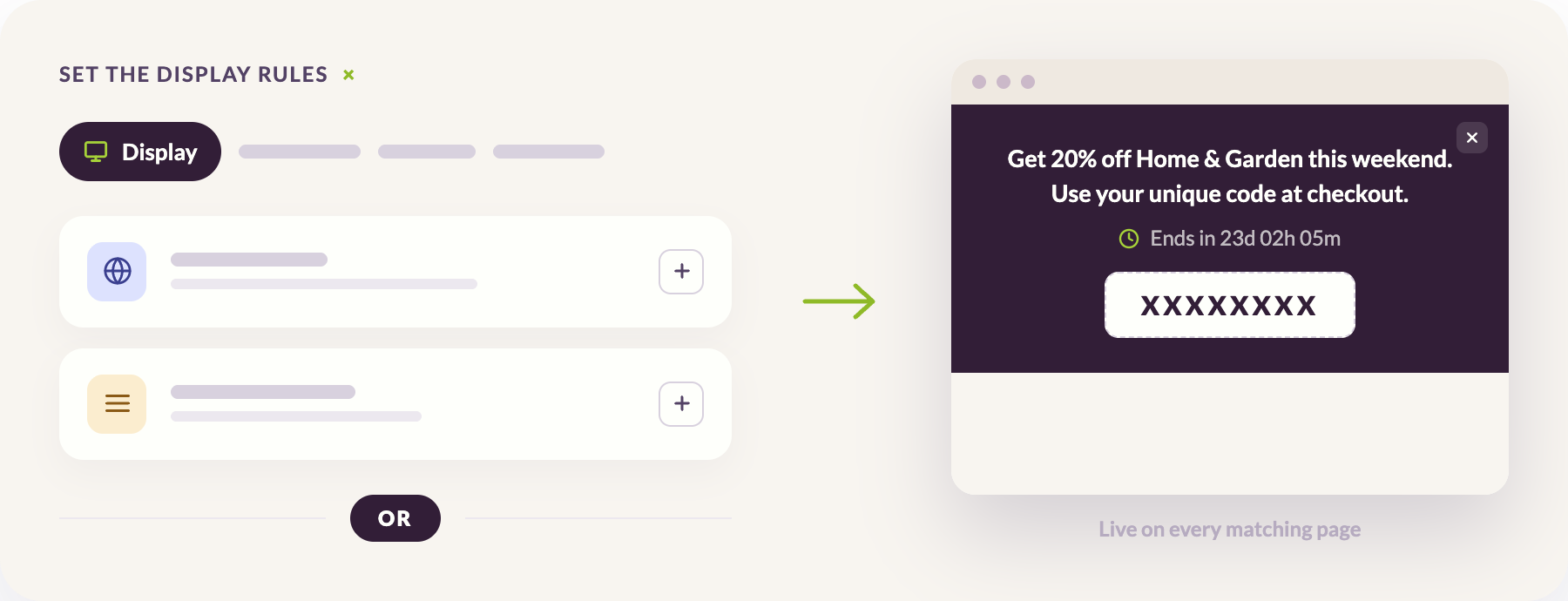
Once a shopper has received a unique code, whether through an exit-intent overlay, a recovery email, or a direct distribution channel, an onsite code reminder banner keeps the incentive visible as they continue browsing. This is a subtle but effective mechanic: the shopper does not need to remember or retrieve the code, because the site surfaces it for them at the right moment and removes one more friction point between consideration and purchase.
Use Time-Limited Promotions to Create Urgency at Checkout
Hesitation at checkout is often not about price but about timing. Shoppers who believe an offer will still be available tomorrow have no reason to complete the purchase today.
Time-limited promotions change that calculation. A countdown timer displayed alongside a basket-level offer ("This discount expires in 2 hours") gives the shopper a visible cost to waiting. When combined with unique codes that carry individual expiry times, the urgency is real rather than manufactured because each shopper's offer genuinely does expire on its own schedule.
Quantity-limited promotions work on the same principle. "First 50 customers get free express delivery" or "This bundle price is available for the next 100 orders" creates scarcity that is tied to a promotional mechanic rather than stock levels. The distinction matters: stock scarcity is a merchandising signal, but a limited-availability promotion is something your team controls and can test.
The critical rule is credibility. If every visitor sees the same "only 2 left" message regardless of actual stock, shoppers learn to ignore it. Urgency that is tied to a real promotional rule with a genuine expiry or redemption cap holds up because it is verifiable.
Use Recovery Emails to Recapture Lost Shoppers Without Discounting
Even with strong onsite promotion coverage, some shoppers will leave. A recovery sequence is your second chance, but how you structure it determines whether it recovers revenue or teaches your audience that abandoning their basket earns them a discount.
The standard approach is a three-email sequence: a reminder within the first hour with no discount attached, a small incentive at 24 hours if the shopper has not returned, and a final nudge at 48 to 72 hours with either a stronger offer or an expiry on the original one. The first email matters most. Many shoppers who abandon will return on their own, and offering a discount immediately removes any reason for them to do so without one next time.
Each recovery email should use a unique code with its own expiry rather than a generic discount. This prevents the offer from being shared, reused, or found on a voucher aggregator site, and it gives you clean data on which touchpoint in the sequence is actually driving conversions.
What Is the Difference Between Cart Abandonment and Checkout Abandonment?
Cart abandonment covers any session where a shopper adds items to their basket but does not complete the purchase. Checkout abandonment is a subset: it refers specifically to shoppers who begin the checkout process (entering delivery or payment details) but stop before completing the transaction.
Checkout abandonment rates are typically lower than cart abandonment rates, but the intent is higher. A shopper who has started entering their address is significantly more likely to convert than one who simply added to basket. Recovery tactics for checkout abandoners should be faster and more direct.
The difference matters for choosing the right onsite tactic. Exit-intent overlays and code reminder banners are most effective for cart abandoners who are still browsing, while in-checkout offers triggered by drop-off behaviour are better suited to checkout abandoners who have already committed to buying but hit a specific obstacle.
How Do Onsite Promotions Protect Margin While Reducing Abandonment?
Reducing cart abandonment with blanket discounts is straightforward. However, doing so whilst preserving your margins requires a different approach.
Target by segment, not by session. Offer discounts only to shoppers who are genuinely price-sensitive or at high risk of abandonment, not to every visitor. Where possible, use non-discount incentives instead: free shipping, gift with purchase, and loyalty points are often more compelling than percentage discounts and cost less per order.
Control how offers are used and combined. Single-use unique codes prevent the same offer being reused by the same customer or shared publicly, and basket thresholds ensure that the incentive cost is covered by the incremental revenue it generates. For teams running multiple concurrent promotions, discount stacking controls prevent offers combining in ways that were never intended.
The goal is to avoid over-discounting shoppers who would have converted without an incentive. A promotion engine that can evaluate basket conditions and customer attributes in real time makes this possible, because each offer is only triggered when the qualification criteria are met. You can read more about the broader approach in our guide to ecommerce promotions best practices.
Frequently Asked Questions About Reducing Cart Abandonment

Kate Forknell
Head of Product