

The best promotion engine for retail depends on your existing stack and promotional calendar. Uniqodo suits retail teams running a constant calendar of promotions needing closed-user-group protection and marketer self-serve speed. Oracle and SAP suit retailers on those platforms, Antavo suits loyalty-led programmes, and Talon.One and Voucherify suit developer-led, API-first builds.
Black Friday is just the beginning. Retail marketing operates around constant commercial moments: January sales, back-to-school, payday offers, bank holidays and brand campaigns, all stacking on top of each other throughout the year. The number and complexity of promotions keeps increasing, and each one can expose margin if the rules behind it are loose, making a robust promotion engine essential to managing retail promotions successfully.
This guide compares the leading platforms on three things together, not one in isolation:
- Marketing autonomy to launch complex promotions independently
- Level of granular control over who a promotion applies to and how,
- The customer experience around the promotion itself, from how it's presented to how it's redeemed
Most platforms are strong on one of these, if you are reading this you are likely aware that Retail needs all three.
For a category-wide view across all verticals, see our best promotion engine software comparison for 2026.
What is a retail promotion engine?
A retail promotion engine is software that evaluates carts, customers and codes against configured rules, then applies the correct discount at the point of purchase. It replaces scattered platform-native settings and hard-coded workarounds with one governed system for every mechanic a retailer runs, from percentage discounts to multi-buys and single-use codes.
The general architecture is the same everywhere; what's different for retail is in the evaluation criteria below. We go into that shared architecture in more depth in our guide to how a promotion engine fits an e-commerce stack.
How should a retail buyer evaluate a promotion engine?
Retail buyers should score promotion engines against six criteria that generic comparisons tend to skip. These reflect where retailers can lose money and time, beyond simple feature counts.
1. Marketer self-serve speed. Retail’s promotional calendar rarely has a quiet week: payday offers, category clearances and brand campaigns often run simultaneously rather than in sequence. Retail buyers should look for promotion engines where marketing and commercial teams can configure and launch campaigns themselves, avoiding reliance on developer resources allowing for more marketer flexibility and crucially avoiding resource bottlenecks.
2. Granular promotion control. Retail promotion rules are rarely “10% off everything”. They are more likely to specify “15% off this brand, excluding clearance, when the basket includes a full-price item from this category”, or a free-gift bundle tied to a specific product line. The same rule engine also has to define who a promotion is for in the first place, whether that’s a staff discount, a student rate or a loyalty tier, each with its own eligibility. The engine needs product-attribute logic that can handle a real retail catalogue, not a handful of blanket discount codes.
Our H1 2026 coupon code statistics dataset shows why this precision matters commercially. In retail and fashion, product-specific discounts, rules that target particular items or categories rather than the whole basket, converted at 39.06%. Blanket percentage-off discounts, despite accounting for the majority of retail redemptions, converted at 12.41%.
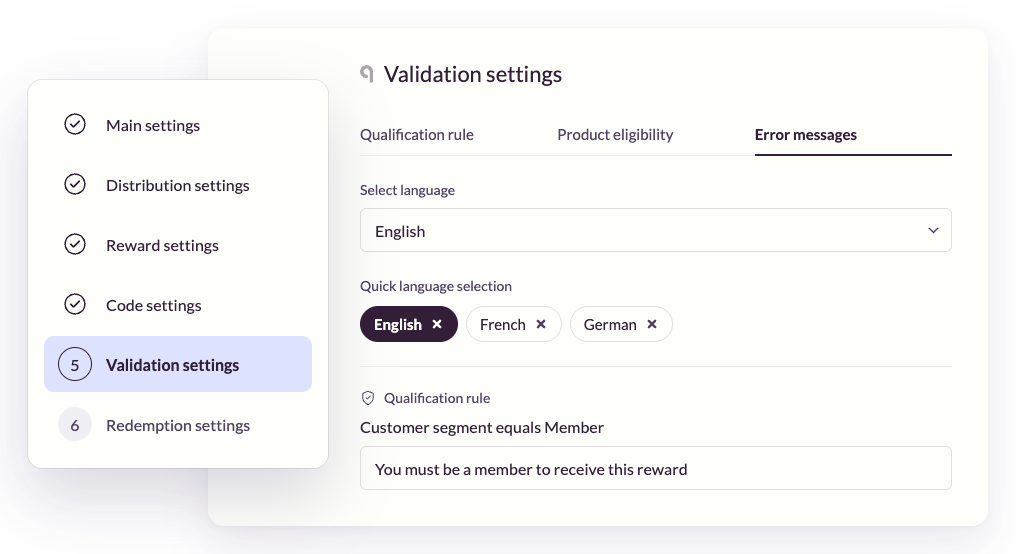
3. Customer experience around the promotion. A discount is only half the interaction. What a customer sees when a code applies, or fails to apply, shapes whether they complete the purchase at all. A generic “invalid code” error gives no indication of what went wrong, whether it expired, didn’t apply to the basket, or was never valid, and many shoppers abandon rather than troubleshoot. The same experience layer covers how a promotion is presented onsite, not just how it’s validated at checkout, and how a service team issues a one-off goodwill code without turning a single gesture into an open, reusable discount.
4. Integration architecture. Some platforms only work if you’re already committed to the stack they’re built into. Others sit above whatever a retailer is already running. An API-led engine that layers on top of an existing commerce platform means promotion depth can be added without migrating or rebuilding around a new system. Check whether a vendor requires replatforming, or works alongside what’s already in place.
Retailers operating across digital and physical channels should also ask how each vendor maintains consistent promotion logic wherever the customer shops. An API-led architecture can provide a foundation for extending that logic as channel requirements evolve.
5. Promotion security. Defining who a discount is for only holds if it stays within that group. Once a single-use safeguard is missing, a generic code can spread far beyond its intended audience through coupon sites, browser extensions or increasingly AI agents, turning a targeted discount into an open one. Look for single-use code generation, audience verification and validation rules that stop a discount travelling beyond the group it was priced for.
Shoppers actively look for these gaps: in a 2024 consumer survey commissioned by Riskified, 58% of US respondents said they had used multiple email addresses to reuse coupons or discounts, and coupon and promotion abuse was the most common form of policy abuse the research identified. Our guide to stopping promo code abuse covers the mechanics of leakage in detail.
6. Pricing model. Billing models in this category vary, and the difference is material. Some vendors bill on codes or events issued, while others bill on outcomes. Our platform shows 28.8 codes issued for every redemption. When issuance outpaces redemption by that margin, conversion-based and issuance-based models can produce very different invoices for the same campaign. Ask every vendor to state which side of that line they bill on.
The 6 Best Retail Promotion Engines: Our Top Picks
Uniqodo: Best for Enterprise Retail Marketing Teams Running Complex, Multi-Channel Promotions Without a Development Queue
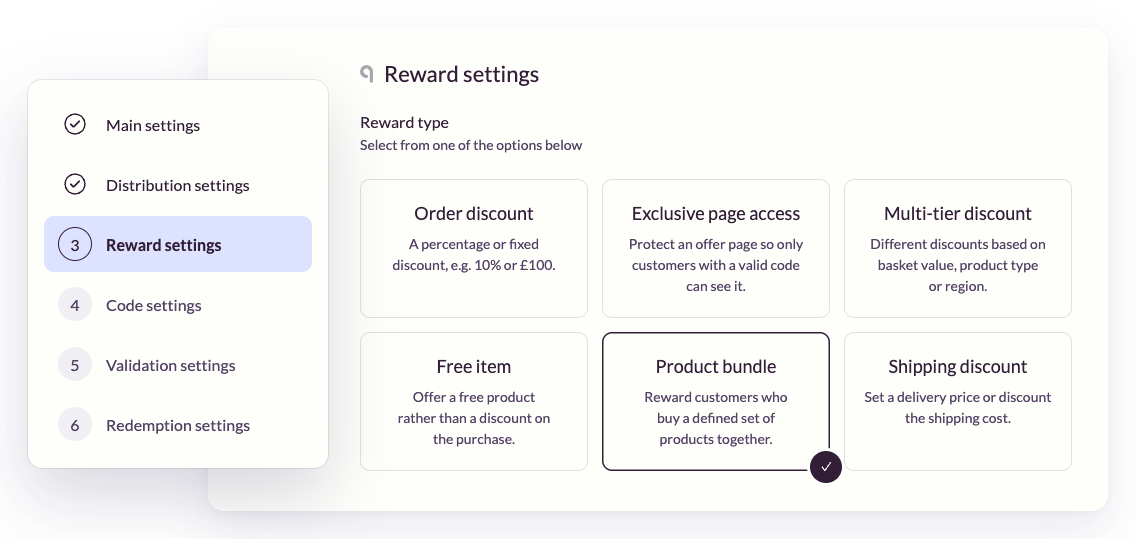
What it does well: Uniqodo is an Intelligent Promotion Experience Platform that puts promotion strategy in the hands of marketing and commercial teams rather than developers. It sits above a retailer's existing commerce stack rather than replacing it, and once the API integration is in place, those teams build, launch, test and adjust campaigns themselves. The rule builder follows how marketing and commercial teams think about a promotion: pick the reward type, set the qualification criteria, write the message a customer sees if they don't qualify, and go live.
The Uniqodo platform covers:
- Promotion Engine for granular, catalogue-level rules, product-specific discounts, tiered rewards, bundles and shipping promotions, including excluding already-discounted or specific products from a promotion and combining conditions, for example a discount that applies only if one product is in the basket but not if another category is present, built to handle a real retail catalogue rather than a single blanket code.
- Code Distribution for single-use, audience-locked codes across seven affiliate networks and 24 publisher platforms, including Blue Light Card, Unidays and Student Beans, plus employee-benefit and closed-user-group channels, so a discount stays within the audience it was priced for rather than reaching shoppers who were going to buy anyway. Attribution is preserved back to the specific source, and a HTML snippet embeds codes into any email platform without a direct integration.
- Onsite Experiences for presenting the right offer in the right context as a shopper browses, and for surfacing and validating a promotion clearly at the point of redemption, rather than leaving a shopper to guess why a code failed, with uplift measured against a control group
- Referral for lower-cost acquisition through customer-driven advocacy, and Loyalty for rewarding repeat behaviour alongside the core promotion mechanics
The same platform also supports customer service teams. Agents can query a customer's code to resolve an issue and issue a single-use goodwill code when one is needed.
The modular advantage: each product works independently or together, so a retailer can start with the Promotion Engine for catalogue-level rules and add Code Distribution or Onsite Experiences as the calendar’s needs grow, without replatforming to get there.
Pricing varies by use case and scale, and the Promotion Engine is priced on conversions rather than API call volume. That means its cost follows the sales a promotion produces rather than the traffic it attracts. A surge in peak-trading traffic doesn't raise the Promotion Engine bill on its own; cost rises when promotions convert.
Best for: Enterprise retail teams running a constant, dense promotional calendar who need marketing, not engineering, to own campaign launch, with closed-user-group protection and catalogue-level qualification rules built in.
Proof point: Notable retail brands including Boots, QVC and the White Company run promotions on Uniqodo, showing evidence that the platform holds up at retail’s catalogue and SKU complexity.
Trade-offs:
- For retailers operating across digital and physical channels, promotion logic increasingly needs to be consistent wherever the customer shops. Uniqodo currently focuses on digital commerce, with an API-led architecture that can support retailers as their promotion requirements expand across channels.
2. Oracle Retail Promotion Engine Cloud Service: Best for Oracle Retail estates
What it does well: Oracle Retail Promotion Engine Cloud Service acts as a single point of promotion execution across an Oracle estate. It validates promotions without retaining state, either as each item is added or at the end of a transaction, then returns the cart with applicable offers applied. It includes out-of-the-box integration with Oracle’s Xstore POS and Order Management. The engine also supports single-use and multi-use coupons through Oracle Retail Customer Engagement, offers audience targeting for specific customer segments and exposes a headless, stateless REST API. Oracle delivers it exclusively as a SaaS subscription hosted in Oracle Cloud.
Best for: Large retailers already running Oracle Retail across commerce, POS and order management who want consistent promotion execution within that estate.
Trade-offs:
- Promotions are authored in Oracle’s separate Customer Engagement module and then propagated to ORPE for evaluation, rather than built and evaluated in one place
- A retailer on a mixed or custom stack would need to move toward Oracle to get any of this, which is a significant undertaking unless that move was already planned
3. SAP Commerce Promotion Engine: Best for SAP Commerce storefronts
What it does well: SAP’s Promotion Engine gives SAP Commerce retailers a dedicated interface for creating and managing storefront promotions. It supports a large number of promotion types. For teams standardised on SAP Commerce, it keeps promotion management inside the platform they already administer, without adding another vendor relationship.
Best for: Retailers committed to SAP Commerce who want promotion management native to their storefront platform.
Trade-offs:
- SAP’s Promotion Engine is scoped to the storefront itself, so it doesn’t handle promotions distributed through channels that start elsewhere, such as affiliate, partner, employee-benefit or closed-user-group channels
- SAP’s own implementation guidance notes performance degrading once a system holds several thousand active promotion rules
- Flexible combination rules, such as any item from one category paired with any item from another, require each specific product pairing to be configured manually rather than defined once as a general rule
4. Antavo Promotion Engine: Best for loyalty-led retail programmes
What it does well: Antavo’s Promotion Engine works independently from its Loyalty Engine, so retailers can use it as a standalone product or alongside a loyalty programme. It supports promotion types including discount rules, bundles, promo codes and cross-selling strategies, with configurable eligibility rules, target products and discount settings. Real-time APIs evaluate and apply promotions against customer carts. Teams can also run safe, isolated tests to verify configurations without changing live data.
Best for: Retailers where loyalty is the strategic centre and promotions extend the programme, such as tiered member pricing and points-linked offers.
Trade-offs:
- The Promotion Engine operates as a separate module from the loyalty cloud, so cross-engine stacking rules need to be explicitly managed via API integration to prevent conflicts at checkout
- Single-use codes aren't described as a core capability, so retailers prioritising leakage protection for staff, student or loyalty-tier discounts may find security sits further from Antavo's core design than a platform built around single-use, audience-locked codes
- No third-party affiliate or publisher distribution network with per-partner attribution
- Headless, API-first architecture with no native onsite presentation tools, overlays or marketing widgets out of the box
5. Talon.One: Best for composable, data-driven promotion logic
What it does well: Talon.One positions its software as the decision layer between customer data and a commerce platform. It evaluates who the customer is and which conditions apply before a promotion fires. This data-first architecture suits organisations with rich customer profiles that want promotion decisions based on segments, attributes and context across multiple brands or markets.
Best for: Enterprise teams with mature customer data infrastructure that are building promotion logic into a composable stack.
Trade-offs:
- Talon.One has a headless architecture with no presentation layer, so onsite elements like basket reminders or exit-intent overlays need separate tooling and developer involvement to build and maintain.
- It also doesn't offer native publisher distribution, so a retailer running codes through affiliate networks, cashback partners or closed-user groups has to build and maintain those integrations independently.
- Commercially, Talon.One bills on codes or events issued rather than on conversions, so a widely distributed retail campaign can accrue cost before it produces revenue, which matters more the further issuance outpaces redemption.
We evaluate Talon.One more directly in our guide to the best Talon.One alternatives.
6. Voucherify: Best for developer-led teams building incentives through one API
What it does well: Voucherify is an API-first promotion and loyalty platform that runs coupons, automatic discounts, gift cards, loyalty and referral programmes from a single engine. It supports bulk generation of unique codes, with rules covering spend thresholds, product and category requirements and per-customer usage limits. Custom fields can be added to customers, products and campaigns, so promotion logic can be built around a retailer's own data, and approval workflows track every change before it goes live.
Plans are published, starting at €600 per month, with a 60-day free trial.
Best for: Retailers with in-house engineering teams who want promotions, gift cards and loyalty exposed as APIs they build their own customer experiences around.
Trade-offs:
- Marketers can manage offer parameters from the dashboard once set up, but the front-end experience around a promotion (banners, landing pages, checkout messaging) needs engineering to build and maintain
- There is no native publisher or affiliate distribution network, so running codes through cashback sites, affiliate networks or closed-user groups means building those integrations and partner attribution separately
- Every plan is set by an API call allowance, and going over it blocks API access until extra capacity is bought. That's a real planning risk when retail traffic peaks, however much of it converts
We evaluate Voucherify more directly in our guide to the best Voucherify alternatives.
Choosing the right retail promotion engine
Most of the platforms on this list handle the same core functions: promotion rules, code generation, validation and reporting. The difference for a retailer is which of the six criteria above actually matter for how your calendar and catalogue work.
If you're already committed to Oracle or SAP Commerce, that stack decision will usually settle the choice before capability comparisons do. If loyalty is the strategic centre of your programme, Antavo's route of adding promotions from the loyalty side may fit better than adopting promotion logic first. If your engineering team wants to own the logic directly, Talon.One or Voucherify put that control in their hands.
If you need marketing autonomy, granular catalogue-level control and a customer experience around the promotion held together in one platform, without replatforming to get it, that's the specific combination Uniqodo is built around.
Every platform here serves a genuine use case. The breakdowns above should be enough to shortlist two or three worth evaluating against your own stack, calendar density and team structure. If Uniqodo looks like the right fit, book a demo to see the rule builder, code distribution and onsite experiences in action.
FAQs about retail promotion engines
Why do generic discount codes hurt retail conversion?
A generic "invalid code" error gives the shopper no way to tell whether the code expired, doesn't apply to their basket, or was never valid in the first place, so many simply abandon rather than troubleshoot. Retail promotion engines that surface a specific reason for the failure keep more of that traffic through to checkout.
What are 5 sales promotion techniques retailers use?
Five common retail techniques are percentage discounts, fixed-amount discounts, multi-buy offers such as 3 for 2, conditional spend-and-save thresholds and free delivery. Each affects margin and conversion differently, which is why we break them down in our guide to the six types of promotions.
What are the 7 types of promotion?
One common seven-part marketing framework lists advertising, personal selling, sales promotion, direct marketing, public relations, sponsorship and digital promotion. A promotion engine operates within the sales promotion category. It governs discounts, coupons, bundles and incentives applied at the point of purchase using rules designed to protect margin.
Is Uniqodo right for retail promotions?
Uniqodo fits retail teams running a dense promotional calendar that need closed-user-group protection, catalogue-level qualification rules and marketer self-serve launch speed after integration. It sits above the existing commerce stack without replacing it. See how it works for retail promotions specifically.

Kate Forknell
Head of Product