

An AI shopping agent can surface promo codes in its answers. Where it operates the checkout, it can also try codes on the shopper's behalf, much as coupon browser extensions have done for years. Generic codes posted online may be found and tested this way, so the validation rules behind each promotion decide what gets redeemed. Publish the offers you want found through product feeds or automatic promotions. Protect the rest with single-use codes and customer eligibility rules.
An AI shopping agent may never see your pop-up or email banner. It may also have no way to tell that a code was meant only for one customer segment. If it finds a code, it can pass it on or try it. For ecommerce, CRM and promotions managers running code-based promotions, that makes checkout validation the main control over who redeems what.
This article explains how ChatGPT and Google handle promotions as of September 2026, how agents can increase exposure to leaked codes and how to set promotion rules so that public offers get found and targeted offers stay targeted. For the wider picture, see our guide to AI in ecommerce marketing.
How do AI shopping agents find and apply promo codes?
AI shopping agents find and apply promo codes by two routes. The first is discovery, where an assistant surfaces an offer in its answer. The second is agentic checkout, where the agent completes the checkout for the shopper. On both routes, the merchant's validation rules decide whether a code works.
Discovery
Discovery is the lighter-touch route. A shopper asks an AI shopping assistant for the best deal on a pair of running shoes. The assistant names a retailer, mentions a current offer and links through. The shopper then finishes the purchase on the merchant's own site, entering the code themselves if needed.
Agentic checkout
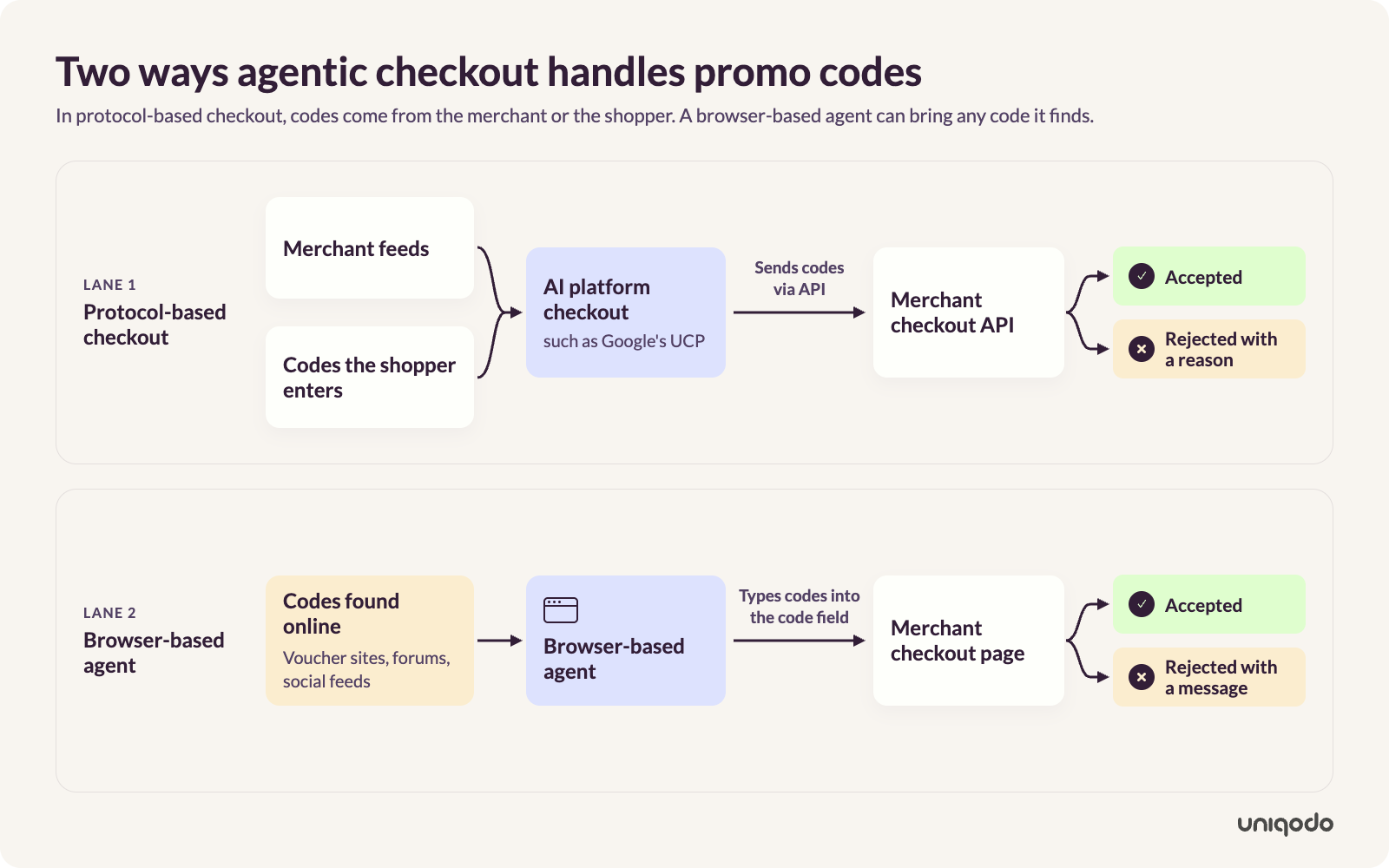
Agentic checkout works in two ways. In a protocol-based checkout, such as Google's, the AI platform builds the basket and sends codes to the merchant's checkout API. The codes come from the merchant's own feeds or from the shopper, and the merchant accepts or rejects each one.
A browser-based agent works differently. It operates the merchant's own checkout page as a person would, filling in fields and clicking through. That means it can type in any code it finds, much as coupon browser extensions do.
Where ChatGPT, Google and merchant assistants stand (September 2026)
ChatGPT shopping. OpenAI launched Instant Checkout in ChatGPT in September 2025 and then changed course in March 2026. ChatGPT now focuses on product discovery. Merchants use their own checkout and share product feeds and promotions with ChatGPT through the Agentic Commerce Protocol (ACP). Retail Dive reported the shift on 25 March 2026.
Google. Google's checkout in AI Mode and the Gemini app runs on the Universal Commerce Protocol (UCP), an open standard Google co-developed with Shopify, Etsy, Wayfair, Target and Walmart. It is live for eligible US merchants, and Google plans to bring it to Canada, Australia and later the UK. At checkout, Google draws promotions from two sources. Auto-applied promotions come from Google Merchant Center feeds. User-applied codes are ones the shopper enters, such as public codes or personalised email offers, and Google's checkout supports up to 10 applied codes per session. According to Google's UCP promo codes and discounts overview, the merchant must validate every code in real time. When it rejects a code, it must return a reason: expired, invalid, already applied, cannot be combined, requires login or customer not eligible.
Merchant assistants. Assistants that brands run on their own sites hand out codes too. Gorgias documents that its Shopping Assistant can generate unique single-use discount codes or surface active automatic discounts from a Shopify store to help close a sale.
Why can AI shopping agents make leaked codes more costly?
AI shopping agents can make leaked codes more costly by surfacing them in answers or trying them at checkout on a shopper's behalf. A generic code posted on a voucher site may then reach shoppers it was never meant for.
The mechanics of coupon code leakage are unchanged: a code meant for one audience ends up where anyone can find it. Agents add another route for shoppers to find and try those codes.
The potential cost falls on margin. When an unintended customer redeems a code, the brand gives a discount on a sale that might have happened at full price. Across 90 merchants and 4,124 promotions in H1 2026, discount given represented 7.3% of total order value, according to Uniqodo's H1 2026 coupon code statistics. To control where that budget goes, brands need rules that restrict redemption to the intended audiences.
Leakage can also enable promo code abuse. Examples include stacking codes that were never meant to combine, reusing welcome offers and redeeming staff or member codes outside the intended group. An agent does not need bad intent to attempt these redemptions. It can try a code it finds, leaving your checkout to decide whether to accept it.
Affiliate programmes face an attribution problem as well. If an agent applies a partner's code that also appears on other sites, the generic code alone may not identify which partner should receive credit for the sale. That is one reason to back affiliate promotions with unique codes for each partner.
Which promotions should AI shopping agents see?
Offers built for reach, such as sitewide sales, welcome offers and free delivery thresholds, should be easy for agents to find. Offers built for one audience should stay restricted at the point of redemption. Decide deliberately which offers are public instead of relying on a code staying secret.
List these offers in the feeds AI platforms read, such as Google Merchant Center and ChatGPT's Agentic Commerce Protocol, so agents can find them. Where you can, run them as automatic promotions that apply at checkout without a code, so there is no code to leak. Apply them in your checkout or promotion engine rather than through on-site scripts alone, so a protocol-based checkout that never loads your pages still receives them. Keep any eligibility conditions, such as a first-order rule, in place.
For targeted offers, use unique single-use codes to limit reuse of retention offers, partner deals and closed user group discounts for students, key workers or employees. Add customer eligibility checks at checkout where the offer must stay with its intended recipient. Single-use limits cap redemption; eligibility rules determine who can redeem.
For every live code, ask what happens if an agent surfaces or tries it for a shopper who was never meant to have it. If that creates a margin problem, add a usage limit or an eligibility rule, or replace the generic code with unique codes.
How to prepare promotion rules for AI shopping agents
Make checkout validation strict and explicit. Checkout is the one point every code passes through, whether a person or an agent enters it.
- Validate every code in real time, so the checkout rejects expired or ineligible codes before the order is placed.
- Set per-customer and total usage limits on every code to cap the potential cost of a leak.
- Define coupon stacking rules explicitly. Google's checkout can hold up to 10 applied codes at once, so your rules need to say which codes can combine.
- Tie private offers to an eligible customer, using login where needed, so possession of the code alone does not grant access.
- Return specific rejection reasons so agents can explain them to the shopper.
- Review which codes are circulating publicly, and cap or retire any that were never meant to be public.
A generic "code not valid" message gives the agent little useful information to pass on. "Requires login" tells the shopper how to claim a member offer. "Customer not eligible" explains why the offer is unavailable and may prompt them to choose a public offer instead.
Put the rules somewhere every checkout can reach. A headless promotion engine validates codes through an API, so the same logic applies across every front end that calls it.
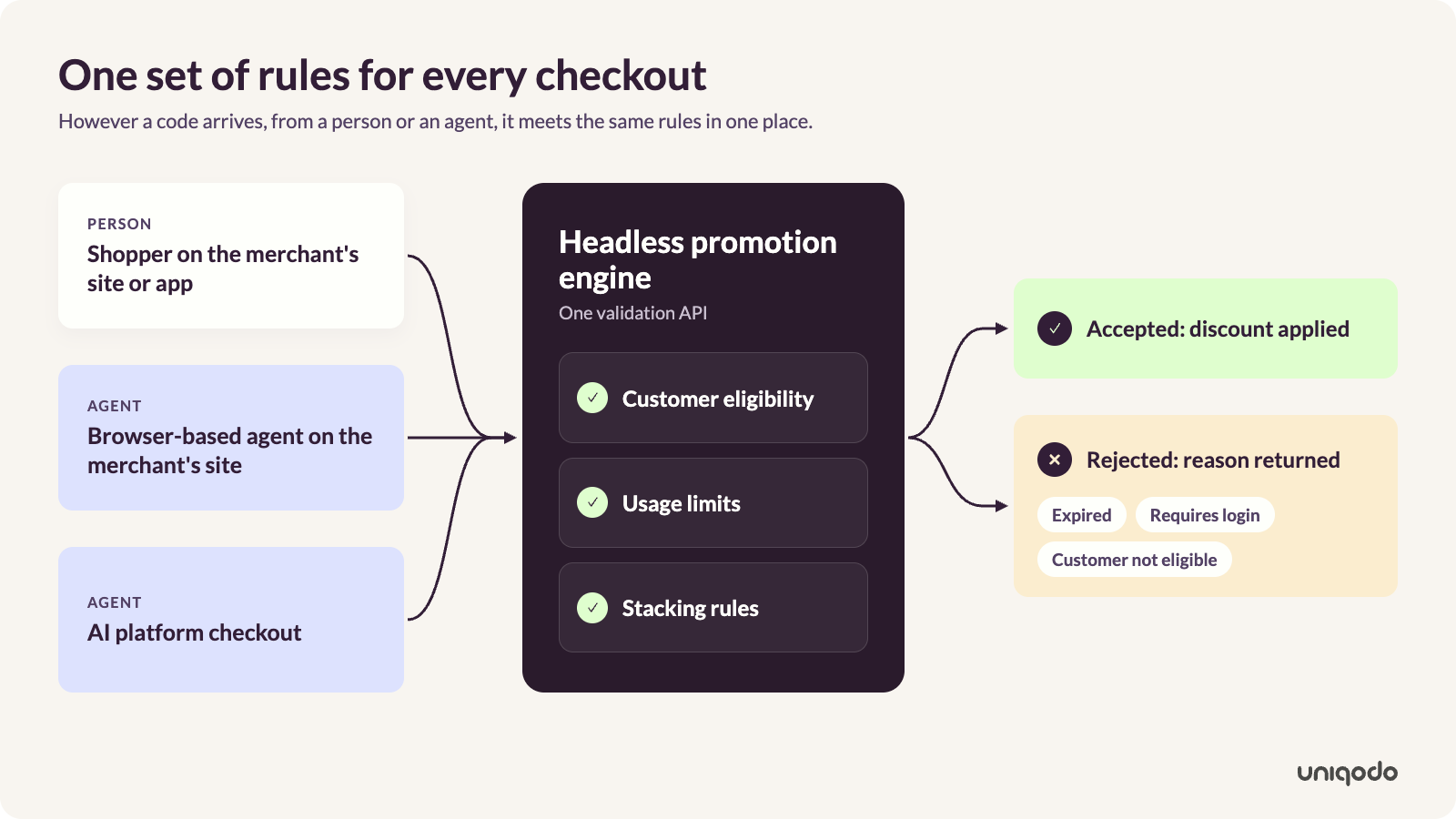
The Uniqodo Promotion Engine validates customer eligibility, usage limits and stacking rules at the moment of redemption, and applies the same checks whoever enters the code. Once integrated, marketers set the rules.
Partner programmes need controls at the point of issue too. Uniqodo's Code Distribution issues unique codes to affiliate and publisher partners. With a single-use limit, a partner code found by an agent can still be redeemed only once. Each redemption is attributed to the partner the code was issued to, so the brand knows which partner drove the sale.
AI shopping agents and promo codes FAQs
Do AI shopping agents use promo codes?
Yes. AI shopping agents can surface promotions in their answers, and agents that complete the checkout can apply codes. As of September 2026, ChatGPT receives merchant promotions through the Agentic Commerce Protocol, Google's UCP-powered checkout (live in the US) passes codes to the merchant's checkout API and browser-based agents can enter codes on the checkout page directly.
Can AI shopping agents find codes that were not meant to be public?
Yes. An agent may surface or try a generic code posted online, whether on a voucher site, a forum or a social feed. Single-use limits stop a leaked code being reused, and customer eligibility checks keep private offers with their intended audience.
Should brands stop AI shopping agents from applying codes?
Not usually. Blocking agents also blocks shoppers who use them to find your public deals. Publish those offers through feeds or automatic promotions, and let validation rules protect the conditions on targeted promotions.
What happens when an AI shopping agent tries an invalid code?
The merchant's checkout rejects it. Under Google's UCP, the merchant must also return a reason: expired, invalid, already applied, cannot be combined, requires login or customer not eligible. The agent can pass that reason to the shopper, who may then log in or choose a different offer.
How do you protect margin when AI shopping agents apply codes?
Set per-customer and total usage limits, define stacking rules explicitly and use unique single-use codes to limit reuse. Add eligibility checks for offers restricted to a specific audience. Review which codes are circulating publicly and cap or retire those that were never meant to be public.

Jenna Tyler
Director of Customer Operations