
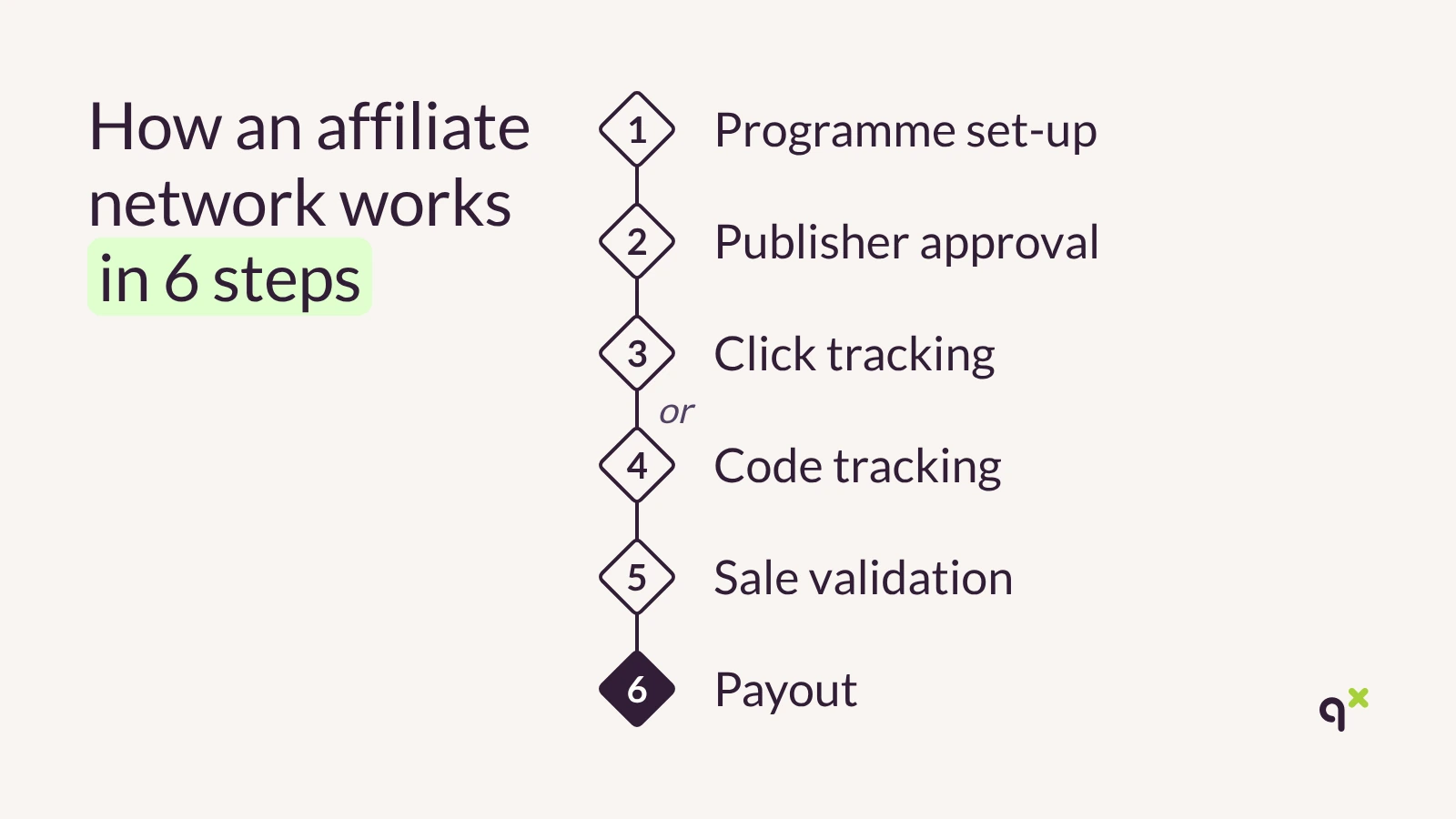
An affiliate network is a company that sits between brands and the publishers that promote them. It recruits and vets publishers, tracks which one drove each sale, checks the sale against the brand’s rules and pays the commission, usually charging the brand a fee on top.
Brands join an affiliate network to get sales from voucher, cashback, student discount and content sites without building the tracking, contracts and payments themselves. In network language the brand is the advertiser and whoever promotes it is the publisher.
An affiliate network is a marketplace with tracking and payments built in. Brands list their affiliate programmes on it, and publishers apply to promote the ones that suit their audience. Awin, CJ Affiliate, Commission Factory and Tradedoubler all work this way.
Each publisher gets an ID that the network uses to credit sales to it. Many of them, from cashback sites to student and key worker discount schemes, promote an offer as well as a product, so a discount code is often part of what the network tracks.
An affiliate network works by tying each sale to a publisher ID and holding back the commission until the brand has checked the order.
An affiliate network stands between the brand and its publishers and takes a fee on the commission it handles, while an affiliate platform is software the brand uses to run its partnerships directly. Impact, for one, calls itself a partnership platform rather than a network and charges a flat software fee instead of a cut of payouts.
| Compared | Affiliate network | Affiliate platform |
|---|---|---|
| What it is | A marketplace of publishers with tracking and payments | Partner tracking and management software |
| Who holds the publisher relationship | The network sits in the middle | The brand, directly |
| How it charges | A network fee or override on top of commission | A software fee |
| Who pays publishers | The network, from the brand’s payment | The brand, through the platform’s payment tools |
The affiliate programme is the brand’s own offer to publishers, made up of its commission rates, terms and promotions, and it can run on either.
An affiliate network holds the record of which publisher drove which sale, and that record decides who gets paid. The Affiliate & Partner Marketing Association’s 2025 figures, compiled from 11 affiliate networks, put UK spend on affiliate and partner marketing at £1.8 billion against £20.7 billion in revenue (APMA, 2026).
Codes can break that record. A generic code given to one publisher gets copied onto voucher sites and browser extensions, which is coupon code leakage. Voucher attribution then credits every sale using that code to the original publisher, however the customer found it, and under last-click link tracking a voucher site clicked on the way to checkout takes the credit instead.
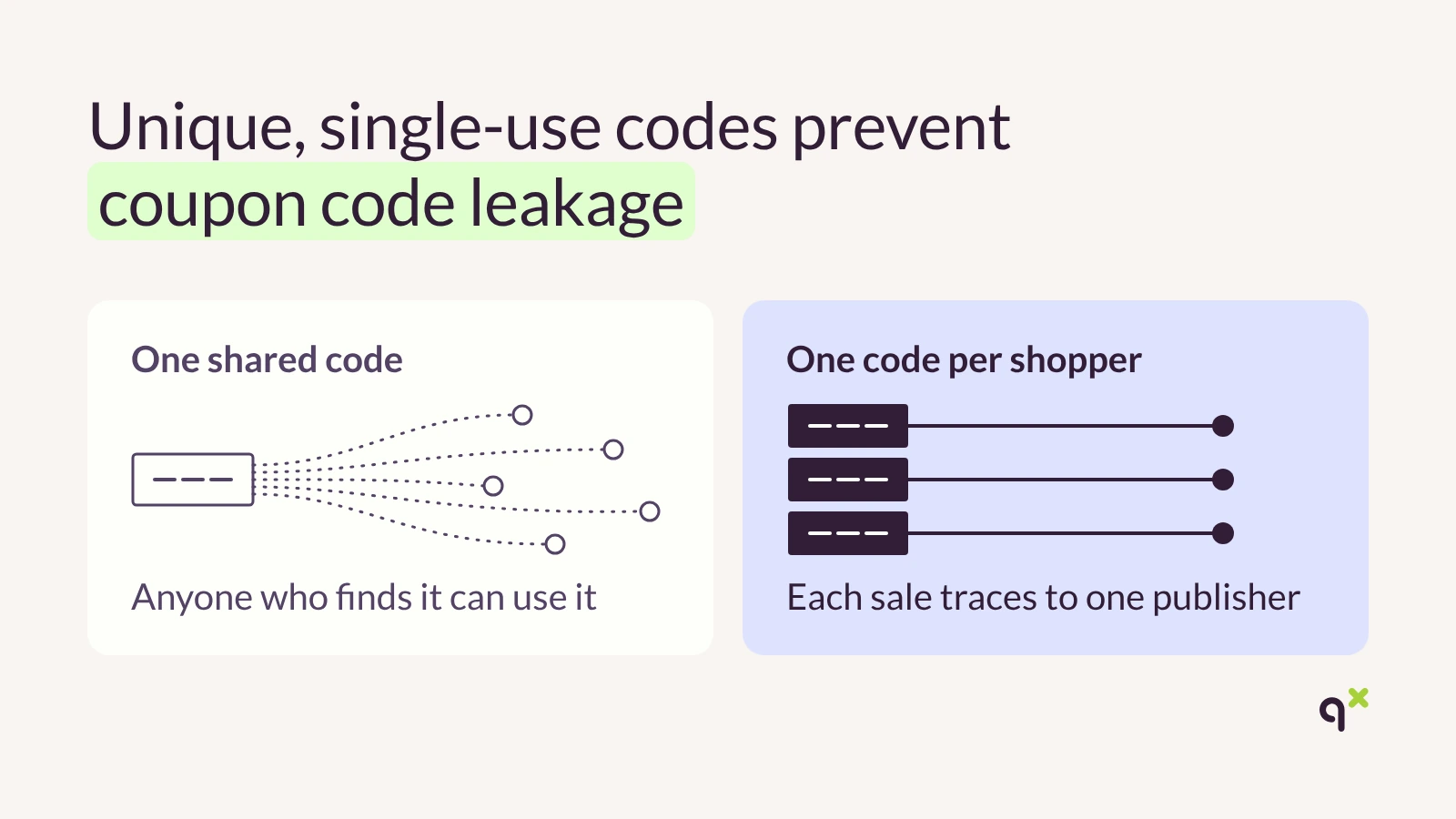
Either way, the brand pays commission to a publisher that didn’t drive the sale. Awin’s own guidance on unauthorised voucher codes recommends unique, single-use codes for this reason.
The hand-off from publisher to brand is the other weak point, because shoppers can lose sight of the offer before they reach checkout. Uniqodo’s Partner Journey Optimisation shows a co-branded message when a shopper arrives from a partner and keeps that offer in view through to checkout.
Uniqodo works alongside affiliate networks rather than replacing them. Its Code Distribution platform issues unique, single-use codes to each publisher, in real time through an API or as pre-generated batches, and links every redemption back to the publisher the code was issued to. Uniqodo’s partners page lists integrations with Awin, CJ Affiliate, Commission Factory, Impact and Tradedoubler, plus 24 publishers including Blue Light Card, Student Beans, TopCashback and UNiDAYS.
Awin’s guidance on unauthorised voucher codes names Uniqodo among the partners that can generate unique codes for a programme, and lists it as an Awin MasterTag partner. For a side-by-side look at the tools that do this job, see how coupon distribution platforms compare.
Most affiliate networks charge the brand a fee on top of the commission it pays to publishers. The fee is usually a percentage of the sale or of the commission, agreed brand by brand, and is often called a network fee or override. Some networks add set-up or management fees, while publishers can usually join for free.
A network can credit a sale to a publisher through the code itself. The brand assigns a code to one publisher and passes the code used at checkout into its tracking, and the network matches the two, even when the customer never clicked a tracked link. It only stays accurate while that code reaches that publisher’s audience alone.
A publisher is the website, app or creator that promotes a brand to its own audience and earns commission on the sales it drives. An affiliate network is the company in the middle: it signs publishers up, tracks their sales, handles the payments and gives the brand one place to manage every publisher on that network.

Stop code leakage. Replace shareable generic codes with high-entropy unique strings. Protect your margins by ensuring discounts only apply to the intended audience under specific, validated conditions.

Execute complex campaigns. Move beyond basic discounts with multi-tiered rewards, product bundles, and discounts, all managed without waiting for a developer to clear your roadmap.

Convert with intent. Use real-time data to trigger onsite nudges or referral loops exactly when they matter. Create a unified journey that turns browsing interest into confirmed sales.

Scale partner sales. Automate the delivery of unique codes to thousands of partners instantly. Replace manual spreadsheets and CSV exports with secure, trackable API distribution.


We'll show you exactly how Uniqodo handles your use case - fraud controls, mechanic complexity, and ROI attribution included.