

Quick Answer: There is no universal best discount percentage. Across 90 merchants and 4,124 promotions on the Uniqodo platform from January to June 2026, retail and fashion promotions converted best at 5 to 10% off, peaking at 30.32% of validated codes redeemed at the 10% tier. Travel behaved almost in reverse: conversion climbed from the 15% tier upward, but average order value peaked sharply at 15%.
Many brands pick a discount depth by habit. A 20% discount feels safe, 10% feels cautious and 30% feels aggressive. The data suggests those instincts produce different results depending on what you sell.
This article uses first-party Uniqodo platform data to show where the best discount percentage sits for retail and fashion compared with travel, why the two sectors invert, and how to set depth by segment instead of defaulting to a single sitewide number.
What is the best discount percentage?
The best discount percentage is the shallowest depth that still moves your conversion rate, and that point differs by sector. In this dataset, retail and fashion perform best at 5 to 10% off, while 15% offers the strongest balance of basket value and volume for travel. Interestingly, our data shows deeper discounts do not automatically produce better results in either sector.
These findings come from Uniqodo's H1 2026 coupon code statistics, an analysis covering 90 merchants and 4,124 promotions on the Uniqodo platform between January and June 2026. One definition matters before the numbers: conversion rate throughout this article means the share of validated codes that were redeemed, not sessions that resulted in orders. A 30% conversion rate means 30% of shoppers who had a valid code applied at checkout completed the purchase with it.
That definition isolates the question this article is asking. Once a shopper has a live discount in hand, how often does the discount depth get them over the line, and what do they spend when it does?
Retail and fashion: shallow discounts do the heavy lifting
In retail and fashion, shallow discounts converted best in our dataset, while deep discounts produce limited gains. Conversion sits at 21.62% of validated codes redeemed at 5% or less, peaks at 30.32% at the 10% tier, then drops to 9.08% by 20%.
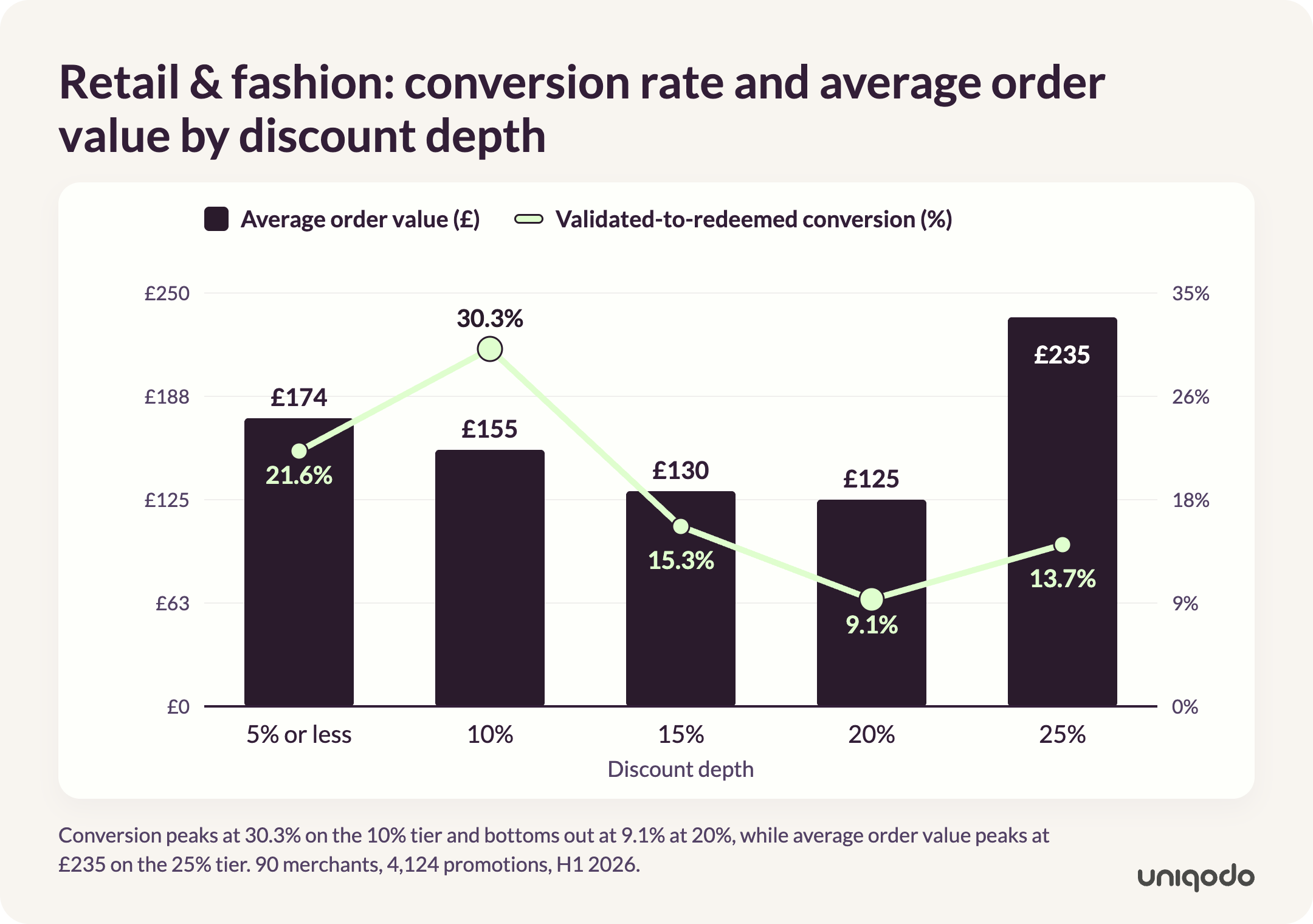
Two findings stand out. The 20% tier carries the most retail redemptions in this dataset, with 162,467, yet it has the lowest conversion rate at 9.08% of validated codes redeemed. Showing that whilst 20% is reached for most often, the offer by itself is not enough to drive increased conv. rate.
Average order value also shows no consistent increase as discounts deepen, ranging from £125 to £235 across the table. Moving from 10% to 20% off in this dataset is associated with a conversion decline of around 70%, while average order value falls from £155 to £125. That means a larger discount is applied at a tier with a lower validated-to-redeemed conversion rate.
The 25% tier breaks that pattern. Its £235 average order value is the highest in the table, and conversion partially recovers from the 20% trough to 13.66%. One interpretation is that 25% discounts in this dataset skew toward higher-value or more considered purchases, the kind that need a bigger incentive to close but where fewer shoppers follow through even once that incentive is offered.
The practical takeaway for retail and fashion teams may be uncomfortable, but it is useful. Your efficiency point could be shallower than the depths you currently run. Small, well-targeted percentages did the conversion work in this dataset. If your instinct is to reach for 20% as the default, test lower depths before going higher. Our guide to discounting inventory without eroding margins explores how to protect margin while running promotions.
Travel: deeper discounts convert more people onto much smaller baskets
Travel inverts the retail conversion pattern. From the 15% tier upward, conversion rises with depth, reaching 71.77% of validated codes redeemed at 30% or more.
.png)
Before interpreting the top of that table, consider the sample sizes. The 5%-or-less tier covers only 1,347 redemptions and the 10% tier only 5,699. Those smaller samples limit what can be inferred from the dip in conversion between them, from 7.89% to 6.04% of validated codes redeemed. The clearer pattern starts at 15%, where volume becomes substantial.
Conversion at 30% or more reaches 71.77% of validated codes redeemed across 65,081 redemptions. That is more than five times the 15% tier. If conversion were the only objective, deep travel discounts would look highly effective.
For travel marketers, 15% offers the strongest efficiency point in this dataset. That tier combines the highest basket value with substantial volume of 292,845 redemptions. Deeper discounts still have a role as targeted tools for defined, lower-value objectives, but they are less suited to the core booking flow. Uniqodo works with travel brands on this type of depth segmentation.
Why does the same discount behave so differently by sector?
The same percentage represents a very different sum of money in each sector, and shoppers respond to both the frame and the amount. On a £130 fashion basket, 10% off is £13, which is easy to understand, potentially motivating and relatively inexpensive to fund. On a £2,778 travel booking, 15% off is more than £400, a potentially decision-shifting amount even though the percentage looks moderate.
A common pricing heuristic is that below roughly £100, a percentage can look larger than the equivalent cash amount. For example, 25% off a £50 item may sound stronger than £12.50 off. Above £100, the absolute figure can appear larger. Retail baskets in this dataset mostly sit below that point, while travel baskets often sit above it. This may help explain why shallow percentages perform well in retail while travel responds differently to discount depth against a larger base price.
The decisions also carry different levels of commitment, and that difference is partly built into how conversion is measured here. A validated code only exists once someone has reached checkout, so the rate already excludes anyone who never got that far. Reaching checkout means something different in each sector, though. A fashion purchase is often quick, inexpensive and easy to reverse, so a shopper can apply a code on a casual browse and still walk away without buying. A holiday is typically planned and compared over a longer period, so a traveller who reaches checkout with a valid code has usually already chosen dates and narrowed down options: real commitment to a specific trip.
That gap may be part of why retail's best conversion rate tops out at 30.32% while travel climbs as high as 71.77% at its deepest tier. Once the groundwork of choosing a trip is done, a discount large enough to matter can be the final push on a decision that's mostly already made. It's a plausible reading rather than a confirmed one, and the discount still remains one input among several in a purchase the shopper had already set out to make.
Whatever the mechanism, the operational conclusion remains the same: discount depth is a sector-level and segment-level decision. A single sitewide percentage does not fit every purchase. This principle also applies across promotional mechanics, as covered in our comparison of the six main types of promotion.
How to choose your discount depth
Use this sequence instead of picking a number that feels right.
- Start at your sector's efficiency point. In this dataset, that means 5 to 10% for retail and fashion and 15% for travel. Treat it as a baseline hypothesis, not a fixed rule.
- Set depth by segment, not sitewide. Product lines, audiences and price points can have different efficiency points. Uniqodo's Promotion Engine lets marketers run different percentage depths by sector, product line or audience segment from one rules engine. This avoids hardcoding a single sitewide number and hoping it averages out. After integration, marketing teams can manage these settings themselves.
- Read conversion and AOV together. Travel's 30%+ tier looks strong on conversion alone but weaker once you see the £234 baskets behind it. Either metric can mislead when viewed in isolation.
- Test in 5-point increments. Move from 10% to 15%, not from 10% to 25%. Promotion Engine reporting shows the conversion and order-value trade-off by segment as depths change, without requiring teams to rebuild a campaign for every test.
- Protect the tier where your value concentrates. For travel in this dataset, that is 15%. Reserve deeper discounts for defined tasks, such as clearing specific inventory or activating a selected segment, and attach a measurable target.
About Uniqodo:
Uniqodo is the Intelligent Promotion Experience Platform. It sits above your existing e-commerce stack, giving enterprise marketing and commercial teams the tools to build, distribute and validate advanced promotions, from unique single-use codes to tiered and segmented discounts, while protecting margin. Founded in 2014, Uniqodo has generated over 1 billion codes for brands including TUI, EE, Avis and Samsung. Book a demo to see how sector-specific discount depth works in practice.

Kate Forknell
Head of Product