

The hotel promotion ideas that work best change the price or value of a stay only for the dates, rooms and guests that need it. Length-of-stay offers, member rates, value-adds, last-minute offers on unsold rooms and unique partner codes add bookings without lowering the rate on nights that would sell anyway.
Most lists of hotel promotion ideas are really lists of marketing channels, such as social posts and influencer stays. The offer behind the channel decides whether any of that pays. A discount meant for a quiet Tuesday in February will also be used on a sold-out Saturday in August unless a rule stops it, and a code shared with one partner can end up on voucher sites. The ideas that work are built on mechanics: which dates and rooms a promotion covers, who can use it and how it reaches them.
What counts as a hotel promotion?
A hotel promotion is any offer that changes the price, value or conditions of a stay for a defined group of guests, dates or channels. Its job is to win bookings the published rate wouldn't, without lowering what other guests pay. That includes rate discounts, but also extra nights, breakfast, parking, upgrades and flexible cancellation.
The useful split is between promotions that apply to everything and promotions with rules. A site-wide percentage code applies to every room on every date. A rule-based promotion applies only to, say, longer stays arriving midweek on dates forecast to stay empty. The second kind is how hotels move distressed inventory while the dates with natural demand keep their full rate.

Why does discount depth matter in a hotel promotion strategy?
Discount depth changes who books and how much they spend, and in travel the deepest offers don't return the most per booking. Across 90 merchants and 4,124 promotions in H1 2026, travel brands on Uniqodo got the highest average order value from 15% discounts, at £2,778 per redemption. Discounts of 30% or more converted 71.77% of validated codes but returned £234 per redemption, according to Uniqodo's H1 2026 coupon code statistics.
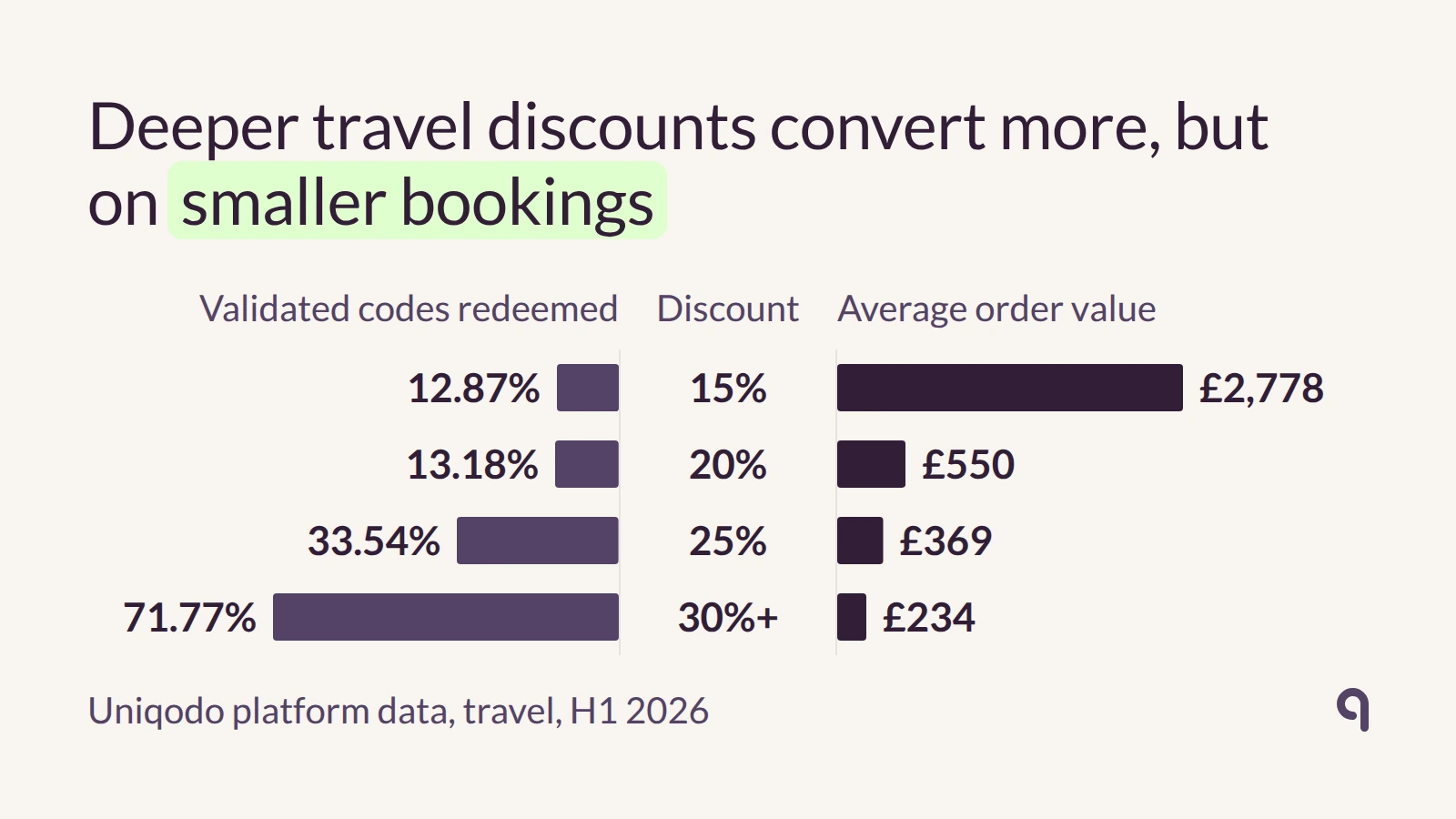
For a hotel, the lesson is to keep most offers moderate and aim them at the dates that need bookings. Save deep discounts for rooms that would otherwise stay empty. Timing matters too. In the same data, 35.2% of non-batch travel redemptions came more than seven days after the code was issued, so an offer with a short expiry misses the guests who plan ahead.
How to run each of these hotel promotions
Hotel promotions work best when each one targets a specific occupancy problem and carries a rule that limits where it applies.
1. Length-of-stay offers for quiet midweek dates
A length-of-stay offer rewards guests for adding nights, usually with a discounted or free extra night. It works because the extra night is often one you wouldn't have sold, and the guest is on property for longer. Limit the offer to the arrival dates and room types that need it and exclude dates that already sell, or it will discount stays guests were booking anyway.
2. Member rates for direct bookers
A member rate is a lower price shown only to signed-in members or email subscribers. It gives guests a reason to book direct and share their details, and because the rate sits behind a sign-in, it isn't the price you advertise publicly. Keep the cost of joining low. An email address is enough for most hotels, and every extra field is a reason not to sign up.
3. Value-adds and add-ons instead of rate cuts
Value-add promotions give guests something extra, such as breakfast, parking, late checkout or an upgrade, instead of a lower nightly rate. They protect your average daily rate, and some cost very little to provide: an upgrade into a room that would otherwise sit empty costs you housekeeping, not a night's revenue.
Add-on offers work the other way round. The discount only applies once the guest adds something paid, such as breakfast or parking, so the booking carries revenue a plain discount wouldn't. If a booking doesn't qualify yet, tell the guest exactly what to add or which dates to change.
4. Last-minute offers on rooms that won't sell
Last-minute offers fill rooms that are still empty close to arrival. They're the one place a deeper discount makes sense, because the alternative is no revenue from the room at all. Keep them narrow by applying the offer only to the dates and room types at risk, and deliver it through channels where you control who sees it, so regular guests don't learn to wait for a cheaper rate.
5. Location-based offers for travellers nearby
A location-based offer reaches guests based on where they are, such as travellers passing through a nearby airport or station who need a room that night. It suits hotels whose demand comes from passing trade rather than planned trips. Keep the offer tied to that audience and those dates, so it doesn't turn into a general price cut for guests who would have booked anyway.
6. Unique codes for partners, corporate accounts and influencers
Partner promotions give a specific audience, such as a corporate client's staff, a cashback site's members or an influencer's followers, an offer of its own. The risk with one shared code is leakage. Once it appears on a voucher site, anyone can use it and you can't tell which partner drove the booking. A unique, single-use code per guest or per partner keeps the offer with the audience it was meant for and shows which partner each booking came from.
7. Offers that recover abandoned bookings
Plenty of guests search dates, see a price and leave to compare. An onsite offer shown at that moment, based on what they searched for, such as destination, length of stay or number of guests, gives them a reason to book now. Match the offer to the search: an upgrade or adjoining rooms for a family searching school holiday dates, flexible check-in for a solo midweek stay.
Travel brands on Uniqodo saw onsite promotions average £5,831 per redemption in H1 2026, 6.8 times the £856 for API-distributed codes. Fix the booking flow first, though: our guide to reducing hotel booking abandonment covers where guests drop out and why.
8. Seasonal promotions with protected peak dates
Seasonal promotions move demand into the weeks and months your hotel struggles to fill. They work when the exclusions are right. Set blackout dates around local events, school holidays and anything else that already sells, so the offer only touches the shoulder and low-season dates it was built for.
Which hotel promotion mistakes cost the most?
The costliest hotel promotion mistakes give away rate on bookings you would have taken anyway.
- Running one generic code everywhere. A single public code spreads to voucher sites and browser extensions, and guests who were already booking use it.
- Leaving out date and room rules. Without them, an offer built for empty midweek rooms also discounts your busiest weekends.
- Stacking a code on top of a rate your revenue management system has already cut. The guest gets two discounts, and you can't tell which one won the booking.
- Going deep by default. A bigger discount wins more bookings, but in the travel data above, 30%+ discounts returned a fraction of the order value of 15% offers.
- Returning a generic error when a code doesn't qualify. “Invalid code” tells the guest nothing, and a guest who sees it may leave to hunt for a code that works instead of changing their dates.
How Uniqodo runs hotel promotions
Uniqodo sits between a hotel's booking engine and its marketing channels and controls who gets which promotion, on which dates. The Promotion Engine lets teams restrict promotions to specific stay dates, rates and customer segments, set blackout dates that promotions never touch, and issue unique, single-use codes for every partner, email or guest. When a code doesn't qualify, custom error messages tell the guest which rule they missed instead of a generic error.
“When we originally met with Uniqodo, we really needed them to only do one thing: to allow us to prevent the misuse of codes, but they have given us the ability to go above and beyond, offering our customers and our partners so much more. From evergreen, always-on discount codes, and offers for free breakfast or Wi-Fi, to custom error messages and in-depth reporting.”
Maryke Lotz, Manager for Partnerships and Affiliates, Travelodge
Uniqodo's Onsite Experiences add the other half: overlays and banners triggered by what a visitor searched for, such as destination, stay length or guest count, to recover bookings before the guest leaves. Uniqodo needs an API integration with your booking engine first. Once that's in place, your marketing team runs promotions without raising a development ticket for each one. See how Uniqodo handles travel promotions for the full set of travel features.
FAQs: hotel promotion ideas
What is the most effective hotel promotion?
The most effective hotel promotion is the one aimed at a specific gap in occupancy rather than the whole calendar. For direct bookings, member rates and value-adds usually work best because they protect the published rate. For rooms still empty close to arrival, a narrowly targeted last-minute offer brings in revenue that would otherwise be lost.
How can a hotel run promotions without lowering its published rate?
A hotel can run promotions without lowering its published rate by putting the offer somewhere other than the public price. Member rates sit behind a sign-in, value-adds such as breakfast or parking add to the stay instead of cutting the rate, and unique codes sent to a closed group only work for the guests who receive them.
How long should a hotel promotion code stay valid?
A hotel promotion code should stay valid for at least as long as your guests take to plan a stay. Travel guests often redeem codes more than a week after receiving them, so short expiry windows on emailed or partner codes lose bookings. Use stay-date rules to control which nights qualify, and keep the redemption window generous.

Julius Somoye
Founder & CTO