The best travel promotion engine depends on who runs promotions and how bookings arrive. Uniqodo suits enterprise travel marketing teams selling through affiliates and partners, with booking-language rules and onsite offers they run themselves once integrated. Talon.One and Voucherify suit developer-led, API-first builds, Antavo suits loyalty-led brands, HotelRunner suits independent hotels and WP Travel Engine suits tour operators on WordPress.
A leaked discount code on a high-value holiday puts far more margin at risk than one on a T-shirt. Travel bookings also come with departure dates, long lead times, room and fare types and a network of affiliate and cashback partners, all of which a promotion has to account for.
This guide compares six promotion engines a travel brand might shortlist in 2026, from enterprise platforms to the promotion tools built into hotel and tour booking software. It uses Uniqodo platform data from H1 2026 to show how travel promotions behave, and turns that into six criteria for choosing software. For a category-wide view across all sectors, see our best promotion engine software comparison.
What is a travel promotion engine?
A travel promotion engine is software that decides which offers a traveller qualifies for and applies them at the point of booking. It validates codes in real time and lets commercial teams run discounts, multi-tier offers, package deals and partner codes across flights, hotels, car hire and holidays, without building that logic into the booking engine itself.
Travel needs this layer because its inventory behaves differently from retail stock. A hotel room or flight seat is worth nothing once the date passes, and its price moves constantly as revenue management systems react to demand. Packages complicate it further, because the flight, hotel and transfer in one booking can each carry a different margin.
Booking engines and e-commerce platforms usually include basic coupon tools for a percentage discount or a shared code. Those tools were built for simpler promotions, and they struggle when a travel brand needs a different offer for each affiliate, rules tied to travel dates as well as booking dates or caps that keep high-value discounts within budget.
The 6 Best Travel Promotion Engines: Our Top Picks
1. Uniqodo: Best for enterprise travel marketing teams running complex, multi-channel promotions without a development queue
What it does well: Uniqodo is an Intelligent Promotion Experience Platform that sits above a travel brand’s existing booking or e-commerce stack. Once the API integration is in place, marketing and partnership teams run promotions from one platform, from the qualification rules and the unique codes sent to affiliates to the offers travellers see during the booking session.
For travel teams, the rule builder follows how an offer is set up: pick the reward, set qualification rules on booking data such as stay dates or party size, write the message a guest sees if they don’t qualify and go live. Interface labels can also be renamed so an order becomes a booking, and attributes that don’t apply, such as shipping, can be hidden.

Uniqodo’s promotion experience platform includes:
- Promotion Engine for booking-level qualification rules, unique single-use codes validated in real time and tiered discounts that reward higher-value bookings. Each rule carries its own error message, in several languages if needed. Codes can also expire on their own schedule, so a campaign can run all year while every code lasts seven days from issue.
- Code Distribution for sending unique codes through partner platforms such as AWIN, CJ Affiliate and Impact plus 24 publisher integrations including Blue Light Card and Student Beans. Each booking is attributed to the partner that distributed the code, and an email code widget places unique codes in any email platform without a dedicated integration.
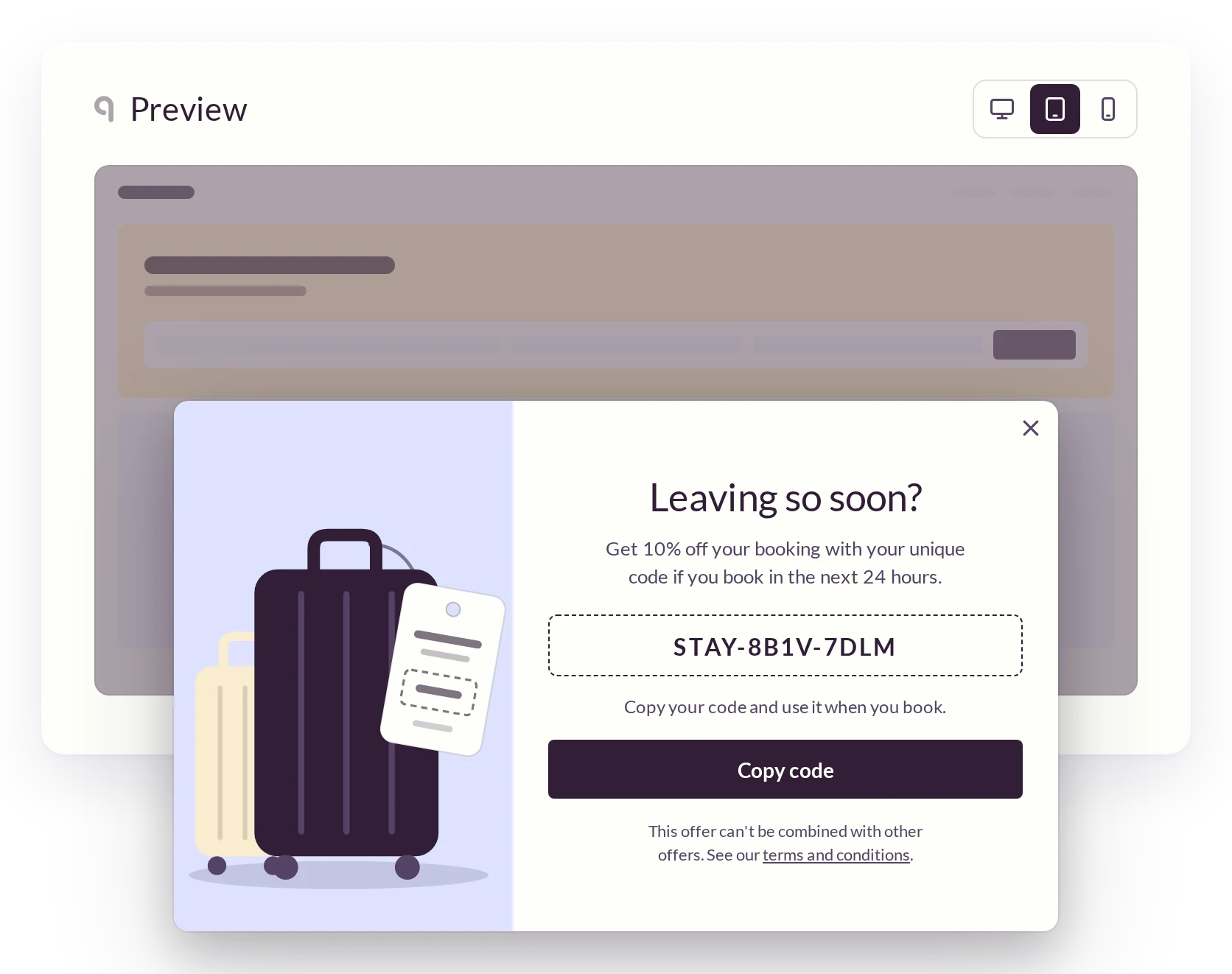
- Onsite Experiences for code reminders, exit-intent offers and booking abandonment prompts during the booking session, connected to the same rules and codes as the Promotion Engine.
Each product works alone or alongside the others, so a travel brand can start with code security for its affiliate programme and add Onsite Experiences later without replacing its booking stack.
Pricing varies by use case and scale. The Promotion Engine is priced on conversions, so its cost follows the bookings a promotion produces. Heavy search traffic during a sale period doesn’t raise the bill on its own.
Best for: Enterprise travel marketing and partnership teams at airlines, hotel groups, car hire firms and holiday companies that want to own campaign launch once integrated. It fits brands running complex promotions across affiliate, cashback, email and onsite channels, with booking-language rules, single-use partner codes and per-partner attribution built in.
Proof point: Avis Budget Group used Uniqodo to give new email subscribers to Avis and Budget unique, single-use discount codes that only genuine new sign-ups could redeem. The campaign grew subscribers by 24% in Spain, 20% in Italy and 12% in France, with no abuse of the discount offers. Read the Avis case study.
“When we originally met with Uniqodo, we really needed them to only do one thing: to allow us to prevent the misuse of codes, but they have given us the ability to go above and beyond… From evergreen, always-on discount codes, and offers for free breakfast or Wi-Fi, to custom error messages and in-depth reporting.”
Maryke Lotz, Manager for Partnerships and Affiliates, Travelodge. Read the Travelodge case study.
Trade-offs:
- The first API integration needs engineering time. Marketers self-serve once it is in place, but travel brands on heavily customised booking engines should scope that setup early.
2. Talon.One: Best for composable, data-driven promotion logic
What it does well: Talon.One positions itself as a real-time decision layer for promotions and loyalty: it checks who the customer is and which conditions apply before an offer fires. Its travel clients include Hostelworld, which replaced its legacy in-house promotion system with Talon.One, along with Trainline and National Express. Its developer documentation describes a customer session endpoint that carries flight, hotel and tour bookings, including modified and cancelled ones, so offers can respond to what a traveller has already booked. Adyen completed its €750 million acquisition of Talon.One on 1 July 2026 and is combining it with Adyen’s payments data.
Best for: Enterprise travel brands with mature customer data that are building promotion and loyalty logic into a composable stack.
Trade-offs:
- Talon.One is headless with no presentation layer. Onsite elements such as booking reminders or exit-intent overlays need separate tooling and developer time.
- It doesn’t offer native publisher distribution, so brands running codes through affiliate networks, cashback sites or closed user groups have to build those integrations themselves.
- Pricing is unpublished and usage-based, tied to API calls and active customer profiles.
We compare it with other options in our guide to the best Talon.One alternatives.
3. Voucherify: Best for developer-led teams building incentives through one API
What it does well: Voucherify is an API-first promotion and loyalty platform that runs coupons, automatic discounts, gift cards, loyalty and referral programmes from a single engine. It supports bulk generation of unique codes, with rules on spend thresholds, product and category requirements and per-customer usage limits. Custom fields can be added to customers, products and campaigns, so a travel team can build rules around its own booking data. Plans are published, starting at €600 per month, with a 60-day free trial.
Best for: Travel brands with in-house engineering teams building promotion logic into a custom booking flow.
Trade-offs:
- Marketers can manage offer settings from the dashboard once set up, but the front-end experience around a promotion, such as banners, landing pages and booking-page messages, is engineering work.
- There is no native publisher or affiliate distribution network. Integrations with cashback sites, affiliate networks and closed groups have to be built separately, along with the partner attribution behind them.
- Every plan comes with an API call allowance, and exceeding it blocks API access until more capacity is bought. That is a planning risk for travel brands whose traffic spikes during sale periods.
For a closer comparison, see our guide to the best Voucherify alternatives.
4. Antavo: Best for loyalty-led hotel and travel programmes
What it does well: Antavo’s Promotion Engine works on its own or alongside its Loyalty Engine. It supports the 10 most common promotion types, including bundles and price reductions, with stacking and exclusion rules, and Antavo built it to extend promotions beyond loyalty members to every customer. Teams can run isolated tests to check a configuration without touching live data. Antavo’s travel and hospitality clients include Scandic Hotels and Brightline, and it reports a 43% year-on-year increase in hotel bookings for Hyatt’s Inclusive Collection loyalty programme.
Best for: Hotel groups and travel brands where loyalty is the centre of the strategy and promotions extend the programme, such as member rates and points-linked offers.
Trade-offs:
- The Promotion Engine runs as a separate module from the Loyalty Engine, so stacking rules across the two have to be managed through the API to avoid conflicts at booking.
- Single-use codes aren’t described as a core capability, which matters for brands protecting partner or closed-group discounts from leakage.
- There is no affiliate or publisher distribution network with per-partner attribution.
5. HotelRunner: Best for independent hotels on an all-in-one hospitality platform
What it does well: HotelRunner is a hospitality platform that combines a booking engine, channel manager and property management system, with a Promotion Engine built in. Hotels can create early bird, last-minute and long-stay offers alongside coupon codes with a flat or percentage discount, validity dates, minimum spend and applicable room types. Promotions connect to the hotel’s own booking engine and website, which supports direct booking, and to online travel agencies including Booking.com, Expedia and Agoda. Reports show how each promotion is used and the sales it generates.
The Promotion Engine is included in the Essential Sell plan, which costs 1.25% of monthly booking revenue with a $29.95 minimum, and in Essential Complete. A free trial is available.
Best for: Independent hotels, B&Bs and small groups that want promotions inside the same platform that runs their booking engine and OTA distribution.
Trade-offs:
- The Promotion Engine comes bundled with HotelRunner’s booking engine and channel manager, so it only suits properties that run their bookings on HotelRunner.
- Its product page describes coupon codes with usage rules but not bulk single-use code generation or partner distribution, so affiliate and closed-group offers fall outside its scope.
- Plan fees are a percentage of booking revenue across all channels, so cost scales with total bookings, promoted or not.
6. WP Travel Engine: Best for tour operators running bookings on WordPress
What it does well: WP Travel Engine is a WordPress booking plugin for tour operators and travel agencies, with more than 20,000 active installations on WordPress.org. Its coupons support fixed or percentage discounts, limits on which trips a code applies to and caps on the number of uses. A July 2026 update added departure-date restrictions, which apply a coupon to trips departing within a set window regardless of when the traveller books, along with an option to promote active coupons across the site. A conditional pricing add-on sets prices by date and offers group discounts.
The core plugin is free, and paid plans start at $12 per month billed annually.
Best for: Small and mid-sized tour operators running their booking site on WordPress.
Trade-offs:
- Coupons are shared codes with usage caps. The documentation doesn’t describe bulk single-use code generation, so a code shared beyond its audience stays valid until it reaches its cap or expiry date.
- There is no partner distribution or per-partner attribution.
- It works only on WordPress, so brands on another booking engine or a custom platform can’t use it.
How should a travel buyer evaluate a promotion engine?
Travel buyers should judge a promotion engine on six criteria: date-based eligibility, margin control on high-value bookings, partner code security, validity windows, the booking experience around a code and fit with the existing booking stack.
1. Eligibility built on travel dates. Travel offers depend on when someone travels as much as when they book. Look for rules on departure or stay dates, blackout periods, minimum nights, party size and room or fare type, combined within a single promotion. A hotel offer might apply only to stays between two dates for two adults, or reward guests who add an extra night to qualify.
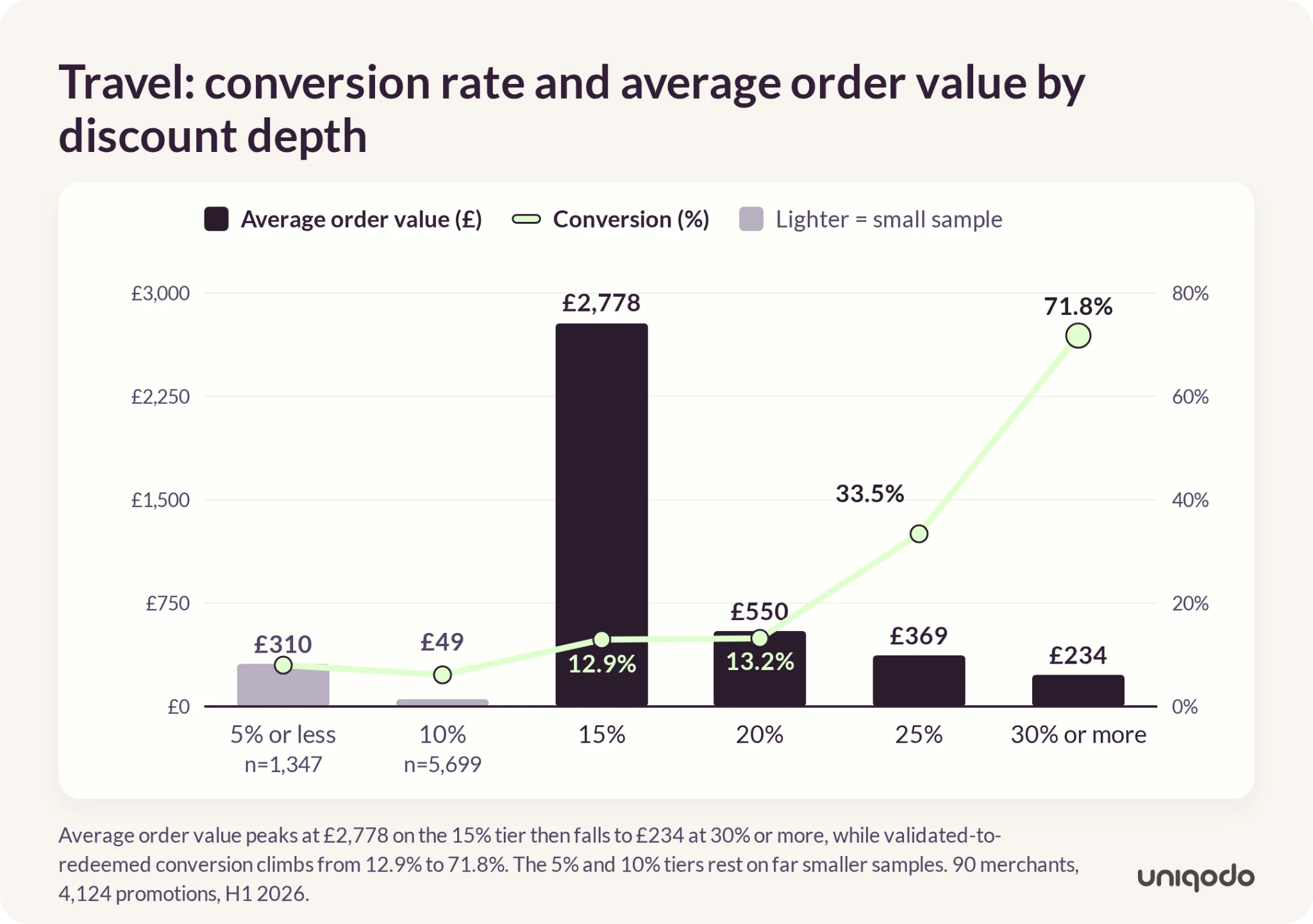
2. Margin control on high-value bookings. Stacking and exclusion rules, redemption caps and budget limits matter more when one booking runs into thousands of pounds. Check how an engine handles coupon stacking across codes, automatic offers and partner deals. It should also be able to exclude fare classes or package components that carry thin margins. In our H1 2026 data, travel order values peak at 15% off (£2,778), while deeper discounts convert more travellers onto much smaller bookings.
3. Partner code security and attribution. Travel brands rely heavily on affiliates, cashback sites and closed groups such as student, staff and emergency-service schemes. A shared code given to one partner can spread to voucher sites, where it discounts bookings that would have happened anyway, often with commission paid on top. Unique single-use codes, validated at booking, can’t be reused once redeemed, which limits coupon code leakage. Because each code goes to one partner, every booking can also be attributed to the partner that sent it.
4. Validity windows that match how people book. The median travel code is redeemed four hours after issue, yet 35.2% of non-batch travel redemptions arrive more than seven days later, the longest tail of any sector in our data. A seven-day expiry would forfeit more than a third of eventual redemptions. Look for per-code expiry, where each code runs on its own clock inside a longer campaign, so urgency doesn’t cost you late bookers. Panellists at Uniqodo’s May 2026 travel event described research windows stretching from days to weeks, as covered in our Travel and Tourism Insights Report 2026.
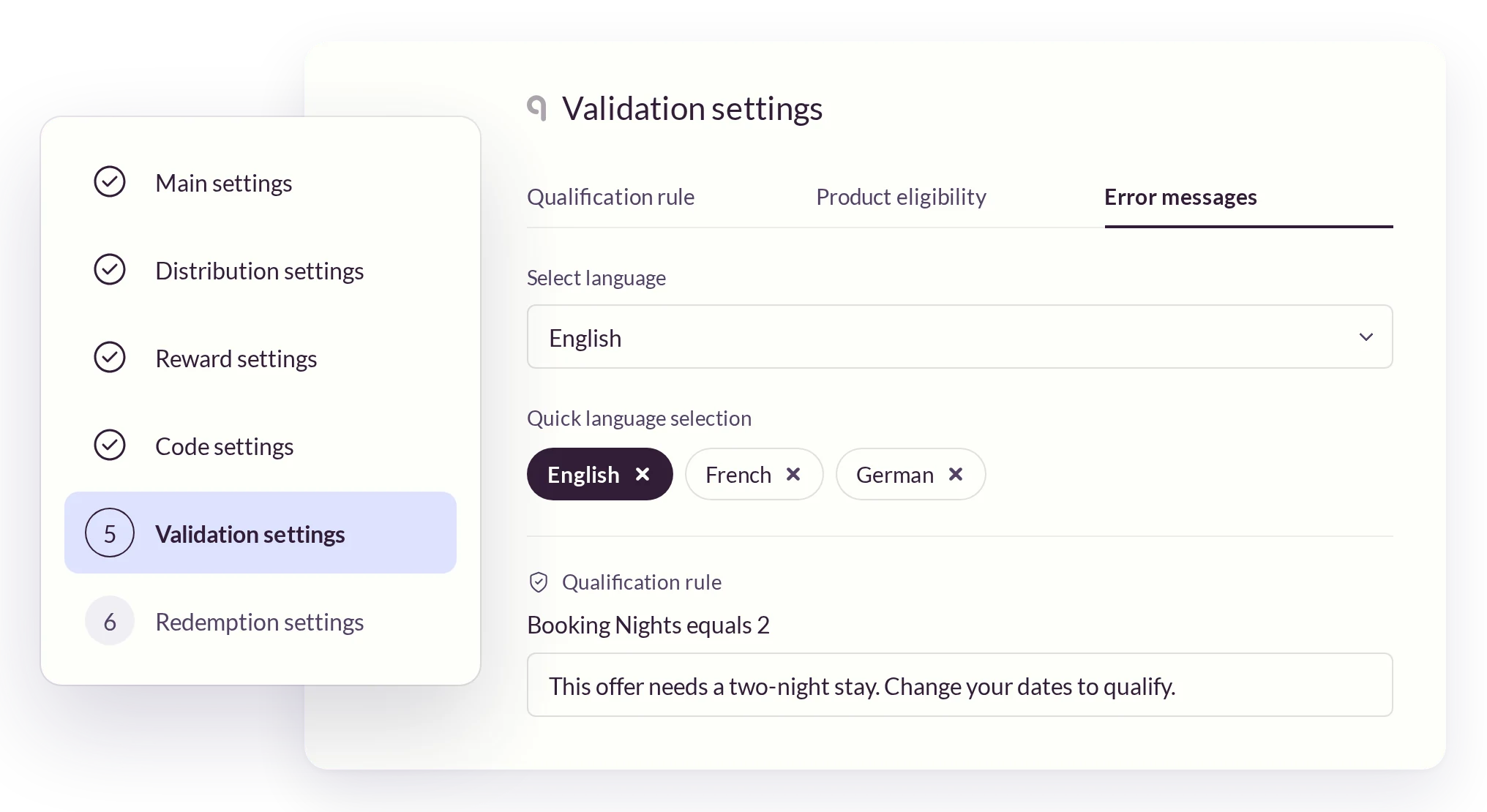
5. What the traveller sees at booking. A failed code at the payment step can lose a booking that was almost won. A generic “invalid code” error leaves the traveller guessing whether the code expired, doesn’t cover their dates or never applied to that room. Engines with custom error messages can name the rule that was missed, for example that the offer needs a two-night stay, so the guest can change the booking and qualify.
6. Marketer control on the existing booking stack. Travel teams often run several offers at once, such as a flash sale on unsold rooms alongside exclusive codes for affiliates. Look for promotion engines where, once integrated, marketing and partnership teams can configure and launch campaigns themselves. That way, time-sensitive offers can go live while the rooms or seats it targets are still for sale and are not susceptible to delays due to requiring developer resources.
Many travel brands also run legacy or custom booking engines, and some run several at once. Check whether a promotion engine needs a platform change or sits above your existing booking engine. Its interface should let your team work in bookings, rooms and flights without translating from retail terms such as orders and shipping.
Which travel promotion engine should you choose?
Most travel brands can narrow this list quickly by matching it to who runs promotions and which booking platform they already use.
If your engineering team wants to own promotion logic inside a custom booking flow, Talon.One and Voucherify put that control in developers’ hands, with Talon.One the closer fit for brands with rich customer data. If loyalty sits at the centre of your strategy, Antavo adds promotions from the loyalty side. Independent hotels already on HotelRunner can start with its built-in Promotion Engine, and tour operators on WordPress can do the same with WP Travel Engine’s trip-based coupons.
Uniqodo suits travel brands whose marketing and partnership teams own promotions, with a large share of bookings coming through affiliates. It adds date-based rules, per-partner attribution and onsite offers during the booking session on top of the booking engine you already run. Its interface can also be set up in your team’s own booking terms. See how it works on the Uniqodo travel industry page, or book a Uniqodo demo to see it on a travel setup.
The breakdowns above should be enough to shortlist two or three platforms to test against your own booking stack, partner mix and team structure. For campaign ideas once an engine is in place, see our coupon strategies for travel brands, promotional ideas for airlines and hotel promotion ideas.
How we chose these travel promotion engines
We assessed each tool against the six criteria above, giving most weight to date-based eligibility, partner code security and margin controls such as stacking rules and redemption caps. We also looked at who runs each tool day to day, whether developers through an API or marketers through an interface, and how it integrates, from features built into a booking platform to layers that sit above an existing stack.
Capability and pricing details come from each vendor’s documentation, product and pricing pages and announcements, checked in October 2026. Travel performance figures come from Uniqodo platform data across 90 merchants and 4,124 promotions in H1 2026. They describe merchant outcomes on the Uniqodo platform and are not industry benchmarks.
FAQs about travel promotion engines
Can a promotion engine work with a legacy booking engine?
Yes, if it sits above the booking engine and connects to it through an API. The booking engine sends booking details to the promotion engine, which validates the code and returns the discount to apply. The integration needs engineering time once. After that, marketing teams can launch and change promotions themselves.
How is a promotion engine different from my booking platform’s discount features?
Built-in discount tools usually handle a percentage off or a shared code. A dedicated promotion engine adds stacking and exclusion rules, unique single-use codes, budget caps, rules on travel dates and real-time validation across connected channels. Capabilities vary by product, but if every new campaign needs an engineering ticket, a dedicated engine is worth assessing.
Is Uniqodo right for travel brands?
Uniqodo suits enterprise travel marketing and partnership teams running promotions across affiliate, cashback, email and onsite channels. It sits above existing booking engines, with a rule builder that uses booking terms. Single-use codes sent through networks such as AWIN and Impact limit leakage, and onsite offers appear during the booking session. Once integrated, marketing teams run it themselves.

Kate Forknell
Head of Product