

A code built for one audience rarely stays with that audience. A win-back offer for lapsed customers surfaces in a browser extension within hours. An affiliate's exclusive code appears on three aggregator sites by the weekend. The discount you priced for a specific segment is now being applied by full-price shoppers who never saw the campaign.
This is promo code abuse: the exploitation of discount codes, sign-up incentives, or referral bonuses beyond their intended terms. Coupon code abuse and discount code fraud describe the same problem in different promotional formats, and the mechanics behind it range from casual code sharing to organised multi-account fraud. Whatever the method, the cost lands in the same two places. Margin goes first, paid out on orders that would have converted anyway. Attribution goes next, because once a code circulates beyond its channel, no redemption report can tell you which partner actually earned the sale.
Most brands only find out after the damage is done, which forces a bad choice: cancel the code and penalise the legitimate customers holding it, or let it run and absorb the loss. Preventing that choice from arising means changing how codes are generated, distributed, and validated, not just watching redemption reports more closely.
Why promo code abuse costs more than the discount
Promo code abuse costs e-commerce brands in three ways: direct margin erosion, broken campaign attribution, and degraded customer experience. The scale of the problem is well documented: 81% of coupon abuse attempts come from serial abusers rather than opportunists, and 42% of businesses admit they knowingly allow promotion abuse rather than invest in preventing it. Abuse is not a marginal cost of running promotions. It is a concentrated, repeatable attack on your discount budget, and it responds to structural controls, not tolerance.
Margin erosion is the most visible cost. When a code intended for a specific segment leaks publicly, you pay the discount on orders that would have happened at full price. Uber's widely reported 2014 code leak cost the company $50,000 on a single incident, and coupon code leakage has only industrialised since then, driven by browser extensions and aggregator sites that scrape and redistribute codes at scale.
Broken attribution is the quieter cost. When one generic code circulates across coupon sites, social media, and affiliate channels simultaneously, you lose the ability to say which partner, influencer or campaign drove which sale. Commission gets paid to channels that did nothing, and the performance data you use for future budget decisions is corrupted. This is a particular problem in affiliate programmes, where accurate partner attribution determines who gets paid.
Customer experience damage follows when brands respond by killing the code entirely. Legitimate recipients arrive at checkout with a dead code, and the customers you most wanted to reward are the ones who feel penalised.
The table below summarises the main abuse types and the control that addresses each one.
How to prevent promo code abuse
Prevention comes down to four structural controls: codes that cannot be shared usefully, distribution that only reaches qualified recipients, validation that enforces the rules at redemption, and terms that limit the damage when something still slips through. Each control addresses a different gap, and prevents abuse before it occurs.
Replace generic codes with unique, single-use codes
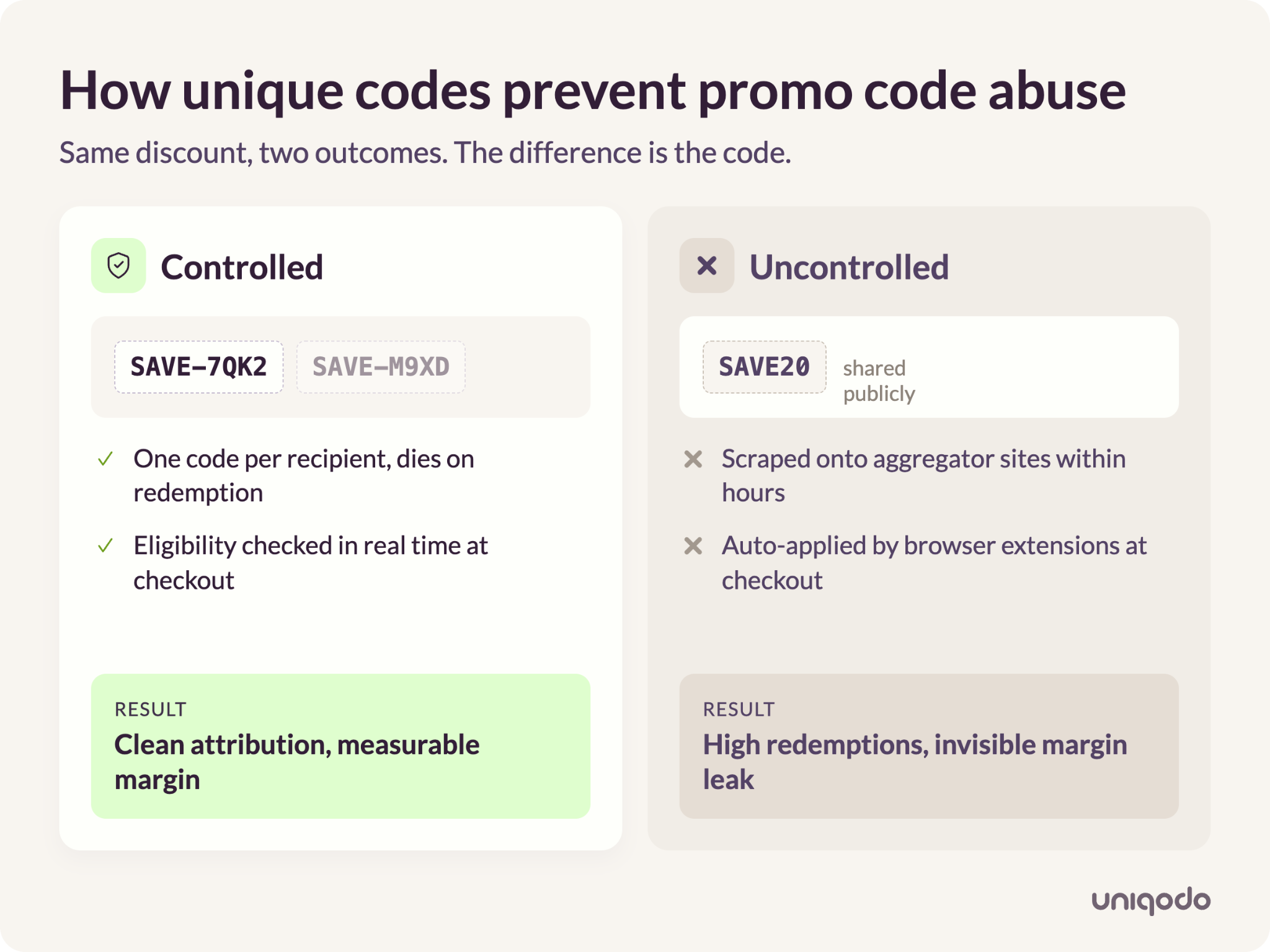
A single-use code is valid for exactly one redemption, so leaking it achieves nothing. This is the single highest-impact change a brand can make, because it removes the economics of code sharing entirely. A code posted to a voucher aggregator is invalid after its first use, and every subsequent attempt fails validation.
Single-use codes also carry a commercial upside beyond security. Because each code is tied to one recipient, you can personalise the offer, track exactly who redeemed it, and attribute every sale to the channel that issued the code. Uniqodo's Promotion Engine generates and validates unique codes at any volume, and once the API integration is in place, marketing and commercial teams self-serve campaign setup without raising tickets for each new promotion.
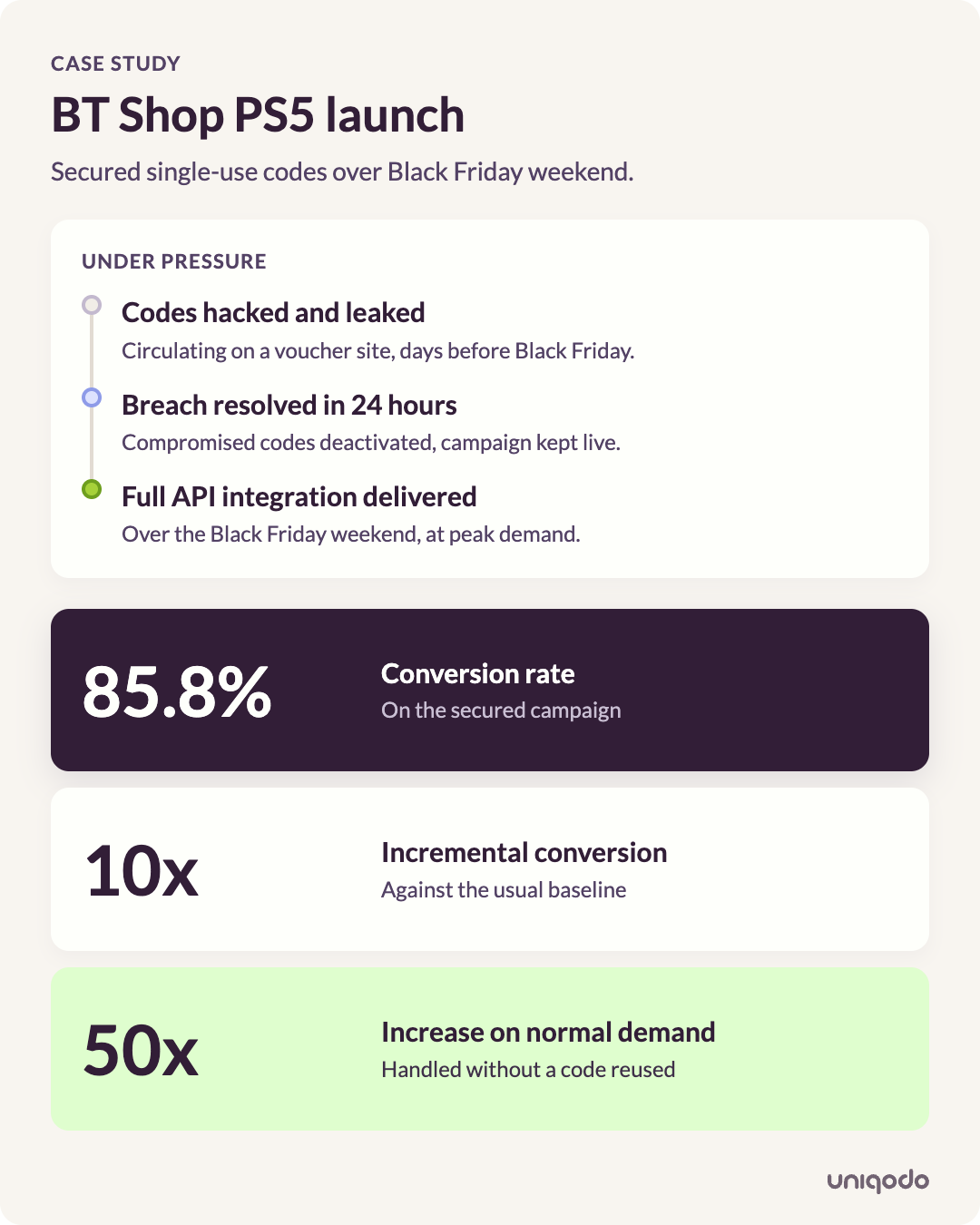
BT Shop's PS5 launch shows what this looks like under pressure. Ahead of the launch, BT Shop discovered its codes had been hacked and were circulating on a voucher site, days before Black Friday and one of the most in-demand product releases in years. Uniqodo resolved the breach within 24 hours and delivered a full API integration over the Black Friday weekend. The secured campaign delivered an 85.8% conversion rate, a 10x incremental conversion rate, and handled a 50x increase on normal demand without a single code being reused. Read the full case study here.
Control distribution so codes reach only their intended audience
Where a code is distributed determines who can abuse it. Codes posted publicly on social media are an open invitation. Codes delivered through closed channels, such as email, SMS, verified partner audiences, or gated early-access lists, only reach people who have already qualified for the offer.
Channel-specific distribution also repairs attribution. When each affiliate, publisher, or partner receives its own pool of unique codes through Code Distribution, every redemption maps back to exactly one source. Commission disputes disappear, and your channel performance data becomes trustworthy again.
Beauty Bay used this approach for a strategic early-access campaign. Rather than publishing a public discount, the brand emailed unique, single-use codes only to customers who had signed up for early access. Every recipient was engaged and had deliberately opted in. The campaign generated 87,000 new customer sign-ups and a 23% revenue uplift in promotion-related sales, with no leaked codes to chase down.
Validate every redemption in real time at checkout
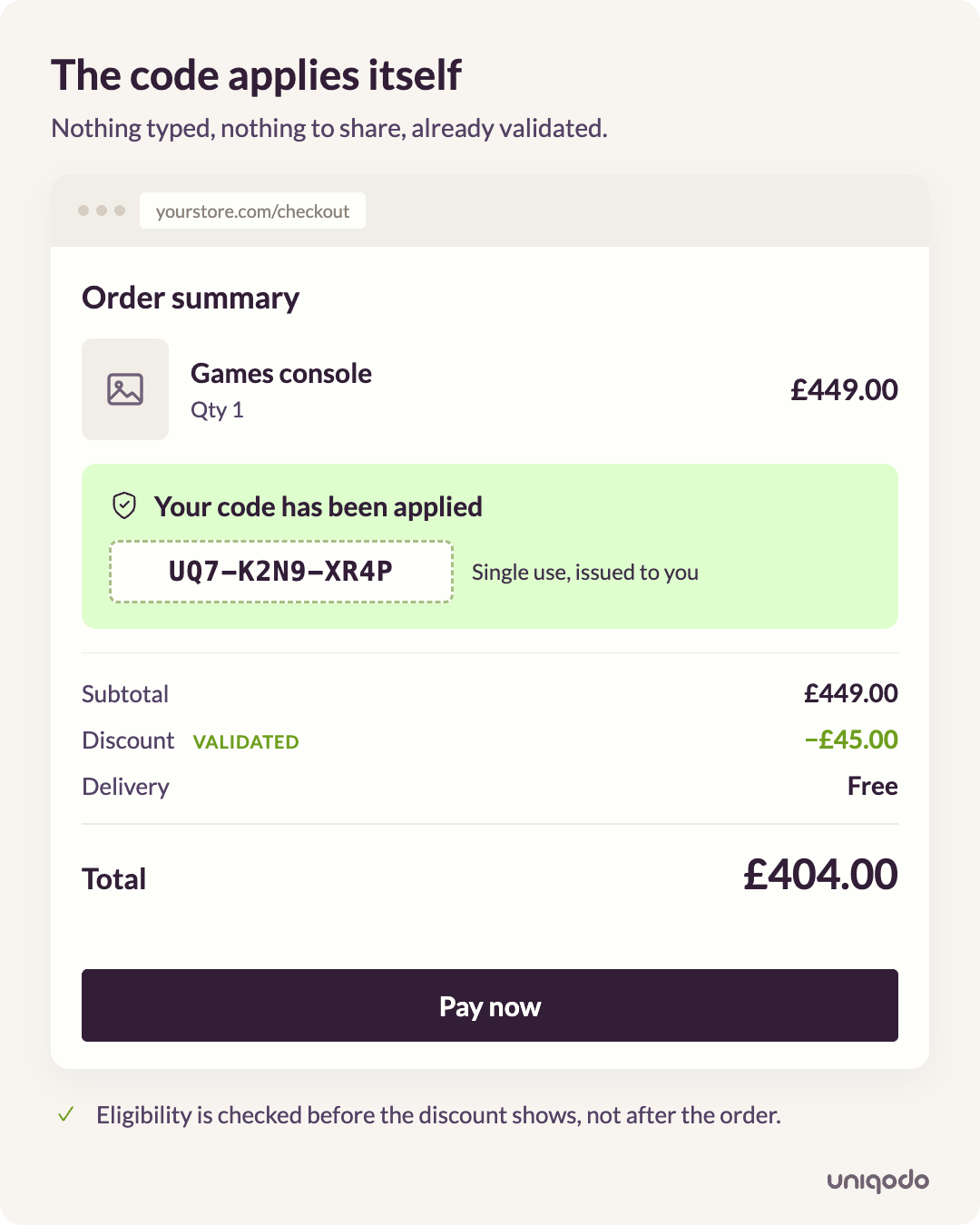
Real-time validation checks each code against your eligibility rules at the moment of redemption, not after the damage is done. Rules can cover usage limits, customer eligibility, product exclusions, minimum spend, expiry windows, and stacking restrictions, all enforced automatically before the discount applies.
This is where multi-account fraud and code stacking get stopped. A rule like "one redemption per verified customer" is meaningless if it is only checked manually after the campaign closes. Encoded into the redemption flow, it blocks the second attempt instantly while letting legitimate customers through without friction. Uniqodo's abuse prevention solution handles this validation layer above your existing e-commerce stack, so the rules apply consistently whatever platform sits underneath.
Samsung's Black Friday campaign demonstrates validation working at enterprise scale. Samsung distributed unique codes that were auto-applied at checkout, removing the manual code-entry step where abuse and error both creep in. The campaign acquired 200,000 new customers, achieved a 56% email open rate and a 4.8% conversion rate, and generated £804,000 in revenue, with every redemption tracked and validated. Read the full case study here.
Design codes and terms that resist abuse from the start
Code design is a cheap, effective first line of defence. Predictable codes like SAVE20 get guessed, scraped, and shared. Randomised alphanumeric codes are harder to circulate memorably and impossible to enumerate, and generating them at scale is a solved problem.
Alongside code design, set terms that limit the blast radius when something does leak:
- Expiry windows: short validity periods (24-72 hours for flash offers) limit how long a leaked code circulates
- Usage caps: a hard limit on total redemptions contains the worst case for any campaign
- Minimum spend thresholds: these deter low-value abuse and lift order values at the same time
- Explicit stacking rules: state clearly which codes combine, and enforce it technically rather than relying on the terms page
Terms only work when they are enforced in the redemption flow. "One per customer" written in small print is a suggestion. "One per customer" checked at validation is a control.
How to identify promo code abuse
You detect promo code abuse by monitoring redemption patterns against expected behaviour. The warning signs are consistent across brands: redemption rates far above forecast, spikes in usage that correlate with a code appearing on aggregator sites, clusters of orders from newly created accounts, and codes redeemed by customers outside the segment they were issued to.
Practical monitoring signals to watch:
- Redemption velocity: a code intended for 500 uses hitting 2,000 redemptions in an hour means it has leaked
- Redemption-to-purchase quality: abuse-heavy cohorts show low repeat-purchase rates at 30, 60, and 90 days, because fake accounts do not come back
- Channel mismatch: codes issued to one affiliate being redeemed via traffic from another source indicates leakage or hijacking
- Account patterns: batches of accounts created minutes apart, all redeeming the same offer immediately after sign-up
With unique codes, monitoring becomes dramatically simpler because every code maps to one recipient and one channel. Anomalies stand out immediately, and you can deactivate a compromised batch without cancelling the whole campaign, protecting the legitimate customers still holding valid codes.
Preventing promo code abuse without punishing good customers
The goal of abuse prevention is making fraud uneconomical, not making promotions unpleasant. Every control described above works invisibly for legitimate customers: their unique code arrives in their inbox, validates instantly at checkout, and can even auto-apply so they never type anything at all. The customer experiences a promotion that simply works. The abuser experiences a code that is worthless outside its intended context.
That balance is the real test of a prevention strategy. BT Shop, Beauty Bay, and Samsung all ran their most aggressive campaigns of the year through unique, validated codes, and in each case the results came in above expectation. Securing a promotion does not mean throttling it. The brands that control their codes are the ones that can afford to run bigger offers, to more valuable segments, with confidence the discount lands where it was priced to land. Abuse prevention is not a separate workstream bolted onto your promotion strategy. It is the foundation that makes an ambitious promotion strategy affordable in the first place.
Promo code abuse FAQs
Is it illegal to abuse promo codes?
It can be. Casual misuse of a leaked code is usually a breach of the retailer's terms rather than a crime, but creating fake accounts, counterfeiting coupons, or systematically defrauding promotions can cross into illegal territory depending on jurisdiction. Retailers can cancel orders, suspend accounts, and pursue action against systematic offenders.
Is it illegal to make new accounts for discounts?
Creating multiple accounts to repeatedly claim new-customer discounts violates almost every retailer's terms of service, and retailers can cancel orders and ban accounts in response. Whether it constitutes fraud in a legal sense depends on scale, intent, and jurisdiction, but systematic multi-accounting using false identity information carries genuine legal risk.
What are examples of promo code abuse?
Common examples include sharing exclusive codes on voucher aggregator sites, creating multiple accounts to reclaim first-order discounts, self-referring through fake accounts to collect referral bonuses, stacking codes that were not designed to combine, and resellers bulk-buying discounted stock to resell at retail price on marketplaces.

Kate Forknell
Head of Product