
To protect margin on Black Friday, set your limits before your discounts: a discount ceiling per category, a minimum margin per order and a capped budget. Then build offers, code controls and stacking rules that enforce them at checkout, so codes only redeem where intended and no order stacks below cost.
Most Black Friday promotion advice tells you how to sell more. Very little of it tells you how to do that without giving margin away. Planning BFCM from the commercial side means structuring offers that protect profitability, stopping promo code leakage when traffic peaks and sequencing the work from October to Cyber Monday. It takes the approach from our guide to ecommerce promotion strategies and applies it to the highest-stakes trading window of the year.
What does it take to protect margin on Black Friday?
Protecting margin on Black Friday means making every discount deliberate: the right offer, for the right customer, redeemed once, under conditions you set in advance. BFCM brings the volume either way. Whether that volume makes money depends on how tightly you control each discount.
A blanket 20% off is easy to launch and easy to communicate, but it gives your deepest discount to shoppers who would have paid full price. A generic code shared with one affiliate can end up on a coupon aggregator within hours, redeeming against orders it was never meant to touch.
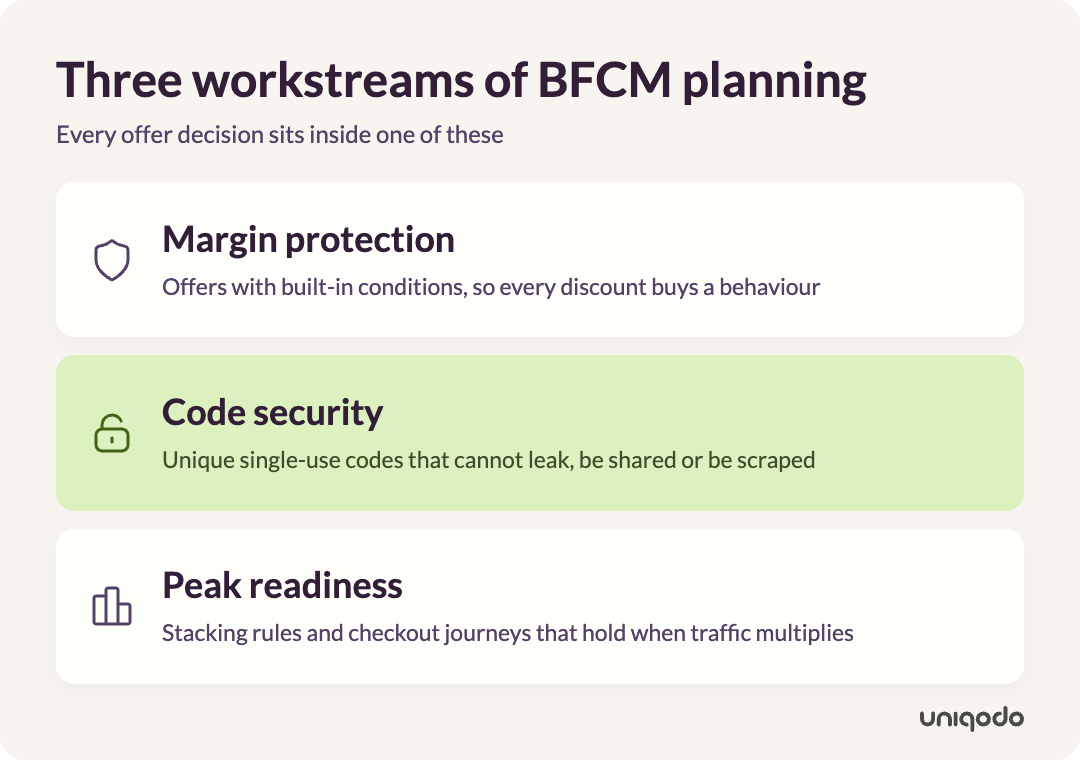
Protecting margin at BFCM comes down to three workstreams:
- Margin protection: offer structures with built-in conditions, so every discount has to buy something: a bigger basket, a new customer or a repeat purchase.
- Code security: unique, single-use codes, so a code that leaks can only be redeemed once.
- Peak readiness: checkout logic, stacking rules and onsite experiences that hold up when traffic multiplies.
Set Black Friday margin guardrails before you set discounts
Margin guardrails are the commercial limits you fix before you design any BFCM offer: a maximum discount depth per category, a minimum contribution margin per order and a total promotional budget for the period. Setting them first, before any creative work starts, forces every offer to justify itself against a number.
- Define your discount ceiling by category. High-margin lines can carry deeper offers. Low-margin lines need conditional structures or should stay out of the sale entirely.
- Set a promotional budget with a hard cap. Budgeted code pools with fixed redemption limits mean a viral moment cannot turn into an uncapped giveaway.
- Decide who gets what. VIP customers, email subscribers, new customers and affiliate audiences should not all receive the same offer at the same depth. Segmenting offers is one of the strongest levers you have for protecting blended margin at peak.
Guardrails only hold at peak if your promotion stack enforces them automatically. Uniqodo's Promotion Engine applies redemption limits and eligibility conditions at validation, so the rules you set in October still hold at 9pm on Black Friday.
Which Black Friday offers protect margin?
Conditional offers protect margin on Black Friday because the customer has to do something valuable to earn the discount, while a blanket percentage off asks for nothing in return. The offer structure you choose matters more than the headline discount depth.
- Tiered discounts reward bigger baskets: 10% off over £75, 15% off over £150. The discount deepens only as order value rises, so average order value climbs alongside redemption.
- BOGO and multi-buy offers move units without cutting the perceived value of any single product.
- Gift with purchase adds perceived value at the cost of the gift's unit price, not a percentage of revenue. For premium brands protecting price integrity through BFCM, a gift with purchase promotion often beats a discount outright.
- Threshold-based free shipping on qualifying baskets nudges order value up while costing far less than an equivalent percentage discount.
The test for every BFCM offer: what behaviour is this discount buying? If the answer is “a sale that would have happened anyway”, redesign it. Our 15 Black Friday promotion ideas cover each mechanic in more detail, with examples.
Why do promo codes leak at BFCM, and how do you stop it?
Promo codes leak because generic codes are infinitely shareable. One code sent to one partner, influencer or email segment can end up on coupon aggregators and browser extensions, where it redeems against traffic you never intended to discount. At BFCM, when redemption volume is at its annual peak, the cost of that leakage compounds daily.
Unique, single-use codes stop a leak becoming an open-ended cost, because each code redeems once in the context it was issued for. A code that reaches an aggregator is worth one order at most.
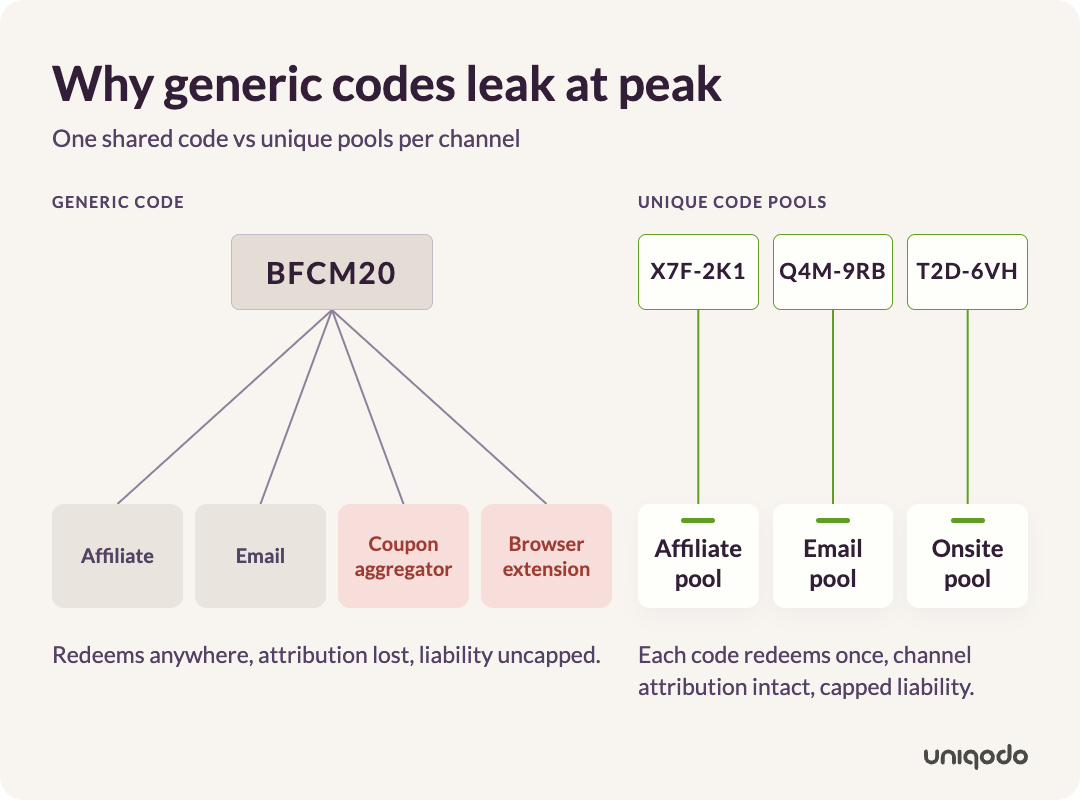
Unique codes also give you three things a generic code can’t:
- Attribution you can trust. When each affiliate, publisher, or email send carries its own code pool, you know precisely which channel drove which redemption. This is why unique single-use codes are the future of affiliate tracking, particularly in a privacy-first measurement environment.
- Budget certainty. A pool of 50,000 single-use codes is a known maximum cost to the business that can be calculated in advance. A generic code on a deal site has unknown potential to maximize business costs.
- Channel exclusivity that holds. An "exclusive" partner offer stays exclusive, which protects both the partner relationship and your commission economics.
BT used single-use codes to keep each affiliate partner's offer exclusive, and its first exclusive Groupon deal led to 2,500 sales. Read the BT story
Uniqodo was founded in 2014 to solve this problem in the affiliate space, and code security at peak is still central to the platform.
Control coupon stacking and abuse at BFCM checkout
Coupon stacking at BFCM turns several acceptable discounts into one unacceptable order. A 20% Black Friday code combined with a 15% welcome code and a free shipping offer can push an order below cost, and shoppers actively hunt for these combinations during peak.
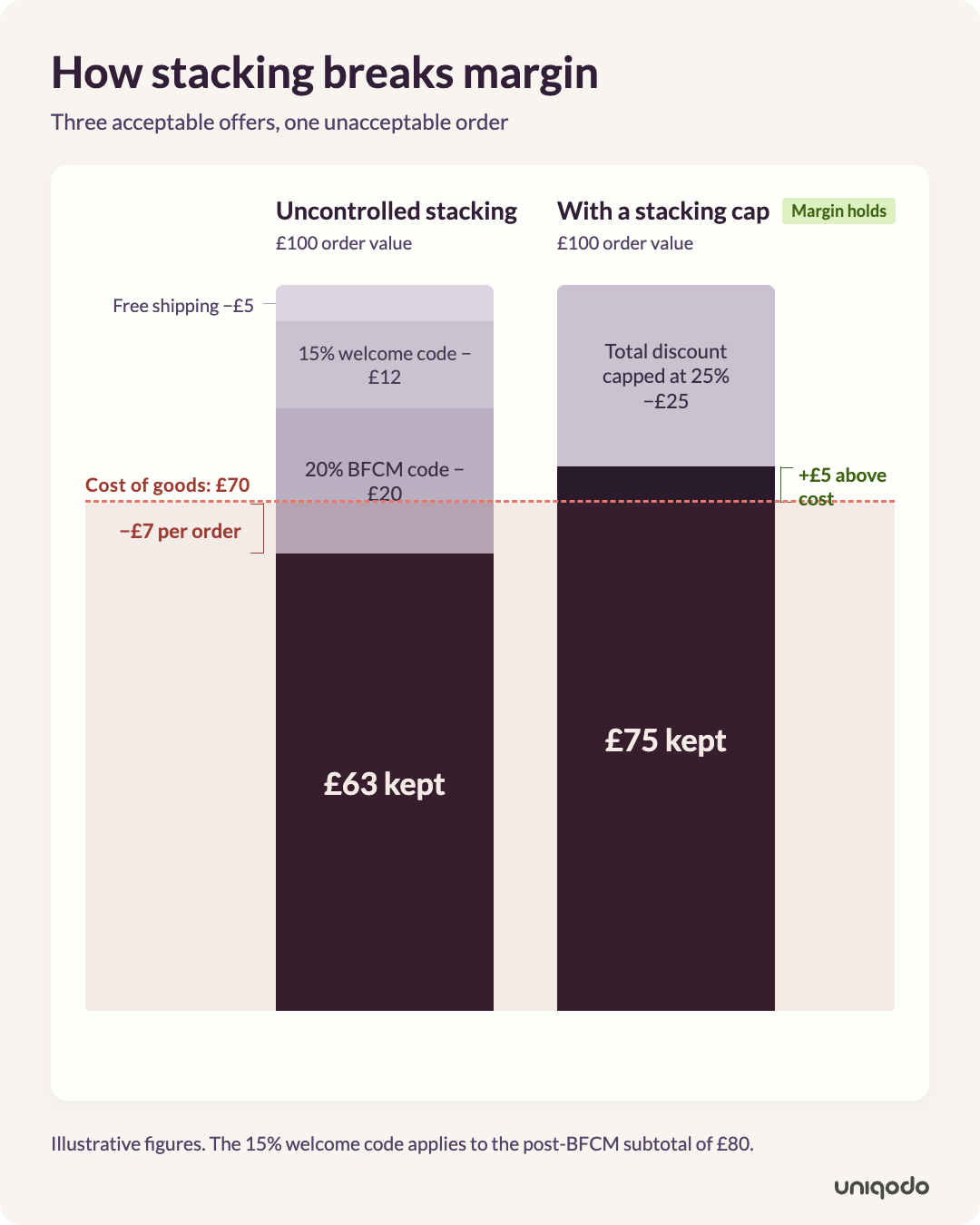
Deliberate stacking can be a useful tool, so a blanket ban isn't the answer. Our glossary entry on what coupon stacking is and how to control it covers when combining offers works. At BFCM, the fix is explicit rules, enforced at validation:
- Define which promotion types can combine and which are mutually exclusive.
- Cap the total discount any single order can receive, regardless of how codes combine.
- Block known abuse patterns, such as repeated new-customer code redemptions from the same account or payment method.
Beyond stacking, peak trading attracts organised promotion abuse: bulk account creation to farm welcome offers, referral self-dealing and code-testing bots. Uniqodo's promotion abuse prevention controls validate every redemption against eligibility rules in real time, stopping abuse before the discount applies, so there is nothing to claw back afterwards.
Plan BFCM code distribution across channels early
Code distribution is where BFCM promotion plans most often fall apart operationally. The offers are agreed and the codes exist, but getting the right pool to the right affiliate network, email platform and paid social audience on time, with clean attribution, is a logistics job in its own right.
Plan distribution in the same document as the offers themselves:
- Map every channel to a code pool. Affiliates, email segments, SMS, paid social and onsite each get distinct pools, so performance reporting stays clean.
- Sequence early access deliberately. Open early access to email subscribers and VIP customers before the public sale, with codes unique to each segment, so the “exclusive” window stays exclusive.
- Automate delivery. Manually exporting CSVs of codes to partners in mid-November is where errors happen. Uniqodo's Code Distribution pushes unique codes to each channel programmatically.
Samsung opened its Black Friday Early Bird offers only to an intended segment of new leads and engaged CRM customers, and gained 200K new customers. Read the Samsung story
Prepare your checkout and onsite experience for Black Friday
Your checkout and onsite experience convert the demand your Black Friday marketing generates, and they are also where the last margin decisions happen. Two priorities stand out.
- Remove code friction. A peak shopper whose code fails at checkout has a reason to leave, and shoppers who leave to hunt for a code often do not come back. Auto-applying valid codes and confirming the discount clearly in the basket keep the shopper at checkout. This is central to any plan to reduce basket abandonment during BFCM.
- Target exit intent with controlled offers. An exit-intent offer built on a unique single-use code recovers the abandoning shopper without creating a new leakage channel. A generic code shown in an exit overlay can be public within days.
Your BFCM 2026 planning timeline
BFCM 2026 runs from Friday 27 to Monday 30 November. Working backwards from Cyber Monday, this is a realistic sequence for commercial and marketing teams:
Don't skip the final row. BFCM acquires customers at your thinnest margin of the year, and a targeted second-purchase code in December, unique to each new customer, is how that acquisition cost turns into lifetime value.
Measure what BFCM actually made you
A BFCM promotion succeeded if it generated margin that would not have existed without it. Revenue alone cannot tell you that. A record-breaking Black Friday can still destroy value if the discounts funded sales that were coming anyway, so plan the measurement before the sale starts.
Three layers separate real performance from a flattering topline:
- Margin contribution per promotion, not blended revenue. Every offer carries a different discount depth, redemption volume and product mix. A tiered offer that lifted order values and a blanket code that leaked to aggregators can produce identical revenue lines while sitting at opposite ends of profitability. Report at the offer level or the numbers hide the story.
- Redemption-level attribution. This is where unique codes repay the setup work. When every affiliate, email segment and onsite placement carries its own set of unique codes, each redemption tells you exactly which channel earned it, with no modelling and no shared-code ambiguity. Channel decisions for next year come from this data, not from last-click guesswork.
- Incrementality. The hardest question is whether the sale would have happened anyway. Holding back a control group, a segment that sees no offer or a lower depth, turns that from a philosophical debate into a measurable difference. If the discounted group spends no more than the control, the promotion bought nothing and its budget belongs elsewhere next year.
Teams that can show Finance the incremental margin of each BFCM mechanic have a much stronger case for next year's promotional budget. Our guide to measuring promotional effectiveness covers the metrics and methods in more depth.
How Uniqodo protects margin at BFCM
Uniqodo is an intelligent promotion layer that sits above your existing ecommerce stack and enforces the guardrails in this plan at the point of redemption. The Promotion Engine applies discount ceilings, eligibility rules and stacking caps at validation, so a code that breaks your rules never applies.
Unique, single-use codes cap what any leaked code can cost, and Code Distribution delivers separate code pools to each affiliate, publisher and email segment, so every redemption is attributed to its channel. Onsite Experiences serve controlled offers to shoppers showing exit intent, using the same unique codes.
Setup needs an integration with your ecommerce platform. Once that's in place, commercial teams build and change BFCM promotions themselves, without waiting on development cycles. If you're planning BFCM 2026 now, book a demo to see how it would work with your stack.
FAQs: protecting margin on Black Friday
How do retailers protect margin on Black Friday?
Retailers protect margin on Black Friday by setting limits before discounts: a discount ceiling per category, a minimum margin per order and a capped promotional budget. They then rely on conditional offers such as tiers and gift with purchase, use unique single-use codes to stop leakage and cap stacking at checkout so no order falls below cost.
How is a Black Friday promotion strategy different from a year-round one?
A Black Friday promotion strategy applies the same principles as a year-round ecommerce promotion strategy, such as conditional offers, unique codes and incrementality testing, under more pressure. Traffic, code sharing and stacking attempts all peak at the same time, so limits that work in a normal week need to be set earlier and enforced automatically.
When is BFCM 2026, and when should planning start?
BFCM 2026 runs from Friday 27 November (Black Friday) to Monday 30 November (Cyber Monday). Commercial planning should start in early October, followed by offer design in mid-October, code generation in late October, distribution setup in early November and peak readiness testing in mid-November.

Kate Forknell
Head of Product