

Referral marketing wins new customers by rewarding existing ones for recommending a brand to friends and family. For ecommerce brands it works best when every friend gets their own single-use code, the referrer is rewarded only after an eligible purchase and each sale is traced to the person who referred it.
Often the topic of referral marketing is approached as a question of incentives: how much to give, and to whom. For ecommerce brands the harder questions sit underneath. Every referral reward is a promotion code, so it carries the same risks as any other promotion. It can leak to voucher sites, stack with a sitewide sale or end up with an existing customer who was never referred.
This guide is for CRM, ecommerce and acquisition teams at retail, travel and telco brands deciding whether to run a referral programme or fix the one they have. It covers how referral marketing works, the ways a referral can reach your checkout, how to choose and protect rewards and how to measure what a programme returns.
What is referral marketing?
Referral marketing is a way of winning customers in which a brand rewards existing customers for introducing new ones, usually with an incentive for the new customer too. It works because a recommendation from someone you know carries more weight than an advert, and the brand pays out only once the friend becomes a customer.
The terms overlap. A referral programme is the scheme a brand runs to do referral marketing, and refer-a-friend is the most common name shoppers see for it. Some European markets call the same thing member-get-member (MGM).
Word of mouth happens without any help from the brand. Referral marketing adds the structure around it: a reason for customers to recommend you, a way for them to share and a record of who brought in whom. That record is what lets you reward the right person and work out what the programme is worth.
How does referral marketing work?
Referral marketing runs as a loop of five steps, and a promotion code changes hands at three of them.
- The brand invites a customer to join, usually at a point when they're happy with the brand, such as straight after an order.
- The customer becomes a referrer and gets a personal referral link or code to pass on by message, email or social.
- The friend follows the link and claims an incentive, usually a discount on their first order.
- The friend places an order, and the checkout checks the incentive before applying it.
- The referrer receives a reward, if they qualify.
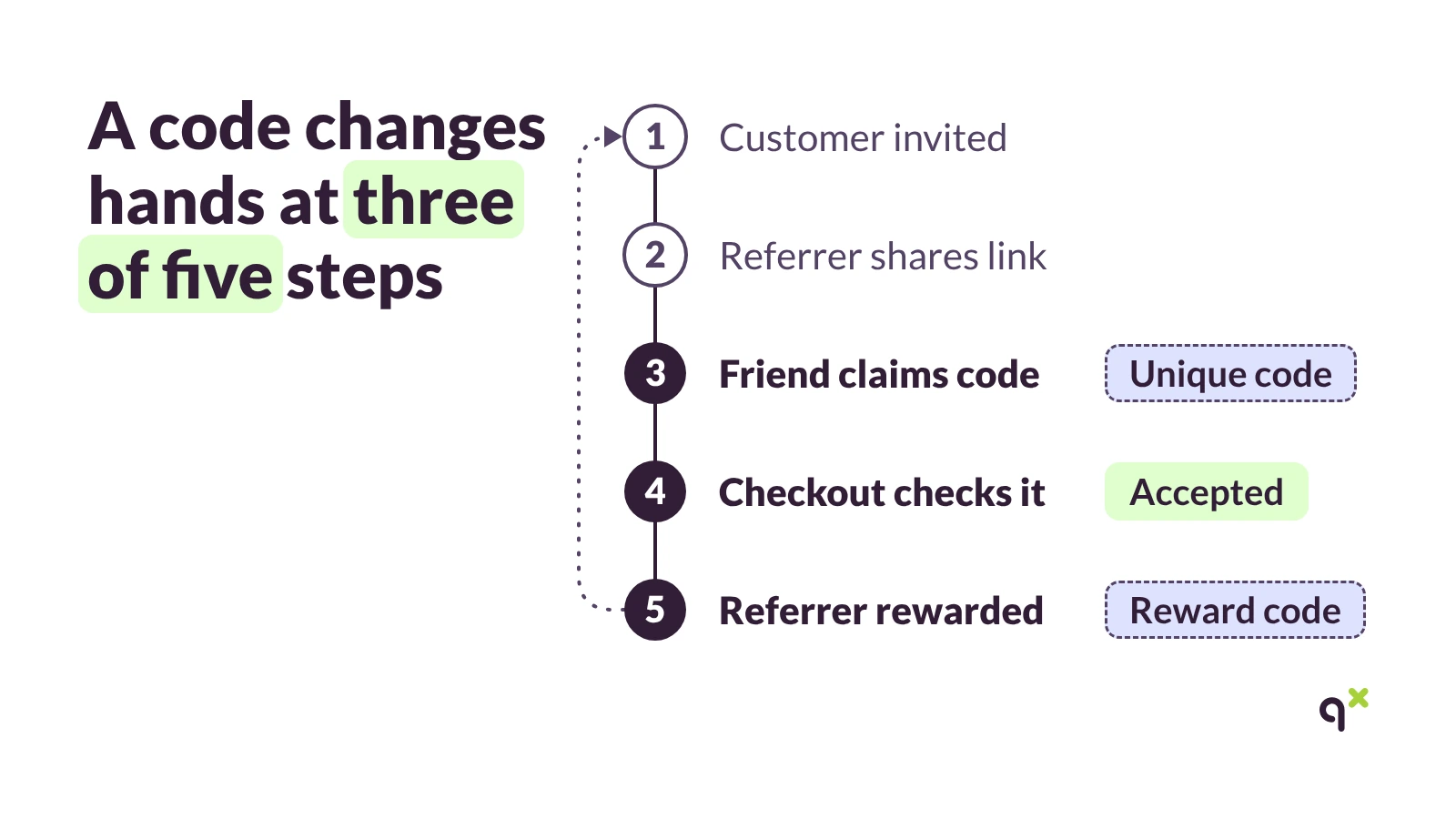
The friend needs a code that works at checkout in step 3, the checkout has to validate it in step 4 and the referrer needs a reward code in step 5. Some referral tools create those codes themselves. Others hand out batches of codes that your team creates in the ecommerce platform and uploads, and those batches need topping up while the programme runs.
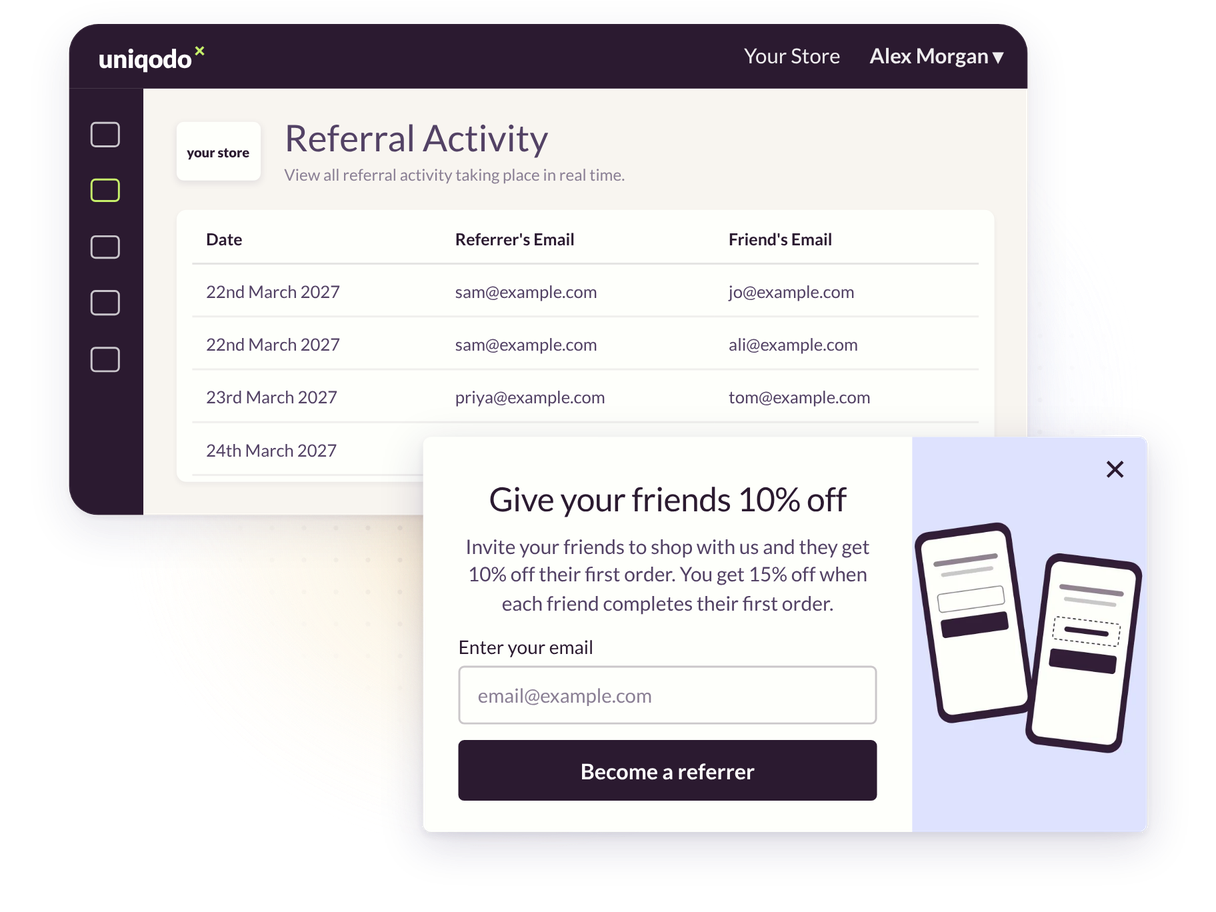
On Uniqodo, an overlay from Onsite Experiences invites customers to join after they order, and each referrer's link takes friends to a branded page that Uniqodo hosts. The friend enters their email address and claims their own unique referral code, and the referrer's reward code arrives by email once the friend's order completes. Uniqodo creates and checks every code itself, so there are no batches to upload.
What are the main types of referral marketing?
The most useful way to tell types of referral marketing apart is by how the referral reaches your checkout. That decides how far an incentive can spread beyond the friends it was meant for, and how reliably each order can be credited to the right referrer.
Many programmes combine two of these, such as a link for sharing online and a name option for recommendations made in conversation. Programmes also differ in who gets rewarded: one-sided programmes reward only the referrer, while two-sided programmes reward the friend as well.
Referral marketing is often confused with affiliate marketing, where publishers and creators earn commission on the sales they drive. The difference matters for cost and control, and affiliate marketing vs referral marketing sets out when each one fits.
How do you choose referral marketing rewards?
A referral reward is a promotion, so choosing one is a promotion decision as much as a marketing one. Each reward has a value, an eligibility rule, an expiry date and a cost to margin, and the friend's incentive will meet your other promotions at the same checkout. On Uniqodo, the friend's incentive and the referrer's reward are set up as two separate promotions, each with its own rules.
Should both the referrer and the friend get a reward?
In most cases, yes. An incentive for the friend gives them a reason to act, and it means the referrer is passing on a gift rather than selling to people they know, which makes sharing feel more natural. One-sided programmes can work in sectors where trust is already high, but a two-sided reward is the safer place to start.
Is a discount, cash or a gift card the best referral reward?
For most ecommerce brands, a discount or store credit is the better starting point, because both bring the customer back to spend with you. Store credit also costs less than its face value, since the customer spends it on your products. Cash and gift cards cost their full value and suit brands whose customers rarely buy twice.
When should a referrer receive their reward?
After the friend's order qualifies, not when the friend signs up. A reward on sign-up pays out for friends who never buy and gives people a reason to create fake accounts. If your return rate is high, ask how a platform handles an order that comes back after the referrer's reward has gone out.
Should you boost referral rewards during peak trading?
If you raise rewards for Black Friday or a product launch, run the boost as its own time-limited promotion. Decide in advance whether the friend's incentive can combine with your sitewide discounts, because a referral discount stacked on a sale can take an order below margin.
How to set up a referral marketing programme
A referral marketing programme is ready to launch once five decisions are made. Our guide to building a customer referral programme goes through each step in detail.
- Decide what a new customer is worth to you, and so the most you'll spend on rewards to win one.
- Choose the reward for each side, and how the friend's incentive interacts with your other promotions.
- Choose when to ask. The order confirmation page catches customers straight after a purchase, and a post-delivery email catches them once the product has arrived.
- Choose how people share. A copied link can go anywhere a customer talks to friends. If you also offer email or text sharing, check it against the UK rules below first.
- Connect the programme to your checkout, so every friend's order is checked and credited to the right referrer.
The fourth decision is the one with a legal side for UK brands. The Information Commissioner's Office says a brand that encourages or incentivises customers to email or text its marketing to friends is responsible for those messages, and that refer-a-friend schemes can't rely on the soft opt-in. Sharing by link to a friend page, where friends enter their own details, avoids asking customers to hand over anyone else's. Check your set-up with your legal team before you offer email or text sharing.
The last decision is the one that involves your developers. Some platforms connect through a JavaScript integration on your site, while teams that want to own every screen can build on a referral API instead. Uniqodo offers both: the JavaScript route needs no Promotion Engine, and Uniqodo's team builds the branded friend page from your logo, imagery and copy.
How to stop referral fraud and code leakage
Referral fraud is any way a programme pays out for a customer it didn't win: a friend code posted on a voucher site, a customer who refers their own second email address or an existing customer who claims an offer meant for new ones. Because a referral incentive is a promotion code, it can travel the same way any other code does, onto voucher sites, into browser extensions that test codes at checkout and into forums where people swap referral codes. The wider problem of promo code abuse applies to referral codes too.
A personal link can be posted publicly too, so limits per referrer still matter when every friend gets a unique code. A stranger who finds the link has to claim a code of their own, which counts against that referrer's limits, instead of reusing one code indefinitely.
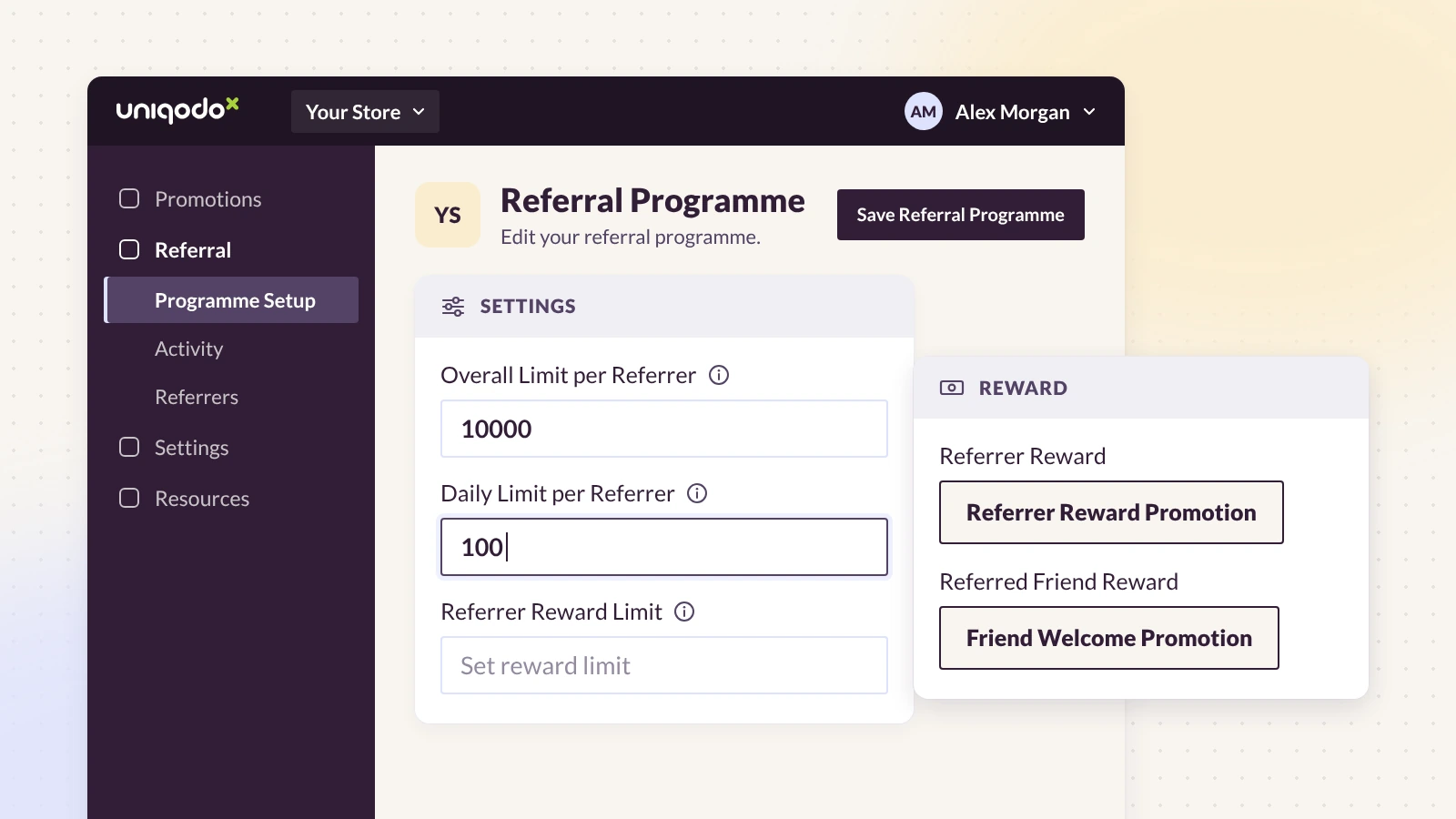
Ask every vendor which of these controls are live today. On Uniqodo, every friend and every referrer gets a unique, single-use code, reward codes can be set to expire and each programme has overall and daily referral limits per referrer and a cap on referrer rewards.
How do you measure referral marketing ROI?
Referral marketing ROI compares the value referred customers bring in with the full cost of running the programme. Value should look beyond the first order to repeat purchases and how long referred customers stay. Cost should include the rewards actually redeemed, platform fees, the cost of promoting the programme and any losses to fraud.
ROI only shows up once orders do, so track the steps before it to see where a programme stalls:
- Participation: the share of invited customers who join as referrers
- Share rate: the share of referrers who actually pass their link on
- Friend conversion rate: the share of friends who claim an incentive and go on to order
- Cost per acquired customer: total programme cost divided by the new customers it won
Cost per acquired customer is the figure to set against your paid channels, and referral rate is a useful headline for the programme's health over time.
The hardest question is whether a referred friend would have bought anyway. A friend may already be on your email list or in an ad audience, so the starting point is matching every order to the referrer behind it, even when the friend has also seen other marketing. Uniqodo does that matching and shows a live log of referral activity and a list of referrers with their referral counts.
Referral marketing in practice: keeping the friend's offer for new customers
The friend's incentive is a new-customer offer, and in practice the test of a referral programme is whether it stays one. A friend code that anyone can reuse turns into a public discount as soon as it reaches a voucher site, and from then on the programme is paying a referral incentive to shoppers nobody referred.
In a protected programme, each friend claims a code issued to them alone, the checkout validates it against the promotion's rules before the discount applies and the code stops working once it has been redeemed. The referrer's reward is a separate code with its own expiry date, issued only once the friend's order completes.
The same approach keeps any new-customer offer for the customers it was meant for, whether the code is delivered through a referral link or a welcome email.
Zero discount abuse
Avis Budget Group put a unique, single-use code in each new subscriber's welcome email to keep its sign-up discount for genuine new subscribers, and saw zero abuse of the discount offers. How Avis kept its sign-up offer to new subscribers
What are the benefits of referral marketing for ecommerce brands?
The main benefit of referral marketing is that new customers arrive already trusting you, because someone they know has vouched for the brand.
- You pay on results. When rewards go out only after a friend's order qualifies, the programme costs nothing for referrals that don't convert.
- The reward goes to your own customers. Affiliate costs usually include network fees and publisher commission, while a referral reward goes to a customer and, as store credit or a discount, brings them back to buy.
- You build your own customer data. A friend who claims a code on your page gives you their email address on your terms, with no third party in between.
- It runs on promotions you already use. The friend's incentive and the referrer's reward are promotion codes, so the same rules, budgets and checks you apply to other promotions apply here.
Referral marketing grows only as fast as your customers recommend you, so it works alongside paid acquisition rather than replacing it. Its value is in adding customers whose cost and quality you can see order by order.
Common referral marketing challenges and how to solve them
The disadvantages of referral marketing are mostly operational, and each has a fix that can be built in before launch.
Few customers join the programme
Low take-up usually comes from asking at the wrong moment or offering a friend incentive nobody wants to pass on. Ask while the purchase is fresh, on the order confirmation page or after delivery, and make the friend's incentive worth more than the discounts already on your site.
Rewards leak or get gamed
Shared codes end up on voucher sites, and generous programmes attract people referring themselves. Give each friend a unique, single-use code, set daily and overall limits per referrer and issue the referrer's reward only once the friend's order qualifies.
Other channels claim the same sale
A referred friend may also click an affiliate link or a paid ad before buying, and two channels then claim, and sometimes pay for, one order. Agree before launch which channel gets the credit for referred orders, and match every order to its referrer so the data backs that decision.
Referral runs in a separate tool from your promotions
When referral codes sit outside your promotion rules, a friend discount can stack with a sitewide sale without anyone deciding it should. Running referral rewards as promotions in the same system as your other offers means combination rules, budgets and expiry dates are set once.
What to look for in referral marketing software
The right referral marketing software depends on who builds the programme and what else the platform needs to do.
- How does it launch? A JavaScript tag, an API build and a managed set-up ask very different things of your IT team, and decide who can change the programme afterwards.
- Where do the codes come from? Check whether the platform creates and validates unique codes itself, or relies on batches your team generates in the ecommerce platform.
- Which fraud controls are live today? Ask about single-use codes, limits per referrer, reward timing and self-referral checks, and which are still on the roadmap.
- What does it report? Order-level credit to the referrer is the minimum. Programme-level cost and return let you compare referral with paid channels.
- Which rewards can it offer? Some tools can only offer what your ecommerce platform's own promotions support.
- What else does it run? Referral on the same platform as your promotions, overlays and code distribution means one set of rules and one less vendor.
Uniqodo's referral marketing software is built for brands that want the referral flow and the codes behind it from one vendor. It launches on a JavaScript integration with no Promotion Engine required, and the same integration connects Onsite Experiences and Code Distribution when you want them. For a side-by-side view of eight platforms, including referral specialists and promotion engines, read our guide to the best referral program software for ecommerce.
Referral marketing FAQs
What is referral marketing in simple terms?
Referral marketing means rewarding your customers for bringing in new ones. A customer shares a link or code with a friend, the friend gets an incentive on their first order and the customer gets a reward once that order qualifies. It turns recommendations that would happen anyway into a channel you can track and pay for on results.
What is member-get-member (MGM)?
Member-get-member (MGM) is another name for refer-a-friend, used more often in some European markets and by banks and membership organisations. The mechanics are the same: an existing member invites someone they know, the new member gets an incentive to join or buy and the existing member earns a reward once the new member qualifies.
What are the disadvantages of referral marketing?
Referral marketing grows only as fast as your customers recommend you, so it can't be scaled up on demand the way paid channels can. Shared codes can leak to voucher sites, rewards can be gamed through self-referrals and referred orders can overlap with affiliate or paid sales. Unique codes, limits per referrer and agreed attribution rules address most of these.
How does Uniqodo help with referral marketing?
Uniqodo runs the whole referral programme on a JavaScript integration: an overlay that invites customers, a branded friend page, a unique single-use code for every friend and a reward code for the referrer once the friend's order completes. Limits per referrer and code expiry keep rewards for genuine referrals, and the Promotion Engine is optional.

Kate Forknell
Head of Product