

Uniqodo, Talon.One, Voucherify and Qixol all handle the basics of promotion management, but they are built differently, priced differently and designed for different types of team. This comparison breaks down what each platform does well, where it falls short and which buyers it suits best.
Uniqodo: a marketer-first promotion engine with secure code distribution and onsite experiences
Full disclosure: Uniqodo is our own product. We obviously highly rate its capabilities and think it deserves top billing on this list. But we also understand that it’s important to explain the full spectrum of choices.
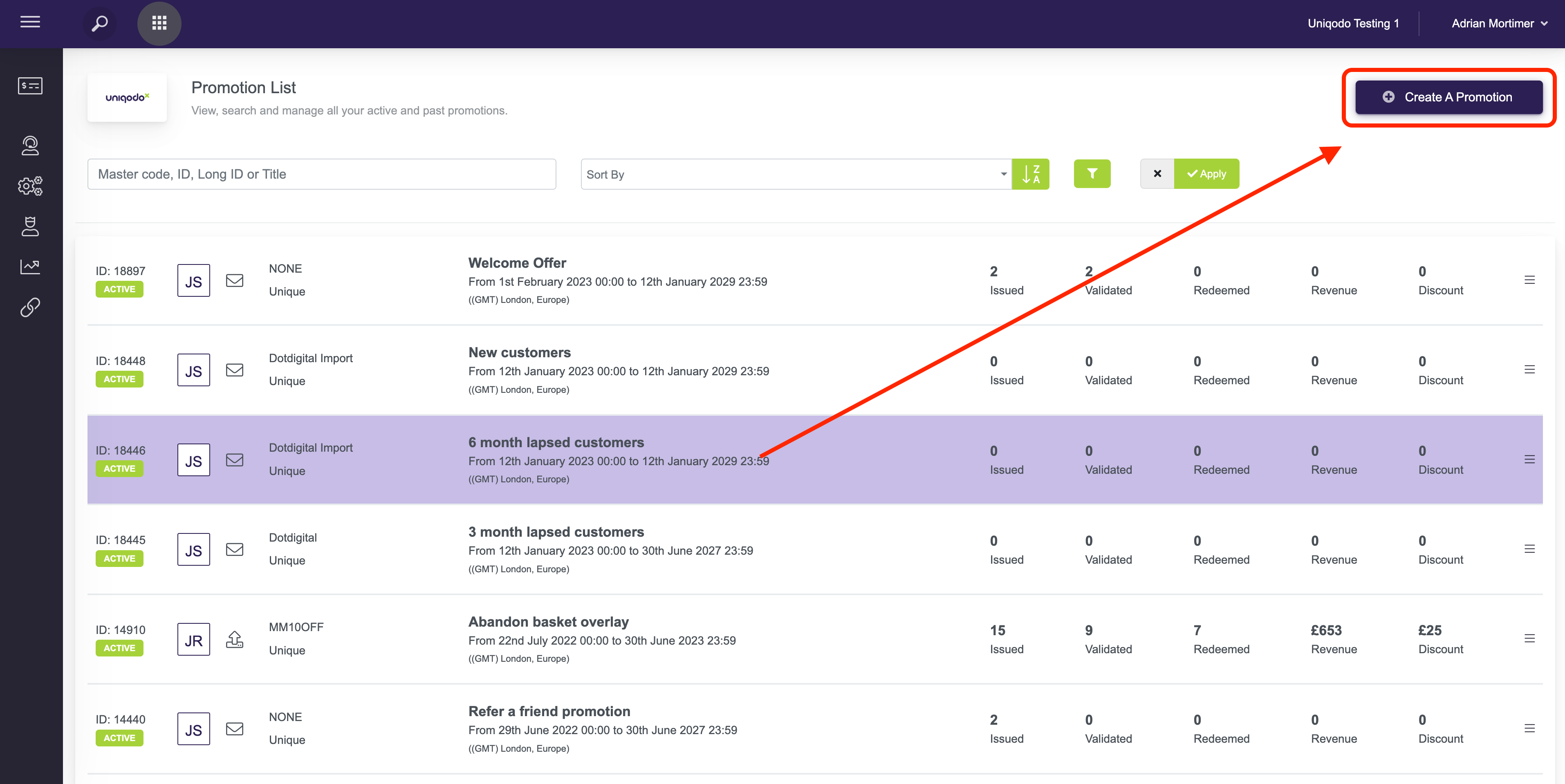
Uniqodo is a promotion experience platform built for enterprise marketing and commercial teams running complex multi-channel promotions at scale.
It connects to a brand's existing stack through an API, leaving it intact, and handles the nested rules, granular targeting, secure distribution and cross-channel attribution that native discount tools cannot. It also delivers those promotions onsite, so the promotion logic and the customer-facing experience sit in the same platform rather than requiring a separate tool. Once integrated, marketing teams design, launch, test and adjust sophisticated promotions entirely within a single interface.
Code distribution through an established publisher network
This is where Uniqodo differs most from the other three platforms in this comparison. Unique codes are issued at scale through real-time API and click-to-reveal partner buttons, with an HTML snippet that embeds codes in any email platform without a dedicated integration. Uniqodo maintains established connections to 7 affiliate networks and 24 publisher platforms, covering cashback sites and closed user groups.
- Affiliate networks include AWIN, CJ Affiliate, Impact and TradeDoubler
- Publisher platforms include Top Cashback, Unidays, Student Beans and Blue Light Card
Each partner is a configuration rather than a build, with per-partner attribution on every redemption.
Promotion logic and onsite delivery in one platform
The Promotion Engine defines qualification against product data, order value, customer attributes and behaviour. Rules can be nested: a discount that applies only if product B is in the basket, but not if category C is present. Rewards cover product bundles, tiered rewards, free items, shipping incentives, spend thresholds and brand-specific discounts. Automatic promotions can also apply without a code when basket conditions are met. Rules are enforced at checkout in real time and can be changed mid-campaign across every channel.
Onsite Experiences delivers the banners, overlays, countdowns and code reminders that surface those promotions to customers, built through the same interface and running on the same rules.
Neither Talon.One nor Voucherify offers native onsite experience tools, so the customer-facing half of a campaign needs a developer or a second vendor. Uniqodo requires an initial engineering project to connect to a brand's checkout and data sources, but campaign changes after that do not return to the development backlog.
Single-use codes that prevent discount leakage
Uniqodo was founded to solve coupon code leakage, where codes intended for one partner end up on voucher sites and in browser extensions. High-entropy single-use codes are issued by default and validated against eligibility rules at the point of purchase. That is what lets brands run exclusive offers through dozens of external partners at once, with each partner's codes traceable and none of them leaking into general circulation.
Where another tool might be a better fit
Uniqodo does not offer gift cards or digital wallets, both of which Talon.One and Voucherify support. Brands that need stored-value products as part of their incentive mix will need a separate tool.
Referral and Loyalty are the newest modules. Referral captures advocates at the point of purchase and generates unique single-use sharing links. Loyalty runs points-based programmes alongside rule-triggered rewards, VIP tiers and gated access. Both cover the core mechanics rather than matching the depth of a dedicated referral or loyalty platform, so brands where either is the primary acquisition or retention channel may be better served by a specialist vendor alongside the promotion engine.
Uniqodo Overview
- Pricing model: Pricing is conversion based
- Unique codes: Single-use, multi-use and repeat-use, with redemption limits per customer and per promotion
- Promotion types: Product and brand-specific discounts, bundles, tiered rewards, shipping incentives, spend thresholds, automatic promotions
- Distribution: 7 affiliate networks and 24 publisher platforms, plus HTML snippet for any email platform
- Integrations: API integration to existing commerce stack. Dedicated CRM and CDP integrations on roadmap
- Clients: Samsung, BT, EE, Avis
- Best for: Enterprise commercial and marketing teams that need promotion logic, partner distribution and onsite delivery in one platform
Talon.One: a programmable rule engine, now part of Adyen
Talon.One is a Berlin-based promotion engine founded in 2015 and acquired by payments company Adyen in a deal that closed on 1 July 2026. Brands including Adidas, Ticketmaster and Burger King have used it for large-scale incentive programmes.
A centralised rule engine for complex campaign logic
Talon.One built its reputation on the Rule Builder, a single interface where developers and technical marketers define campaign conditions, effects and eligibility logic. Campaign logic is configured as a decision tree, giving teams fine-grained control over which customers qualify for which incentive and under what conditions.
The platform supports coupons, discounts, product bundles, referral programmes, loyalty points and geofencing. It connects to tools including Braze, mParticle, Shopify and commercetools.
Talon.One does not publish pricing. Capterra lists an entry point of EUR 1,500 per user per month from third-party data, and the model scales on transaction volume and feature requirements. There is no self-serve free tier.
What the Adyen acquisition changes
Adyen is integrating Talon.One's rule engine into its payments infrastructure, positioning it as the incentives layer within a unified commerce stack. For merchants already on Adyen, that promises promotional decisioning tied directly to payment and transaction data.
For buyers evaluating Talon.One as a standalone promotion engine, the acquisition introduces uncertainty. Future development will follow Adyen's payments-first roadmap rather than independent promotion engine priorities.
Where another tool might be a better fit
The Rule Builder is powerful but expects technical configuration, so teams without dedicated engineering resource typically take longer to get campaigns live. Talon.One is also headless, which means it carries no native onsite experience tools. Brands that want code reminders, basket abandonment triggers or exit-intent overlays connected to their promotion logic will need a second vendor for that layer.
Talon.One does not operate a publisher or affiliate distribution network. Brands distributing unique codes across cashback partners or closed user groups build and maintain those integrations themselves.
Talon.One Overview
- Pricing model: Not published. Scales on data volume, with no API call limits
- Unique codes: Yes, with bulk generation and redemption limits
- Promotion types: Coupons, discounts, product bundles, referral rewards, loyalty points, geofenced offers
- Distribution: No publisher or affiliate network. Distribution via connected messaging and martech tools
- Integrations: Braze, mParticle, Segment, Shopify, commercetools and others
- Clients: Adidas, Ticketmaster, Burger King
- Best for: Enterprise teams with dedicated engineering resource that want a single programmable rule engine
For a broader comparison, see our full guide to the best Talon.One alternatives.
Voucherify: an API-first promotion engine
Voucherify is a Katowice-based, API-first promotion and loyalty engine founded in 2015. It is built for developer-led teams that want to construct promotion logic through API endpoints and integrate it into a custom tech stack. Clients include Breville and Michelin.
An API-first engine with broad incentive coverage
The platform supports coupons, cart-level promotions, gift cards, product bundling, referral programmes, loyalty programmes, digital wallets and gamification. That is the widest feature spread of the four platforms in this comparison, particularly on stored-value products.
Voucherify's campaign builder gives marketers a visual interface for individual campaigns, while the API layer gives developers control over validation rules, code generation, distribution and redemption tracking. The platform connects to CRMs, CDPs, messaging tools including Braze, Iterable and Bloomreach, and commerce platforms including Shopify and commercetools, through pre-built integrations and webhooks. Voucherify holds ISO 27001 certification and is a MACH Alliance member.
Published pricing that scales on API volume
Voucherify is the only platform in this comparison that publishes its pricing. Business plans start at EUR 600 per month, covering 25,000 API calls and three projects. Organisation plans cost EUR 1,200 per month for 50,000 API calls and five projects. Enterprise pricing is custom.
All self-serve plans include unlimited users and campaigns, with a 60-day free trial. The trade-off is that cost scales on API call volume rather than on results, so high-traffic seasonal campaigns can drive significant increases regardless of whether that traffic converts.
Where another tool might be a better fit
Voucherify does not operate a publisher or affiliate distribution network. Brands distributing unique codes across cashback partners or closed user groups build and maintain those integrations themselves.
The platform offers hosted landing pages, but no onsite experience layer for a brand's own site. Teams that want code reminders, countdown timers or exit-intent overlays running on the same rules as their promotions will need a separate tool for that. Building the customer-facing side of a campaign is developer work rather than something a marketer configures.
Overview
- Pricing model: Published. Business from EUR 600 per month, Organisation EUR 1,200 per month, Enterprise custom. Scales on API call volume. 60-day free trial
- Unique codes: Yes, up to 100,000 codes per campaign on paid plans
- Promotion types: Coupons, cart-level promotions, gift cards, product bundles, referral, loyalty, digital wallets, gamification
- Distribution: No publisher or affiliate network. Distribution via connected messaging tools and API
- Integrations: Braze, Iterable, Bloomreach, Segment, Shopify, commercetools and others
- Clients: Breville, Michelin
- Best for: Developer-led teams that want API-level control and transparent, published pricing
For a broader comparison, see our full guide to the best Voucherify alternatives.
Qixol: a promotion engine for omnichannel retail
Qixol is a UK-based standalone promotion engine built on Microsoft Azure. It is designed for omnichannel retailers that need the same promotion logic running across ePOS, ecommerce and call centre, and it is the narrowest of the four platforms in this comparison by design.
Consistent promotion logic across physical and digital channels
Qixol's core proposition is channel consistency. A promotion configured once applies identically whether the basket is built in store, online or over the phone, which matters for retailers whose customers move between those channels mid-purchase.
The engine supports percentage and amount-off discounts, multi-buy, BOGO, mix and match, deal pricing, free gifts, free shipping, voucher codes, gift cards and loyalty points. Rules are configured in a web application and validated via API in JSON, XML or WCF. Basket and product data is captured at line level, which supports margin analysis in an external BI tool rather than inside the platform.
A native fit for Microsoft Dynamics retailers
Qixol publishes a native extension for Microsoft Dynamics 365 Business Central, which automates promotion validation directly within sales order processing. For retailers already running operations on the Dynamics stack, that removes most of the integration work the other three platforms would require.
Pricing is based on the number of baskets processed rather than API calls or conversions. Qixol does not publish figures, and offers a 30-day free trial.
Where another tool might be a better fit
Qixol does not offer publisher code distribution, onsite experience tools or referral programmes, and its martech integration ecosystem is narrow next to Talon.One and Voucherify. Brands running promotions through affiliate partners, or wanting onsite messaging tied to promotion rules, will need additional tools.
The platform is also built around a retail basket model. Teams on Shopify, commercetools, Salesforce Commerce Cloud or a headless build, and sectors that do not fit a conventional basket structure such as travel or telco, will find the fit less natural.
Qixol Overview
- Pricing model: Not published. Based on number of baskets processed. 30-day free trial
- Unique codes: Yes, with batch generation, import of existing codes and per-customer redemption limits
- Promotion types: Percentage and amount off, multi-buy, BOGO, mix and match, deal pricing, free gifts, free shipping, loyalty points, gift cards
- Distribution: No publisher or affiliate network
- Integrations: Microsoft Dynamics 365 Business Central native extension. API integration (JSON, XML, WCF) to other platforms
- Clients: Not publicly disclosed
- Best for: Omnichannel retailers running Microsoft Dynamics that need consistent promotion logic across ePOS, web and call centre
How to choose the right promotion engine for your business?
All four platforms generate unique codes, enforce validation rules and report on redemptions. To figure out who is best for you, you should ask the following 4 questions.
1. Who builds and changes campaigns day to day?
If a technical team owns promotion logic and has capacity for it, Talon.One's rule engine and Voucherify's API both reward that. If commercial and marketing teams need to run campaigns themselves, the question becomes what happens after integration. Uniqodo and Qixol both put ongoing campaign management in a marketer-facing interface, though only Uniqodo extends that to the customer-facing side of a campaign.
2. Which channels do your codes need to reach?
If promotions run through your own channels alone, all four work. If they go out through affiliate networks, cashback sites, closed user groups or influencer partners, only Uniqodo carries those connections natively. With the others, each partner is an integration your team builds and maintains.
3. Who builds what the customer actually sees?
Talon.One and Voucherify are headless, so the banners, code reminders, countdown timers and exit-intent overlays that surface a promotion come from a separate vendor. That means a second contract and a gap between the rule and what the customer sees. Uniqodo runs both from the same rules. Qixol addresses a different version of this problem, keeping logic consistent across ePOS, web and call centre.
4. What does your bill scale with?
The four platforms bill on four different bases: data volume for Talon.One, API calls for Voucherify, baskets processed for Qixol and conversions for Uniqodo. Only the last ties cost to commercial outcomes. The others can rise during a heavy trading period whether or not the traffic converts, which matters most for retail and travel brands with sharp seasonal peaks.
There is also a stack answer. Retailers on Microsoft Dynamics should look at Qixol first, because the native Business Central extension removes integration work the others would need. Merchants already on Adyen have a similar reason to look at Talon.One.
For teams weighing promotion engines against dedicated loyalty or referral platforms, our guides to the best Talon.One alternatives and Voucherify alternatives cover a wider field including LoyaltyLion, Antavo, Smile.io and Mention Me.

Julius Somoye
Founder & CTO