

A promotion engine is the layer that sits between your customer data and your commerce platform, evaluating cart contents, customer attributes and business rules to decide which incentive to apply in real time.
When the native discount tools inside your ecommerce platform can no longer handle complex eligibility rules, multi-condition stacking or code security at scale, a dedicated promotion engine fills that gap.
Most ecommerce promotion engine software handles the basics well. The differences show up in who runs campaigns once the platform is live, how codes reach partners and what shoppers see on site. Below are eight platforms that take different approaches, with the trade-offs of each, followed by the criteria to test in a demo. Retail teams can go straight to our shortlist of the best promotion engines for retail.
| Platform | Best For | Standout Feature | Pricing |
|---|---|---|---|
| Uniqodo | Enterprise marketing teams running complex multi-channel promotions without developer dependency | Visual rule builder for marketers, integrated onsite experience, native publisher code distribution | Performance-based: pay on conversions |
| Talon.One | Rules-based promotion logic at scale | Single rule-tree builder for complex campaigns with sub-50ms latency | Custom, usage-based (API calls + active users) |
| Voucherify | Developer-led promotion builds | Headless, API-first with SDKs for six languages and sandbox testing | Published tiers from free to enterprise |
| Eagle Eye | Grocery and omnichannel retail with POS | 90,000+ connected stores with wallet-based architecture | Variable, revenue share in some cases |
| Vouchery | Coupon-focused ecommerce | AI-powered coupon management with AWS-hosted fraud detection | Variable, based on business size |
| Antavo | Loyalty-first brands adding promotions | Standalone Promotion Engine with 10 promotion types and stacking rules | Transaction-based |
| Salesforce Commerce Cloud | Salesforce-standardised enterprises only needing standard promotion mechanics | Commerce-embedded promotions with native Salesforce ecosystem integration | Part of commerce licence |
| Adobe Commerce | Adobe Commerce storefronts needing condition-rich cart promotions | Cart price rules with product attribute and customer segment conditions | Part of commerce licence |
1. Uniqodo: Best for Enterprise Marketing Teams Running Complex Multi-channel Promotions Without Developer Dependency
Full disclosure: Uniqodo is our own platform, so we've put it first. Every other entry lists its trade-offs so you can judge whether that's fair.
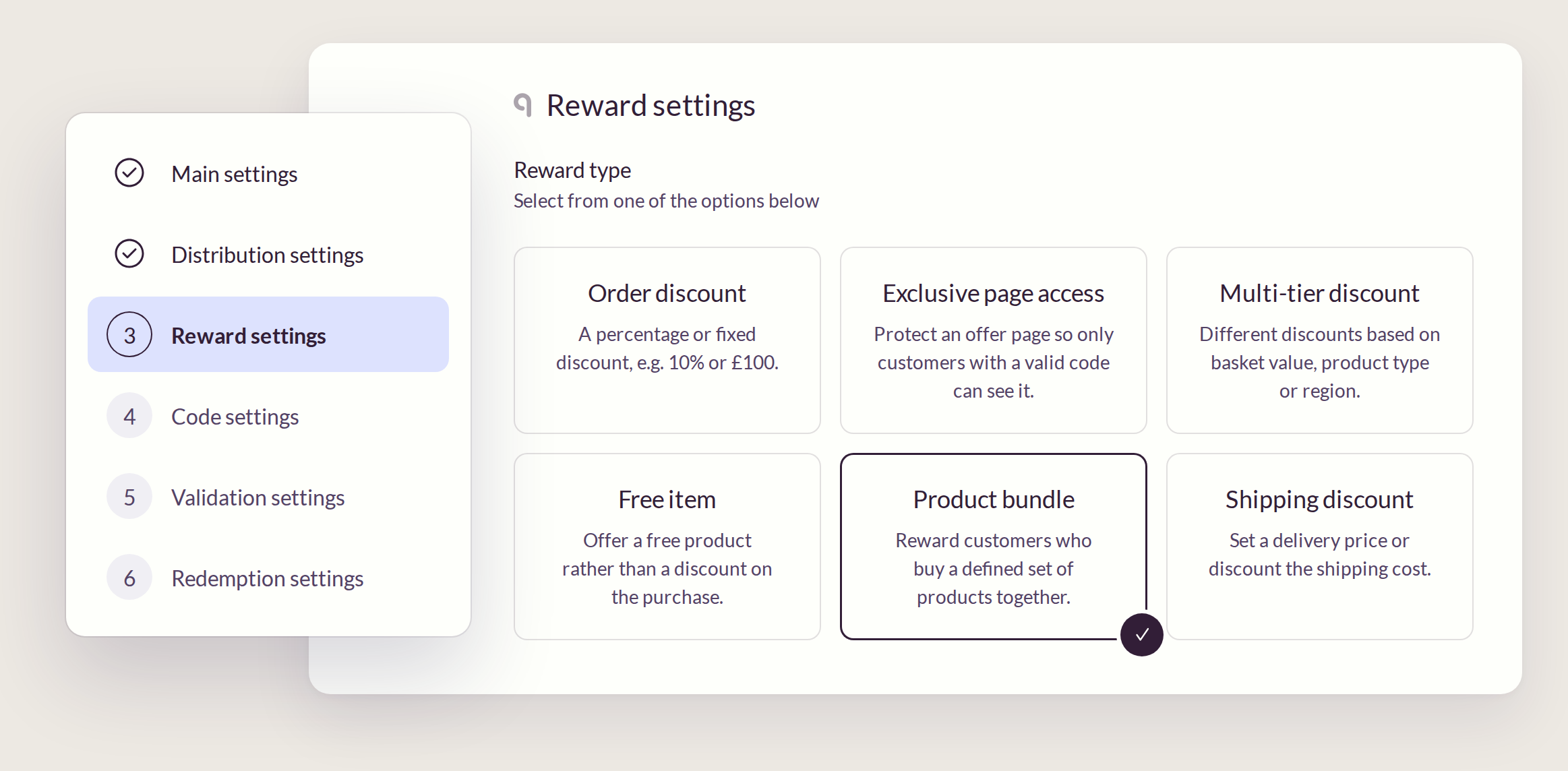
Uniqodo is an Intelligent Promotion Experience Platform built for enterprise marketing and commercial teams that need to run complex multi-channel promotions at scale without developer support for each campaign. It sits above a brand's existing ecommerce stack and comprises five products:
- Promotion Engine for building complex incentive rules (product-specific discounts, tiered rewards, bundles, shipping promotions, automatic promotions)
- Onsite Experiences for surfacing the right offer at the right moment (exit-intent overlays, countdown timers, code reminders)
- Code Distribution for distributing secure single-use codes across affiliate networks, cashback sites and closed-user groups with per-partner attribution
- Referral for capturing advocates at the point of purchase with unique sharing links
- Loyalty for points-based or event-triggered rewards, VIP tiers and gated access
Samsung, Boots, Avis, Travelodge, TUI, BT and EE run promotions on Uniqodo. Over one billion unique codes have been issued to date, and brands generated more than £4bn in revenue through the platform in 2025.
Key Capabilities:
- Code security and fraud prevention: Uniqodo was founded to solve affiliate code leakage, where codes intended for one partner end up on voucher sites and in browser extensions. The platform generates unique single-use codes by default, each validated against configurable rules covering eligibility, usage limits, timing and product or category restrictions. Generic codes are also supported, with the same qualification rules applied to control who can redeem them.
- Nested promotion logic: The Promotion Engine builds multi-layered rules that standard platforms struggle to configure, for example a discount that applies only if product B is in the basket but not if category C is present. Rewards cover product bundles, tiered rewards, free items, shipping incentives, spend thresholds, product or brand-specific discounts and automatic promotions that apply without a code.
- Publisher and affiliate distribution: Uniqodo integrates with seven affiliate networks including AWIN, CJ Affiliate, Impact and TradeDoubler, and twenty four publisher platforms including Unidays, Student Beans, Blue Light Card and Top Cashback, with per-partner attribution on every redemption. An HTML snippet embeds codes in any email platform, with no integration required.
- Onsite promotion delivery: Onsite Experiences deliver overlays, banners, inline messages and countdowns triggered by exit intent, traffic source, page URL or basket state, with uplift measured against a control group.
- Vertical-specific configuration: The platform adapts its vocabulary to the vertical: travel brands build promotions against bookings, flights and rooms rather than generic orders and products. For travel operators, blackout dates and qualification rules control discounts by date, rate and segment. See how this works for travel brands.
- Marketer self-serve after integration: Once the API integration is in place, marketing and commercial teams build, launch, test and adjust promotions through the Uniqodo interface, without developer support for each campaign. The rule builder is designed around how those teams think about promotions: pick the reward type, set the qualification criteria, define error messages for customers who don't qualify, and go live.
“Having Uniqodo has given us flexibility to create and test our customer offers. The system protects the discounts we want to give, so it’s easier to agree promotions internally, even if we’re giving away a larger margin to a selected group.”
Sian Worthington, Affiliate Strategy Manager, N Brown Group
Campaign results can be reviewed through A/B tests and per-partner transaction tracking.
Pricing model: Variable, depending on use case and scale. The Promotion Engine is priced on conversions rather than API call volume.
Single-use unique codes: YES
Promotion types: ALL
Integrations: Any CRM or eCommerce platform. Common integrations include Salesforce Commerce Cloud, Adobe Commerce, commercetools, Shopify Plus, VTEX, BigCommerce, SAP, custom headless builds. Seven affiliate networks (AWIN, CJ Affiliate, Impact, TradeDoubler). Twenty four publisher platforms (Unidays, Student Beans, Blue Light Card, Top Cashback). Any email platform via HTML snippet.
Best for: Enterprise ecommerce, retail, telecoms and travel brands where commercial and marketing teams need to run complex, multi-channel promotions themselves, covering code generation, partner distribution, onsite personalisation and fraud prevention. Clients include Boots, BT, EE, Avis and TUI.
2. Talon.One: Best for Rules-Based Promotion Logic at Scale
Founded in Berlin in 2015, Talon.One serves more than 300 enterprise brands including Adidas, Sephora and Carlsberg. In July 2026 it was acquired by Adyen, the Dutch payments company, in a transaction valued at €750 million. Talon.One continues to operate as a standalone product, and Adyen has said it will begin integrating the promotion engine into its own platform. What that integration means for brands running a different payments stack is not yet clear.
The platform offers customers the ability to create campaigns based on their own data. Integration is API-first. From there, customers can promote their coupons, discounts, referral discounts and loyalty programmes.
Talon.One has features such as code control, setting validation criteria and reporting capabilities. It includes the ability to integrate with third-party APIs, and the platform is able to handle unexpected load spikes or peaks. Talon.One automatically scales to meet the demands of its customer’s needs. In addition, automation and customisable attributes are available with all plan types.
Trade-offs:
- Talon.One does not offer a native publisher code distribution network or onsite experience tools.
- Brands that need to distribute secure codes through affiliate, cashback or closed-group publisher channels, or surface offers via overlays and exit-intent recovery, would need additional tooling.
- Pricing is based on API call volume rather than conversions, which can make costs less predictable for high-traffic sites where most sessions don't result in a redemption.
- Following the Adyen acquisition, roadmap direction now sits inside a payments company. Buyers on a different payments stack should ask how platform-neutral the product will remain before committing.
Pricing model: Based on API call volume
Single-use unique codes: YES
Promotion types: ALL
Integrations: Most CRMs and eCommerce platforms
Best use case: Enterprise teams with dedicated engineering resource that want a unified rule engine for promotions, loyalty and referrals across a custom tech stack.
For a fuller comparison, see our guide to the best Talon.One alternatives in 2026.
3. Voucherify: Best for Developer-Led Promotion Builds
Positioned as a developer-friendly promotion engine, Voucherify entered the market in 2016. Some of the platform's largest customers include Bloomberg, Saatchi Art and Bellroy. The API-first platform allows developers to integrate plugins and popular applications to build targeted campaigns.
A few notable features of the platform include setting advanced validation criteria, custom workflows with role-based access, flexible webhooks and multi-use coupons. The platform claims to be enterprise-level ready with fast integration times.
Trade-offs:
- Loyalty and promotions run as separate modules, so combining redemptions and promotions in a single flow is not natively supported.
- No native publisher code distribution network or onsite experience tools.
- Brands needing to distribute secure codes through affiliate and cashback channels, or surface offers via overlays and exit-intent recovery, would need additional tooling.
Pricing model: Variable, depending on needs
Single-use unique codes: YES
Promotion types: ALL
Integrations: Most CRMs, eCommerce platforms and mobile
Best use case: Mid-market and developer-led teams that want full programmatic control over promotion logic through code, with broad SDK coverage and a sandbox environment for testing.
For a fuller comparison, see our guide to the best Voucherify alternatives in 2026.
4. Eagle Eye: Best for Grocery and Omnichannel Retail with POS
Eagle Eye is positioned as a loyalty, promotions and personalisation platform that has been on the market since 2003. Primarily working with hospitality and food clients, the platform offers the ability to connect with new customers, develop digital services, reward customer loyalty and reward staff loyalty.
With its years of development, the platform offers features such as digital promotions, code control, customer targeting at checkout, prepaid gift cards and an extended audience network. Eagle Eye suits brands that want online-to-offline purchase and redemption, as it integrates with many POS systems.
Trade-offs:
- Architecture built around in-store transaction flows and campaign templates, which DTC or digital-first brands may find restrictive.
- No native strikethrough pricing, SDKs or publisher code distribution network.
Pricing model: Variable, depending on use
Single-use unique codes: YES
Promotion types: ALL
Integrations: Most POSs, CRMs and eCommerce platforms
Best use case: Large grocery and omnichannel retailers with extensive physical store networks that need POS-connected promotions at scale.
5. Vouchery: Best for Coupon-Focused Ecommerce
Vouchery is an AI-powered coupon management and automation platform, designed to help incentivise shoppers across the different stages of the buying cycle.
With Vouchery, eCommerce sites can create, redeem and synchronise their promotions in a single location, making it highly user-friendly and simplifying the promotion implementation process.
They offer additional features such as fraud detection and prevention, 24-hour customer support and programmable APIs. Site data is stored on the cloud in Amazon Web Services (AWS), providing users with an extra layer of security against fraud.
Trade-offs:
- Smaller platform without the same depth of rules engine complexity or enterprise case studies as others on this list.
- No native publisher code distribution network with per-partner attribution.
- No onsite experience tools such as overlays and exit-intent recovery.
Pricing model: Variable, depending on business size
Single-use unique codes: YES
Promotion types: Coupons
Integrations: Most CRMs and eCommerce platforms
Best use case: eCommerce brands and businesses working across multiple channels
6. Antavo: Best for Loyalty-First Brands Adding Promotions
Antavo is an AI-powered loyalty platform that launched a dedicated Promotion Engine in 2025 as a standalone product. The platform's roots are in loyalty (tier management, gamification, challenges, workflows), but the Promotion Engine can be used independently. It supports 10 promotion types with stacking and exclusion rules, a promotion calculator for testing configurations before going live, and API-first architecture that integrates with POS, ecommerce and pricing engines.
Antavo claims processing performance of over 100,000 requests per minute with a 60ms average response time. The platform also includes Timi AI, an AI co-pilot for loyalty programme guidance and optimisation.
Trade-offs:
- Promotion Engine operates as a separate module from the loyalty cloud, so cross-engine stacking rules need to be explicitly managed via API integration to prevent checkout conflicts.
- Headless, API-first architecture with no native onsite presentation tools, overlays or marketing widgets out of the box.
- No third-party affiliate or publisher distribution network with per-partner attribution.
Pricing model: Transaction-based
Single-use unique codes: Not a core capability
Promotion types: 10 types including discounts, bundles, free gifts and cross-sell
Integrations: POS systems, ecommerce platforms, pricing engines
Best for: Brands whose primary need is a loyalty programme and who want to add promotion capabilities from the same vendor without introducing a separate platform.
7. Salesforce Commerce Cloud: Best for Salesforce-Standardised Enterprises
Salesforce Commerce Cloud (B2C Commerce) is an enterprise ecommerce platform with promotions built natively into the storefront layer. Merchants can manage campaigns, coupon-qualified offers and compatibility rules through Business Manager, with A/B testing and scheduling included out of the box. Integration with the broader Salesforce ecosystem (CRM, CDP, MuleSoft, AppExchange) is available via OCAPI and SCAPI.
Trade-offs:
- Promotion logic is natively tied to the Salesforce commerce engine, so centralising incentives across non-Salesforce channels, disconnected storefronts or POS networks typically requires an external decisioning layer.
- Built-in page designers and content slots can render promotions on Salesforce storefronts, but there are no native conversion-marketing widgets such as exit-intent popups or promotional overlays.
- Handles standard coupon limits and bulk code generation, but relies on external integrations for third-party affiliate distribution and advanced coupon fraud mitigation.
- Native promotion types cover standard mechanics (percentage off, BOGO, free shipping, coupon-qualified offers) but complex multi-condition rules, tiered rewards or personalised incentives that change in real time typically require custom development or additional Salesforce products.
Pricing model: Part of Salesforce Commerce Cloud licensing
Single-use unique codes: Basic coupon functionality
Promotion types: Product, order, shipping and coupon-qualified promotions
Integrations: Salesforce ecosystem (CRM, CDP, MuleSoft, AppExchange)
Best for: Enterprises standardised on Salesforce that need standard promotion mechanics within their own storefronts and don't require complex multi-condition rules, cross-channel distribution or advanced fraud prevention beyond native coupon controls.
8. Adobe Commerce: Best for Adobe Commerce Storefronts
Adobe Commerce (formerly Magento) is a commerce platform with cart price rules and coupon tooling built into the core product. Marketers can configure rule conditions based on product attributes, customer segments and cart context, then schedule promotions through a campaign-style management layer. The platform supports percentage discounts, fixed-amount discounts, free shipping and Buy X Get Y mechanics with quantity steps and discount caps.
Trade-offs:
- Native promotion capabilities are focused on transactional cart discounts (percentage off, fixed amount, free shipping, Buy X Get Y), so complex multi-condition stacking, tiered rewards or personalised offers that change in real time typically require custom development or extensions.
- Promotion logic is tied to the Adobe Commerce cart architecture, so orchestrating real-time incentives across mobile apps, external marketplaces and non-Adobe channels typically requires an external decisioning layer.
- Loyalty programmes, referral loops and other retention mechanics are not part of the native toolset and require additional Adobe Experience Cloud modules or third-party extensions.
- Handles standard bulk coupon generation for its own storefront but lacks native frameworks for multi-channel code distribution or tracking across third-party marketing networks.
Pricing model: Part of Adobe Commerce licensing
Single-use unique codes: Basic coupon functionality
Promotion types: Cart price rules (percentage, fixed amount, free shipping, Buy X Get Y)
Integrations: Adobe Experience Cloud ecosystem
Best for: Brands whose primary ecommerce runs on Adobe Commerce and need cart-centric promotion mechanics.
How Should You Evaluate Ecommerce Promotion Engine Software?
Most platforms on this list can apply a percentage discount, validate a code and report on redemptions. At enterprise scale the differences sit elsewhere: who changes campaigns once the platform is live, how codes reach partners, what the customer sees on site and how much the vendor's direction depends on someone else's roadmap. These are the criteria worth testing in a demo or an RFP, each with a question to put to every vendor.
Who runs the platform once it is integrated
Every enterprise promotion engine needs an integration. Your commerce platform, checkout and customer data all have to connect before the first campaign runs, so treat any claim that no developers are involved with caution. The useful question is what happens after go-live. On some platforms a new eligibility rule or reward type is a configuration change the marketing team makes itself. On others it becomes an engineering ticket, and campaign timing depends on the release schedule.
Question to ask: Which campaign changes can marketing make without a code release, and which need engineering?
Breadth of incentive types
Percentage off is the easy part. Enterprise promotional calendars also need product-level discounts, order thresholds, shipping promotions, bundles, free gifts, tiered rewards and automatic promotions that apply without a code. Check how the engine handles stacking and exclusions as well, because overlapping campaigns are where margin erodes.
Tiered rewards are worth testing specifically. Across 90 merchants and 4,124 promotions on Uniqodo in H1 2026, 29.28% of validated multi-tier discount codes were redeemed, from 283,540 redemptions across 48 promotions at 14 merchants. One merchant contributes 86% of that volume, so read it as evidence of what the format can do at scale rather than a typical result.
Question to ask: Can you show a tiered reward, a bundle and an automatic promotion running at the same time, with the stacking rules between them?
Code security
Generic codes leak. Once a code reaches a voucher site or browser extension, anyone can redeem it and the discount stops reaching the customers it was designed for. This is coupon code leakage, and at enterprise volumes it is one of the most direct sources of margin loss in a promotion programme.
The defence is unique, single-use codes validated in real time against eligibility, usage limits and expiry. Check whether the platform issues unique codes as standard for every campaign or treats them as an add-on, and how quickly a leaked code can be shut off.
Question to ask: What happens, step by step, when one of our codes appears on a voucher site?
Publisher and affiliate distribution
Many enterprise promotions are distributed by partners: affiliate networks, cashback sites, student platforms and closed user groups such as employee and emergency services schemes. Most promotion engines pass codes to the tools a brand already runs, such as its email platform or CDP. Partner distribution is then left to separate tooling or manual file exports.
Uniqodo connects directly to affiliate networks including AWIN, CJ Affiliate and Impact, and has 24 publisher integrations including Blue Light Card, Quidco and Student Beans. Each redemption is attributed to the partner that issued the code.
Question to ask: Which partners are integrated natively, and how is a redemption attributed back to the partner that issued it?
Onsite delivery
A promotion engine decides who qualifies. It does not always control what the customer sees. Headless engines return a decision to your front end. Code reminders, exit-intent overlays and basket threshold messages are then built and maintained by your own developers. Uniqodo includes this layer through Onsite Experiences.
The layer affects conversion. In Uniqodo's H1 2026 retail data (90 merchants, 4,124 promotions), onsite promotions converted 18.60% of validated codes into redemptions, against 7.67% for email.
Question to ask: Is onsite presentation part of the platform, or does every overlay and message need front-end development?
Pricing model
Enterprise promotion engines usually charge in one of three ways: on API call volume, on conversions or as part of a wider commerce licence. Usage-based pricing grows with traffic, so a seasonal peak raises costs whether or not the extra sessions convert. Conversion-based pricing, which is how Uniqodo charges, ties cost to redemptions. Bundled licences look cheaper until you need promotions to work beyond the storefront.
Question to ask: What would we have paid last Black Friday under your pricing model?
Vendor independence
Ownership in this category is changing. Adyen completed its €750 million acquisition of Talon.One on 1 July 2026 and has said it will begin integrating the promotion engine into its payments platform. Promotions in Salesforce Commerce Cloud and Adobe Commerce are tied to their own storefronts. None of this makes those products the wrong choice, and for merchants already inside those ecosystems it can be an advantage. It does mean a buyer on a different payments provider or commerce platform should ask how neutral the product will stay.
Question to ask: How does your roadmap depend on a parent company's other products, and what happens to our terms if we change payments provider or commerce platform?
When to Move From Platform Discounts to a Promotion Engine
Every major commerce platform ships with discount features, and for straightforward percentage-off campaigns they work. The gap appears when campaigns need multi-condition eligibility, controlled stacking, secure unique codes at volume or distribution into partner channels. At that point teams either file engineering tickets for every campaign change or simplify the promotion to fit the tool.
A dedicated promotion engine externalises that logic so the campaign is built to the strategy, not the other way round. Salesforce Commerce Cloud and Adobe Commerce are common examples because they mark that boundary: strong within their own storefronts, dependent on an external decisioning layer beyond them.
Promotion Engine Results From Uniqodo Customers
Securing a peak launch for BT
BT Shop's first PS5 launch on 19 November ran into promotion problems. Uniqodo came back with five solutions within 24 hours and completed a full API integration over the Black Friday weekend. The relaunched promotion handled 50 times normal demand and converted at 85.8%. Read the case study.
How Do You Choose the Right Promotion Engine Software?
You might have noticed that most of the platforms on this list offer similar core functions: promotion rules, single-use code generation, validation criteria and tracking. So which option is right for your brand?
If all you need is a self-service promotion engine and nothing more, your decision may come down to specific use case or pricing model.
If you're looking for a promotion engine that goes beyond standard capabilities, combining code security, partner distribution, onsite experiences, loyalty and referrals with consulting and development support to help you get more from your campaigns, Uniqodo is built for that.
Every platform in this guide serves a genuine use case. The breakdowns above should give you enough to shortlist two or three options worth evaluating against your stack, your team structure and your promotion goals.
If Uniqodo looks like the right fit, book a demo to see the rule builder, code distribution network and onsite experiences in action. If it's not the right fit, this guide should have pointed you toward what is.
FAQs about promotion engine software
What is promotion engine software?
Promotion engine software is the layer between your customer data and your commerce platform that evaluates cart contents, customer attributes and business rules to decide which incentive to apply in real time. Instead of hardcoding discount logic into your commerce platform, a promotion engine externalises that logic so campaigns can be configured, tested and launched without an engineering ticket for every change.
How is a promotion engine different from my ecommerce platform's discount features?
Built-in discount tools handle basic mechanics like percentage off and simple coupon codes. A dedicated promotion engine handles complexity at scale: multi-condition eligibility rules, stacking and exclusion logic, unique code generation, budget caps and fraud prevention. If your team files engineering tickets for each new campaign type, you've likely outgrown native tools.
When should I invest in dedicated promotion engine software?
A few signals: marketing can't launch or modify campaigns without developer help, campaign conflicts cause unintended discount stacking and margin leakage, your team defaults to blanket discounts because anything targeted is too hard to build or you're losing margin to coupon code leakage on voucher sites. If any of those sound familiar, a dedicated engine is worth evaluating.
Which promotion engines are best for ecommerce brands?
Most ecommerce brands are best served by matching the engine to who runs promotions. Uniqodo suits enterprise teams running complex, multi-channel promotions with partner distribution and onsite offers. Talon.One and Voucherify suit engineering-led teams. Eagle Eye suits grocery and POS-heavy retailers and Antavo suits loyalty-first brands, while Salesforce Commerce Cloud and Adobe Commerce cover simple storefront promotions.
What does promotion engine software cost?
Pricing models vary significantly across platforms. Some charge based on API call volume (Talon.One), some publish tiered pricing (Voucherify), and some price on conversions rather than traffic (Uniqodo). Platform-embedded options like Salesforce Commerce Cloud and Adobe Commerce bundle promotions into the wider commerce licence. The right model depends on your traffic volume, redemption rates and how predictable you need costs to be.

Chris Roye
CEO