
The best Black Friday promotion ideas change what customers do instead of simply cutting prices. Tiered discounts, bundles, gift with purchase, exclusive partner codes and single-use recovery offers all lift order value or win new customers, while keeping your blended discount rate below a sitewide markdown.
Most brands plan Black Friday the same way: pick a sitewide percentage, put it on a banner and accept the margin hit to capture as much volume as possible. It's the least imaginative option and the most expensive, because it discounts every order equally, including the ones that would have converted at full price.
BFCM 2026 runs from Friday 27 to Monday 30 November. Each of the 15 ideas below changes what the customer does, and each entry says what it does to margin and average order value. The offer mix is the focus here. Budgets, code controls and the planning timeline are in our guide to how to protect margin on Black Friday.
Black Friday promotion ideas at a glance
Which Black Friday offer ideas lift average order value?
The strongest Black Friday offer ideas make a bigger basket the condition of the reward, so the customer funds the discount through incremental spend. Running several conditional offers at once is where promotional tooling gets stretched at peak, and it's what Uniqodo's Promotion Engine is built for: multiple concurrent, rule-based offers validated in real time.
1. Tiered discounts that reward higher spend
A tiered discount increases the reward as the basket grows: 10% off over £100, 15% off over £200. It works at peak because shoppers are already comparing, and the next tier turns “should I buy?” into “should I add one more item?”.
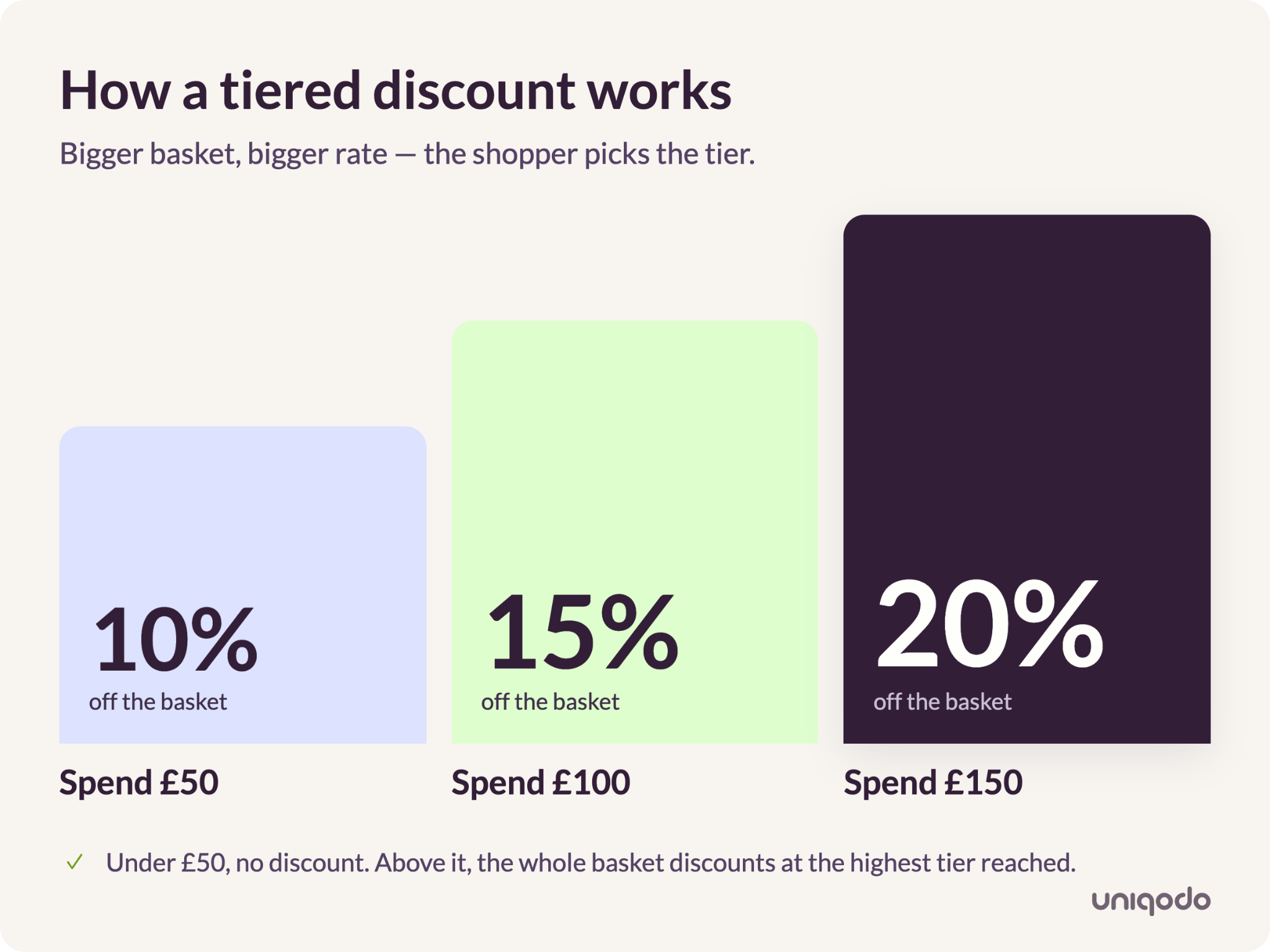
Set tier boundaries just above your current AOV bands, and keep the gap between tiers wide enough that the next reward is worth reaching for. Two or three tiers is usually enough: an offer that needs explaining at peak loses to a competitor's flat percentage. Show progress towards the next tier in the basket, because the mechanic only changes behaviour if the customer knows how close they are.
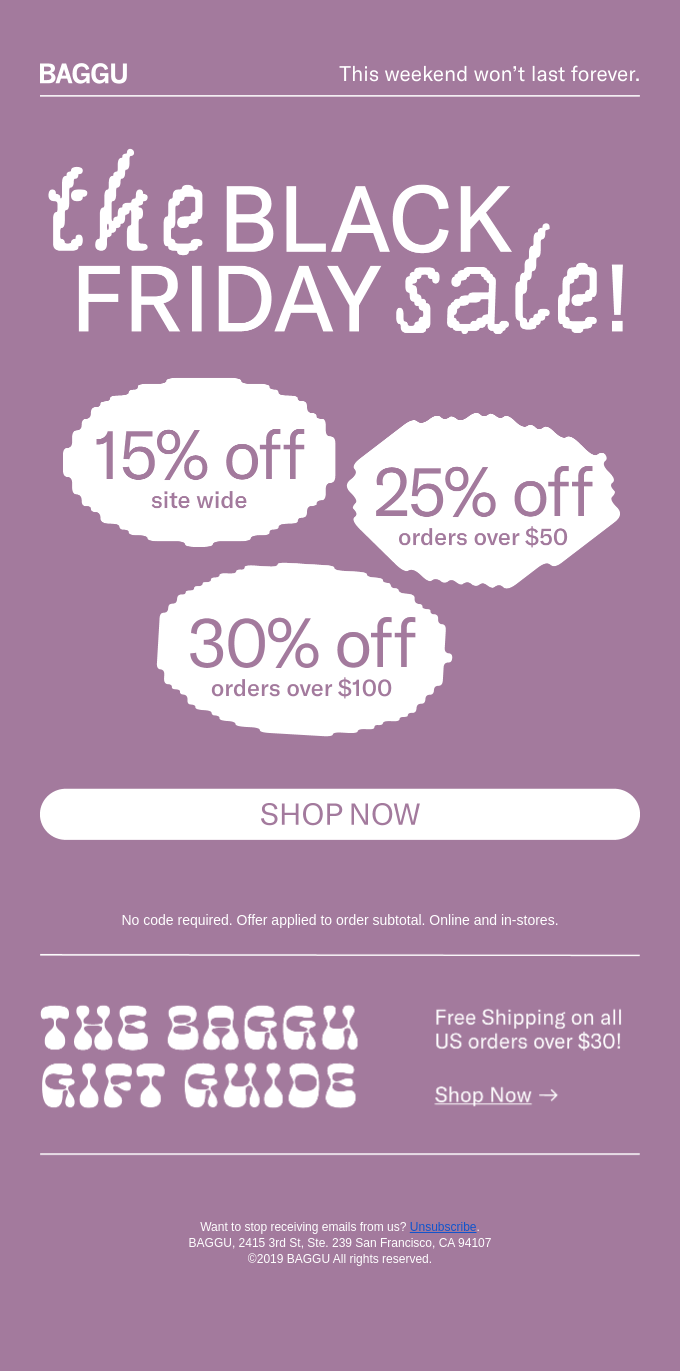
Baggu ran its Black Friday sale on three tiers: 15% off sitewide, 25% off orders over $50 and 30% off orders over $100.
2. Product bundles at a combined price
Product bundling packages items that are bought together at one combined price. At peak the saving is obvious, and a bundle can't be price-checked against a competitor's individual listings the way a percentage discount can. Because the saving sits in the combined price, each product's own price looks unchanged once the sale ends.
Pair a high-demand item with a higher-margin or slower-moving one, so the blended rate lands below what a matching percentage discount would cost. Choose a combination that reads as a considered set: Black Friday is a heavy gifting period, and a bundle that works as a gift, or as an introduction to a range, gives people a reason to buy beyond the saving.
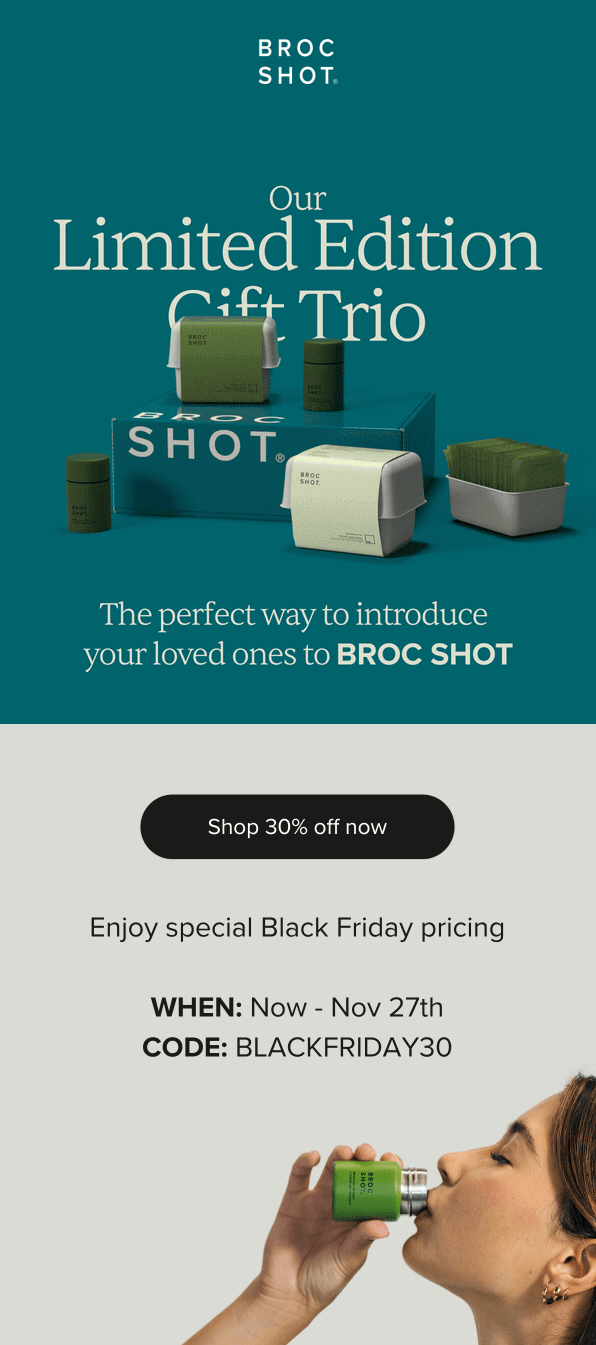
Broc Shot launched a limited edition gift trio for Black Friday, sold as the way to introduce someone to the brand, alongside 30% off with a Black Friday code.
3. Gift with purchase at a spend threshold
A gift with purchase adds a free product once the basket passes a set value. A tangible gift reads as more generous than the equivalent percentage off, and you control exactly what the reward costs.
Set the threshold above your current AOV and choose a gift with high perceived value relative to its cost. Sample and travel sizes are the obvious choice. Pick them from a range the customer hasn't tried, so the gift gets the basket over the threshold and puts a product in their hands they might come back and buy at full price.
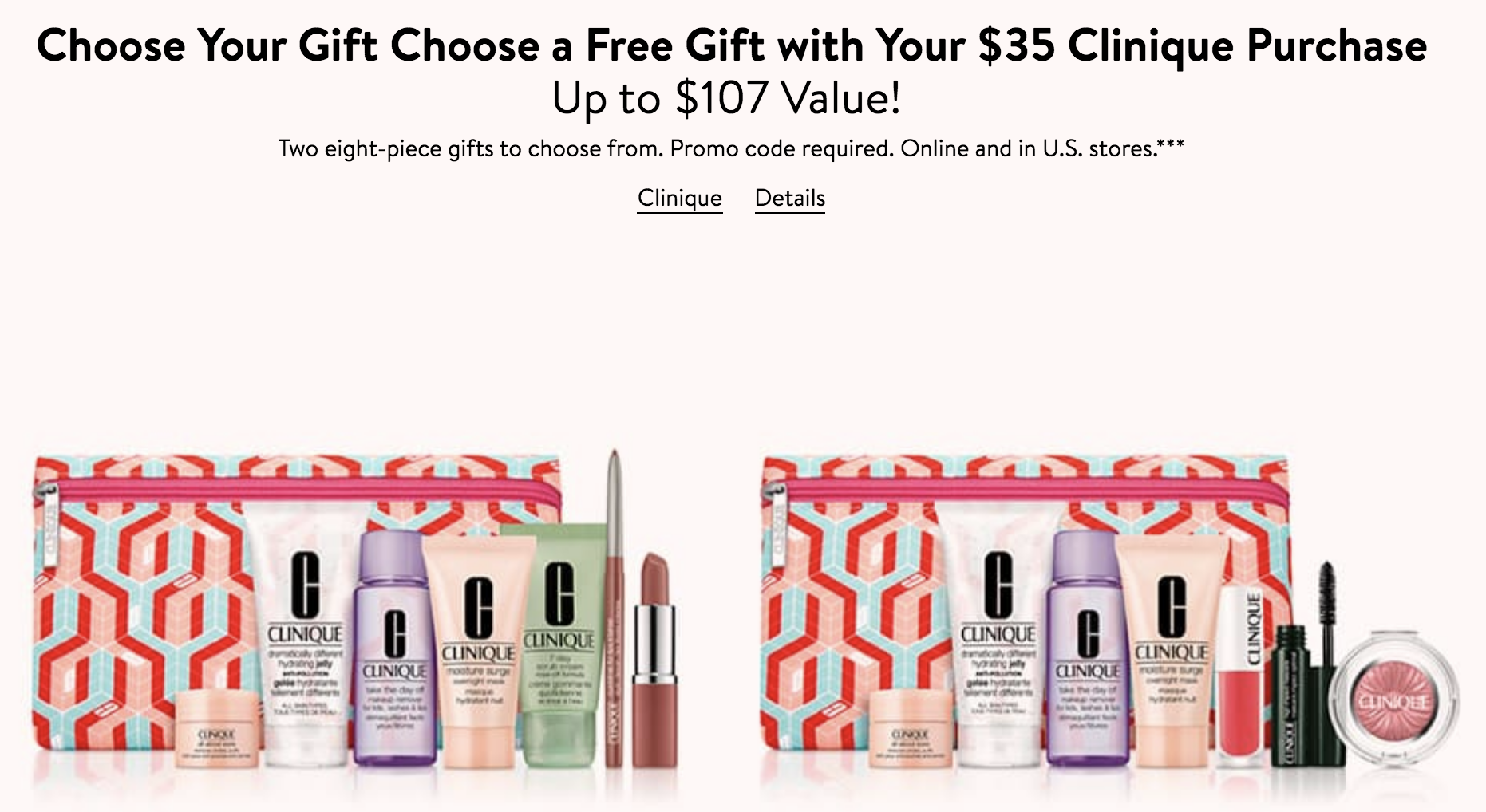
Clinique shows the economics: US shoppers who spent $35 could choose one of two eight-piece gifts with a stated value of up to $107. The customer sees up to three times their spend in free product, while the cost to Clinique is eight sample and travel sizes.
4. Threshold-based free shipping
Free shipping over a spend threshold is one of the simplest offers that changes behaviour. Shoppers add an item to qualify, a trade most make willingly in gift-buying season.
Set the threshold close enough that one more item clears it, and show the shortfall in the basket so the customer knows exactly what qualifying costs. Set it too high and shoppers abandon. It can also sit on top of a code-based offer without deepening the discount on the products themselves, as long as your stacking rules allow that combination on purpose.
5. Shipping upgrades at a higher threshold
Free delivery gets the basket over one line; a delivery upgrade gives the customer a second line worth reaching for. Offer next-day or premium delivery once spend passes a higher threshold, so the reward keeps improving as the basket grows.
At peak, gift buyers care less about what delivery costs than whether it arrives in time, and the upgrade answers that. Set the upgrade threshold well above the free delivery one and show both in the basket, the same way a tiered discount shows progress. It also puts your best delivery experience in front of customers who have only ever used your cheapest.
6. BOGO and multi-buy offers
BOGO and multi-buy formats, such as buy one get one half price or 3 for 2, tie the discount to unit volume, so the customer only gets value by buying more. At peak, multi-buys suit gifting: one for them, one for me.
Apply them to a defined set of products where you have the stock to back the volume. Multi-buys work on consumables and giftable products, not on a £400 purchase nobody wants two of. Done well, units per order rise and the discount is funded by volume.
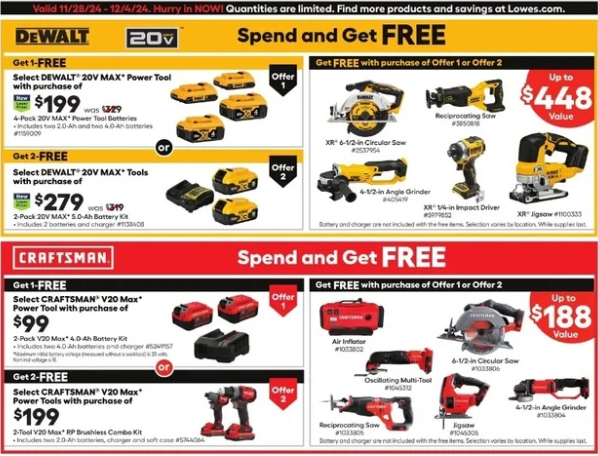
Lowe's ran “spend and get free” offers on selected DeWALT and Craftsman tools for Black Friday 2024, from 28 November to 4 December: buy a qualifying battery pack or kit and choose one or two free tools. Limiting the offer to chosen brands let the multi-buy do its work without touching the wider range.
How do you protect margin with Black Friday sale ideas?
Margin protection on Black Friday comes from deciding what not to discount as much as what to discount. These Black Friday sale ideas put discount spend where it does the least damage.
7. Category-specific or brand-specific discounts
Apply discounts to selected categories or brands and hold your best sellers at full price. Best sellers convert on Black Friday anyway, so discounting them gives margin away on demand that already exists.
Pick the ranges with margin headroom, or the stock you need to move, and set the rule against product attributes and brands so the boundary holds as your range changes through the weekend. Put what's included in the headline: “Up to 40% off beauty and home” sets the expectation, while “Up to 40% off” with the exclusions buried in the terms frustrates shoppers when the discount doesn't apply. You still have a visible discount to promote, at a fraction of the cost of a sitewide rate.
8. Flash offers on distressed inventory
A flash offer puts a deep, time-boxed discount on stock you've already written down or need to clear before year end. The short window drives conversion: a fixed deadline can do more than extra discount depth.
Keep the flash pool separate from your main BFCM offer so it can't cannibalise margin on your strongest lines, and publish a specific end time; “while stocks last” doesn't create the same urgency. Run flash windows when traffic is already high.
Black Friday marketing ideas that win new customers
Black Friday brings the year's biggest audience of first-time visitors, and the right Black Friday marketing ideas turn that traffic into customers you can identify and keep. Exclusive partner codes are the clearest example, and issuing them across dozens of publishers is what Uniqodo's Code Distribution handles, delivering codes to each partner with attribution built in.
9. Exclusive codes for affiliate and publisher partners
Give each affiliate, publisher or influencer their own exclusive code instead of one generic code shared everywhere. Partners promote harder when the offer is theirs alone, and the code itself tells you which partner produced each sale.
Vary the offer by partner too: a partner with a distinct proposition has something to lead with, and you learn which incentive works where. Cap what each code can do, by redemptions, total value or both, so a partner who overperforms doesn't take more margin than the deal was worth. With third-party cookies retreating, the code is increasingly the only reliable attribution signal you own.
BT built exclusive propositions for individual partners, working with Awin to bring on partners including Wowcher and vouchercodes.co.uk, with controls over customer numbers and total promotion value on each.
10. Referral offers that turn peak traffic into acquisition
A referral offer rewards an existing customer for introducing a friend, who gets an incentive on their first order. Black Friday concentrates purchase intent on both sides of the referral, which is when the mechanic works hardest.
Reward both sides, because a referral that only pays the referrer asks them to sell to a friend for your benefit. Cap how many times each customer can refer, so the perk can't become an unlimited discount. Limit it to customers who have bought from you, because a referral carries weight only if the person making it has something to vouch for.
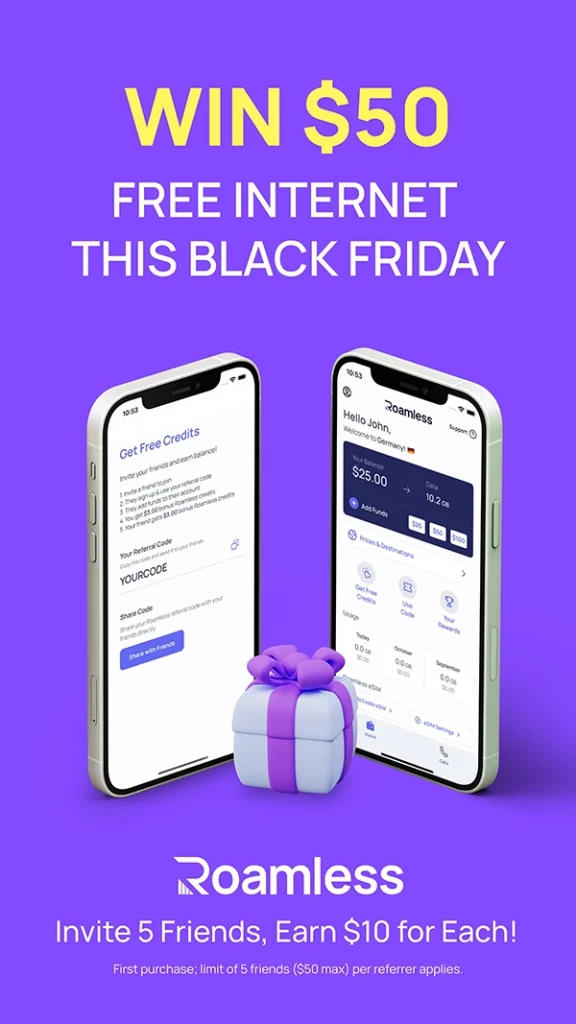
Roamless, a travel eSIM provider, ran its Black Friday campaign as a referral offer: customers earned $10 in credit for each friend who made a first purchase, up to five friends ($50) per referrer. The offer controls cost three ways: the reward is only paid on a friend's first purchase, the cap stops it becoming an unlimited discount, and paying in credit means the payout can only come back as usage.
Black Friday campaign ideas that use urgency to recover sales
Urgency-led Black Friday campaign ideas work because the deadline changes behaviour more than the discount depth does. A shopper who sees “ends in 3 hours” acts differently from one who sees the same offer running all weekend.
11. Short-expiry unique codes for onsite recovery
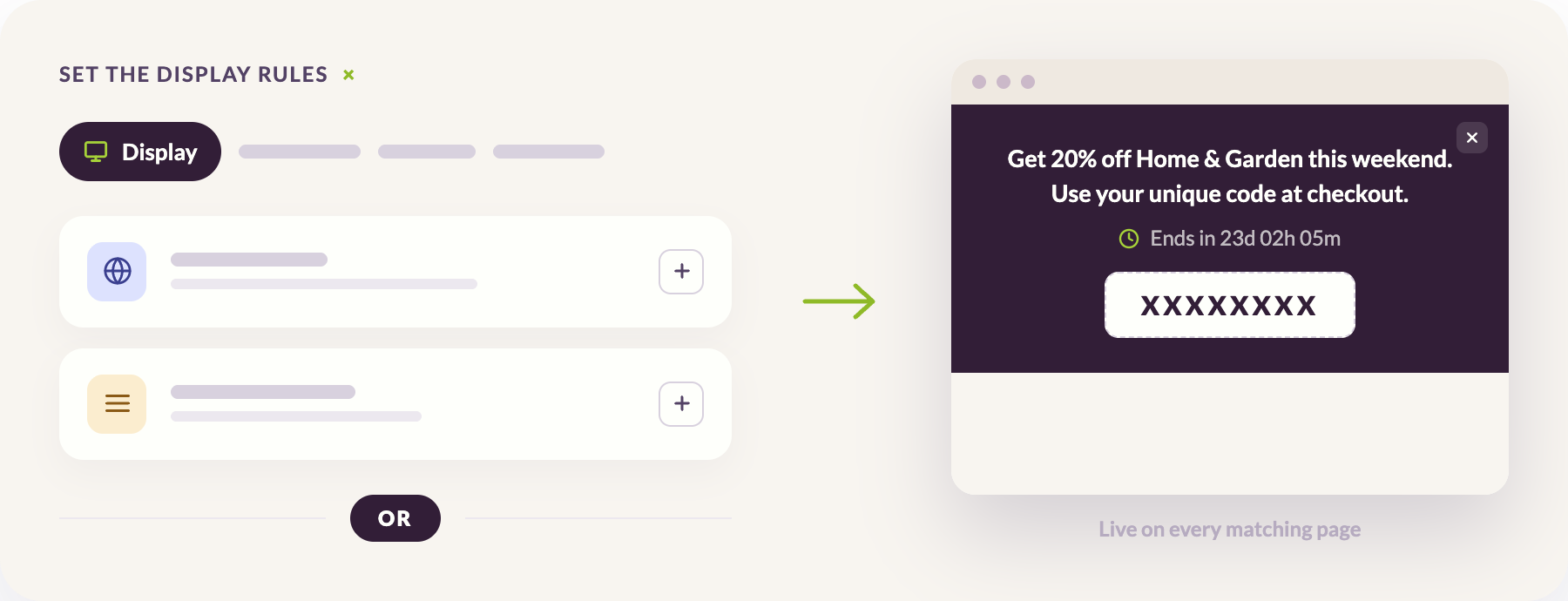
Serve a unique, single-use code with a short expiry to a visitor showing exit intent or code-hunting behaviour. Highlighting a product name or copying it to search elsewhere is as strong a signal as a cursor heading for the tab bar, and both are the moment to step in.
Trigger on real hesitation signals, so you aren't handing a discount to people who were going to buy anyway. Keep the expiry to minutes, because a code that outlives the session can end up on an aggregator. Make the expiry visible: a deadline the customer can't see doesn't change what they do. Each code is limited to one order, so recovery spend never turns into a de facto sitewide offer, which is the difference between a unique code and a generic one at peak.
12. Basket abandonment offers
Shoppers compare across competing sales at peak, so more baskets sit open than at any other point in the year. A targeted offer reaches the specific shoppers who left something behind, which a sitewide banner can't do.
Prioritise shoppers with high-value baskets. The bigger the basket, the more you can afford to discount and still profit from the sale, which is why a single flat recovery rate leaves money on the table at both ends. Lead with an onsite reminder when the customer returns, which costs nothing if they were coming back anyway, and hold the discount for those who need it. Recovery spend then stays limited to the orders that are really at risk.
Cyber Monday promotion ideas that reward existing customers
The best Cyber Monday promotion ideas for retention reward who the customer is, not how much they spend. A members-only offer works both ways: shoppers who want the discount have a reason to join, and existing members get something the general public doesn't.
13. Early access for email subscribers and members
Open your sale to subscribers or members 24 to 48 hours before the public launch. Early access rewards loyalty with priority, and in the weeks before Black Friday it becomes a sign-up incentive in its own right: join the list, shop first.
Give members first pick of the stock, since the value is in getting the thing before it sells out. Run the sign-up drive well ahead of the window so people have time to join. Decide whether access is free or paid: a free list grows reach, while a paid tier makes the access itself the product.
Samsung ran its Black Friday early access window this way, opening its Early Bird offers page only to new leads and engaged customers from its CRM base, with a unique code applied at checkout. The campaign brought in 200,000 new customers at a 26% average discount, and 4.8% of validated codes went on to be redeemed.
14. Member-only or returning-customer rates
Put your best rate behind a login or account creation, so only identified customers see it. Members feel recognised, shoppers who'd prefer not to register still get the public offer, and every redemption is tied to a known profile you can remarket to after peak.
Set the rate against the customer segment instead of issuing a code, so the qualifying condition is account status and there's nothing to share. A password or hidden page doesn't protect the rate: it only takes one customer to post it publicly. Decide what counts as a member before you launch, because account holders, subscribers and previous purchasers are different audiences with different economics, and the deepest rate should go to the one that has actually spent.
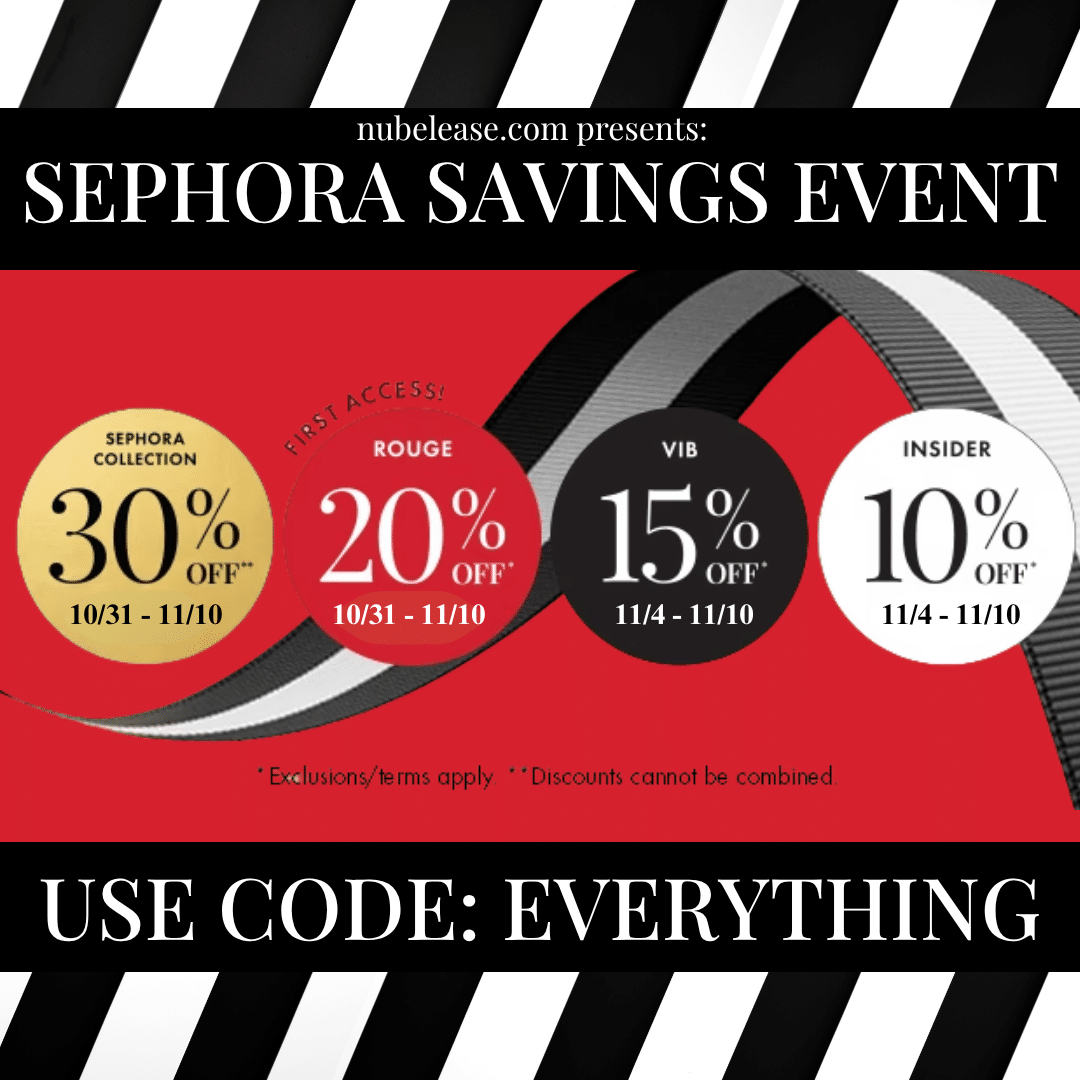
Sephora limits its version to its top tier: Rouge members can share their 20% Savings Event discount with one friend, once, which caps the cost while making the perk read as status, not a coupon.
15. Post-purchase offers on the confirmation page
The order confirmation page is the highest-intent space you own, and many brands leave it doing nothing. Show a time-limited offer on a related product, or a single-use code for a follow-up order.
Offer something that complements what they just bought, since the confirmation page is the one place you know exactly what's in the order. Set the redemption window to open after your sale ends, so the code creates a December purchase instead of discounting one the customer would have made that weekend anyway. Keep it single-use and tied to that order, because a code handed to every converting customer can reach an aggregator by the weekend.
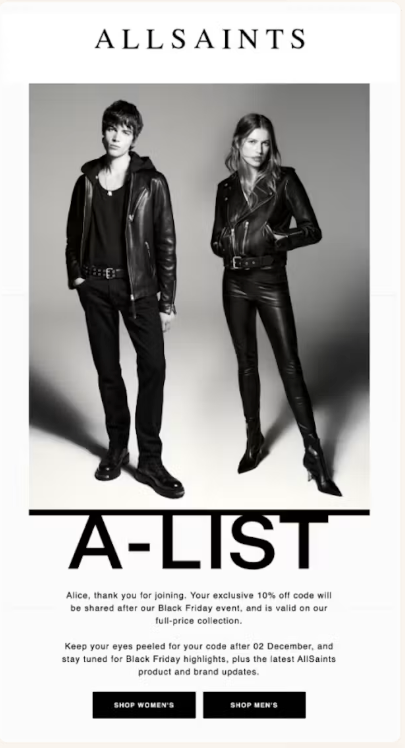
ALLSAINTS used the same timing on its welcome offer: shoppers who joined its A-List were told their 10% code would arrive after the Black Friday event, from 2 December, and would only apply to the full-price collection.
More Black Friday promotion ideas worth testing
A few more mechanics are worth testing if they suit your range: a gift card with purchase above a threshold, which brings the customer back after the sale; mystery discounts, where the shopper reveals a single-use code worth a random amount; gamified offers such as spin-to-win, which turn the discount into an interaction; and a donation per order, for brands whose customers respond to a cause more than a code.
How we chose these Black Friday promotion ideas
Every idea on this list had to pass two tests.
First, it had to change customer behaviour: a bigger basket, a first purchase, a completed checkout or a repeat order. An offer that discounts a sale the customer was already going to make fails, which is why sitewide percentage-off isn't on the list.
Second, its cost had to be containable: fixed per order (gift with purchase, free shipping), limited to a specific audience (members, partners, abandoners) or tied to incremental spend (tiers, multi-buys).
Uniqodo's Promotion Engine and Code Distribution run most of these mechanics, and once integrated, your team sets them up without waiting on development. If you want to see how that would work for your peak plan, book a demo.
FAQs: Black Friday promotion ideas
What are the best Black Friday promotion ideas?
The best Black Friday promotion ideas make the customer do something to earn the discount. Tiered discounts and gift with purchase lift basket size, exclusive partner codes and referrals win new customers and short-expiry single-use codes recover abandoning shoppers. Each costs less than a sitewide markdown, because the discount only applies when behaviour changes.
How do you run Black Friday promotions without losing margin?
Decide what not to discount before you decide what to discount. Keep best sellers at full price, put deeper offers on categories with margin headroom, use single-use codes so a leaked code is worth one order at most and cap how discounts stack at checkout. Our guide to protecting margin on Black Friday covers the full plan.
Is Uniqodo right for running Black Friday promotions?
Uniqodo suits enterprise retail and travel brands running several conditional offers at peak. Its Promotion Engine validates tiered, bundle and threshold offers in real time, Code Distribution issues unique codes to each partner and Onsite Experiences serve recovery offers. Setup needs an integration; once that's done, your team builds and changes promotions without development work.

Jenna Tyler
Director of Customer Operations