

A coupon marketing strategy is a structured approach to using discount codes and promotional incentives to change specific customer behaviour, whether that is a first purchase, a larger basket, or a return visit after a lapse. For commercial and marketing teams, the difficulty is not creating the offer. It is controlling what happens to it after it leaves your hands.
Most e-commerce brands run coupon campaigns. Fewer build the rules around them that determine whether the discount generates incremental revenue or quietly subsidises purchases that would have happened at full price. A percentage-off code shared through an affiliate, scraped by a browser extension, and redeemed by a customer who was already mid-checkout is not a marketing success. It is a margin leak with a redemption count attached to it.
This guide covers the full framework: setting a campaign goal, choosing the right incentive, segmenting the audience, building redemption rules that protect margin, matching distribution to the channel, and measuring return beyond the redemption rate. It gives specific attention to the part most coupon guides skip: preventing your codes from ending up in the wrong baskets.
What is coupon marketing?
Coupon marketing is the use of discount codes, vouchers, and promotional incentives to influence a specific customer action, such as making a first purchase, increasing order size, or returning after a lapse. It differs from blanket discounting because each offer is tied to a defined goal, audience, and set of redemption conditions.
The distinction between the two is structural. A sitewide 20% off banner is a price cut. By contrast, a single-use code delivered to lapsed customers, valid for seven days, restricted to full-price items, and capped at one redemption per account is a coupon marketing strategy, because the rules around the discount are doing as much commercial work as the discount itself.
What makes coupon marketing effective for e-commerce brands?
Coupon marketing works because discounts remain one of the most reliable triggers for purchase decisions, and digital delivery has made them measurable in ways print could never be. Introductory offers consistently lower the barrier for first purchase among shoppers weighing up an unfamiliar brand, and conditional discounts tied to basket thresholds routinely lift average order value above the baseline for the same segment.
For marketing and commercial teams, three properties make coupons more useful than most other promotional formats:
- Coupon codes are attributable. A code redeemed at checkout ties revenue to a channel, a partner, or a campaign with no modelling required.
- Coupon codes are conditional. Unlike a sitewide sale, a coupon only discounts the transactions you choose. Minimum spend, product exclusions, customer eligibility, and usage limits all sit inside the offer itself.
- Coupon codes are targetable. Codes can be issued to a segment rather than a market, which means the discount lands with the customers whose behaviour you want to change rather than the ones who would have paid full price anyway.
Common coupon marketing mistakes
Five coupon marketing mistakes come up repeatedly, and each one spends discount budget without changing the behaviour the promotion was meant to change.
Blanket discounting erodes the brand. When every visitor sees the same offer at the same time, the discount stops being an incentive and becomes the price. Repeated broadly enough, it repositions the brand around the discounted figure and makes full price feel like a penalty.
Constant promotion trains shoppers to wait. Customers who learn that a sale arrives every few weeks stop buying between sales. The discount pulls demand forward at first, then simply reschedules it, and finally suppresses full-price conversion altogether.
Irrelevant messaging wastes the incentive. A discount attached to a message that does not fit the recipient is still an irrelevant message, and raising the percentage rarely changes that. Channels also do different jobs: email suits basket recovery and rewards for existing customers, while affiliate and influencer codes reach audiences the brand does not own yet. A promotion earns its redemption when the message and the channel both fit the segment it was built for.
Empty coupon fields cause basket abandonment. A visible promo code box at checkout tells every shopper a better price exists somewhere. A meaningful share of them leave to search for it, and many never come back. If you run codes, the checkout experience needs to close that loop rather than open it, which is a core part of reducing basket abandonment.
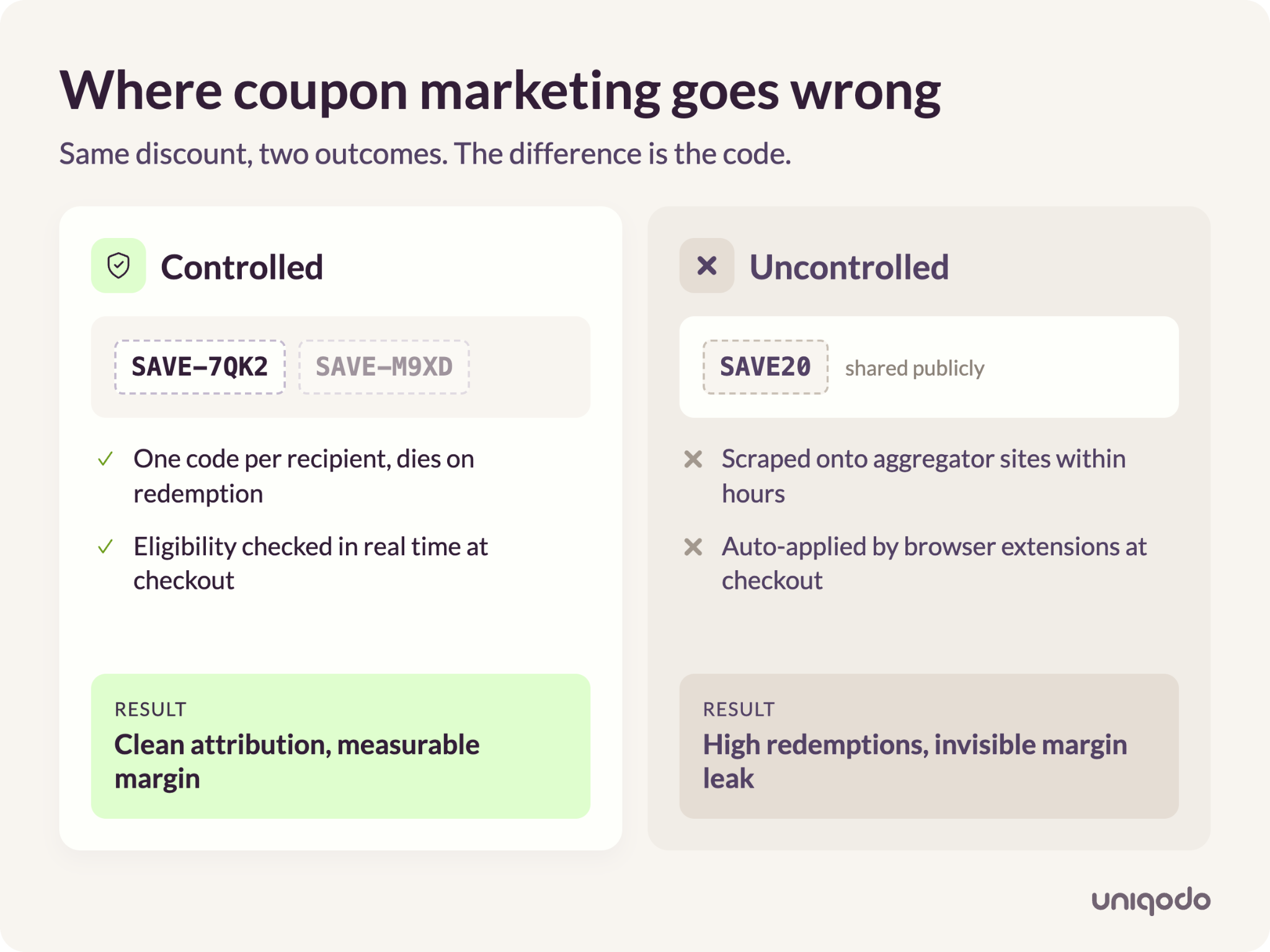
Code leakage drains margin invisibly. Generic codes shared with a partner, an influencer, or an email segment routinely surface on coupon aggregator sites and browser extensions within hours. At that point the discount applies to shoppers who were never the target, attribution collapses, and what started as a campaign becomes coupon code leakage, and the campaign's economics fall apart while the redemption dashboard shows what looks like success.
How do you build a coupon marketing strategy that protects margin?
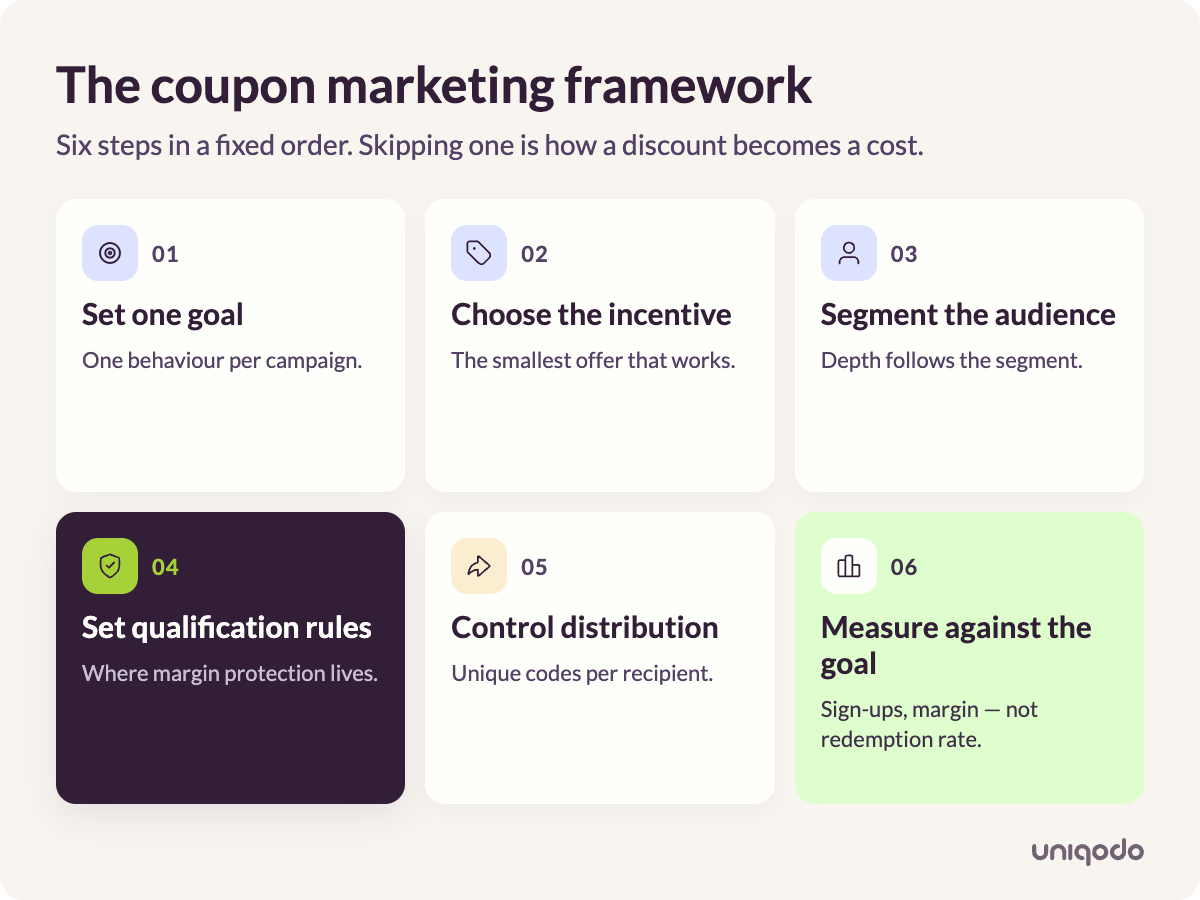
A margin-protecting coupon strategy follows a fixed sequence: define one goal, choose the incentive that serves it, segment the audience, set qualification rules, match distribution to the channel, and measure beyond redemption rate. Skipping a step is how discounts turn into costs.
1. Start with a single campaign goal
Every campaign should have a clear focus to change one behaviour. Whether that be to acquire a first purchase, lift average order value, recover an abandoned basket, reactivate a lapsed segment, or clear specific stock. One clear goal per campaign, because the goal dictates everything downstream: the incentive type, the audience, the rules, and the metric that defines success. A campaign built to do two things usually does neither, and it becomes impossible to read the results.
2. Choose the right incentive type
The goal should determine the incentive, not the other way around. The right offer is the smallest one that changes the behaviour you are targeting.
| Incentive type | How it works | Best use case |
|---|---|---|
| Order discount | Applied to the basket total once conditions are met | Acquisition offers and AOV campaigns with a clear spend target |
| Tiered discount | Reward increases as spend rises through defined thresholds | Pulling baskets upward through threshold steps rather than discounting everything equally |
| Product discount | Applied to specific products, categories, or attributes rather than the whole basket | Protecting full-price lines while clearing defined stock |
| Free item | A qualifying basket earns a free product, whether BOGO, multi-buy, or gift with purchase | Unit volume, inventory clearance, and adding value without cutting price |
| Product bundle | Two or more products grouped into a single combined offer | Cross-sell campaigns and moving slow stock alongside higher-demand items |
| Shipping discount | Delivery cost reduced or removed above a threshold | Removing the most cited reason for checkout abandonment |
Order discounts, product discounts, and bundles can each be structured as a percentage off, a fixed amount off, or a set price, and that choice matters as much as the reward type. Percentage discounts scale with basket size, which makes them expensive on large orders. Fixed-amount discounts give a predictable cost per redemption. Set prices work well for clearance and bundle offers where the target price point is the selling message. Defaulting to percentage off across every campaign is how brands over-spend on acquisition while under-investing in AOV and retention. For a deeper comparison of when each format earns its keep, see our guide to the six types of promotions.
In retail, percentage-off codes are also the least likely to be redeemed once validated. Across 90 merchants and 4,124 promotions on the Uniqodo platform in H1 2026, percentage discounts made up 51.8% of retail and fashion redemptions. Only 12.41% of validated retail percentage codes were redeemed, against 36.71% for fixed discounts. Our coupon code statistics break the figures down by sector and channel.
3. Segment the audience before choosing the offer depth
The most expensive coupon is the one redeemed by a customer who would have bought at full price anyway. Segmentation is how you avoid paying for behaviour you already had.
- Repeat, full-price customers do not need discounting. They need recognition. Offering 20% off to someone who already buys from you every six weeks trains them to wait for the code before their next order.
- Category-locked customers need breadth, not depth. A shopper who buys skincare every six weeks does not need 20% off skincare. They need a consumer incentive to try a category they have never bought from.
- Lapsed customers may justify your deepest offer, because the alternative is losing them entirely. A customer who has not purchased in six months is a reactivation target, not a loyalty segment.
Personalising the offer against what each segment has actually bought, and at what discount depth they previously converted, is the difference between a targeted incentive and a margin giveaway. Our work on personalising promotions covers the segmentation models in more detail.
4. Set qualification rules that protect margin
Qualification rules are where the commercial protection actually lives. At minimum, every campaign should define:
- Eligibility: which customers or accounts can redeem, and whether new-customer codes are actually restricted to new customers
- Product scope: which SKUs or categories qualify, with low-margin and sale items excluded
- Thresholds: minimum spend or quantity conditions the basket must meet
- Usage limits: redemptions per code, per customer, and per campaign
- Stacking policy: whether the code can combine with other offers, since uncontrolled discount stacking is one of the fastest routes to negative-margin orders
- Expiry: a genuine end date, enforced at validation rather than just stated in the email
Time limits also do behavioural work. A code valid for 72 hours converts differently from one valid for a month, because urgency compresses the decision. The expiry is both a margin control and a conversion mechanic, and it should be set deliberately for each campaign rather than defaulted.
5. Distribute codes through channels you can control
How a code reaches the customer determines how much control you keep over it. Owned channels such as email and SMS support unique coupon codes issued per recipient. Partner and affiliate channels need codes that attribute revenue accurately to each partner. Influencer campaigns need codes that measure each creator's real contribution rather than the aggregator site that scraped their code within a day of the post going live.
A generic code shared publicly stops being a campaign asset the moment it is published. Distribution strategy for enterprise coupon programmes is a discipline in its own right, and our comparison of coupon distribution platforms covers the tooling options.
6. Measure beyond redemption rate
Redemption rate tells you the offer was attractive. It does not tell you the campaign made money. A 40% redemption rate on a campaign where three quarters of redeemers were existing full-price customers is a commercial failure dressed as a marketing success.
The metrics that actually answer the question sit in the ROI section below, but the principle belongs in the planning stage: define the success metric before launch, and make it a profit metric, not an activity metric.
Coupon marketing ideas that increase engagement
Once the strategic framework is in place, the next question is how to increase the number of shoppers who actually use the codes you send them. Mechanics that introduce uncertainty, time pressure, or accumulated progress tend to outperform a flat discount at the same or lower margin cost, because they give the shopper a reason to act now rather than later. We cover some of the most popular below.
Use mystery rewards to drive redemption at lower discount depth
A mystery reward gives the customer a code without revealing the discount value, which is uncovered at checkout. The uncertainty drives redemption at lower average discount depth, because curiosity does part of the work a bigger number would otherwise have to do. With the right tooling, an algorithm controls the distribution of discount values across the campaign, so you get the eye-catching appeal of a headline discount while the average cost to margin stays within your target.
When fashion retailer Jacamo ran a mystery Halloween promotion using this approach, the campaign held an average discount of 10% while achieving a 42% response rate.
Use diminishing discounts to penalise delay instead of rewarding it
A diminishing discount starts at its deepest and reduces on a schedule: 25% today, 20% tomorrow, 15% the day after. This inverts the usual wait-for-the-sale pattern, because delay now costs the shopper money rather than saving it. It is one of the few urgency mechanics that actively untrains discount-waiting behaviour, and it pairs well with reactivation campaigns where the goal is to bring lapsed customers back quickly.
Use countdown timers to compress the purchase decision
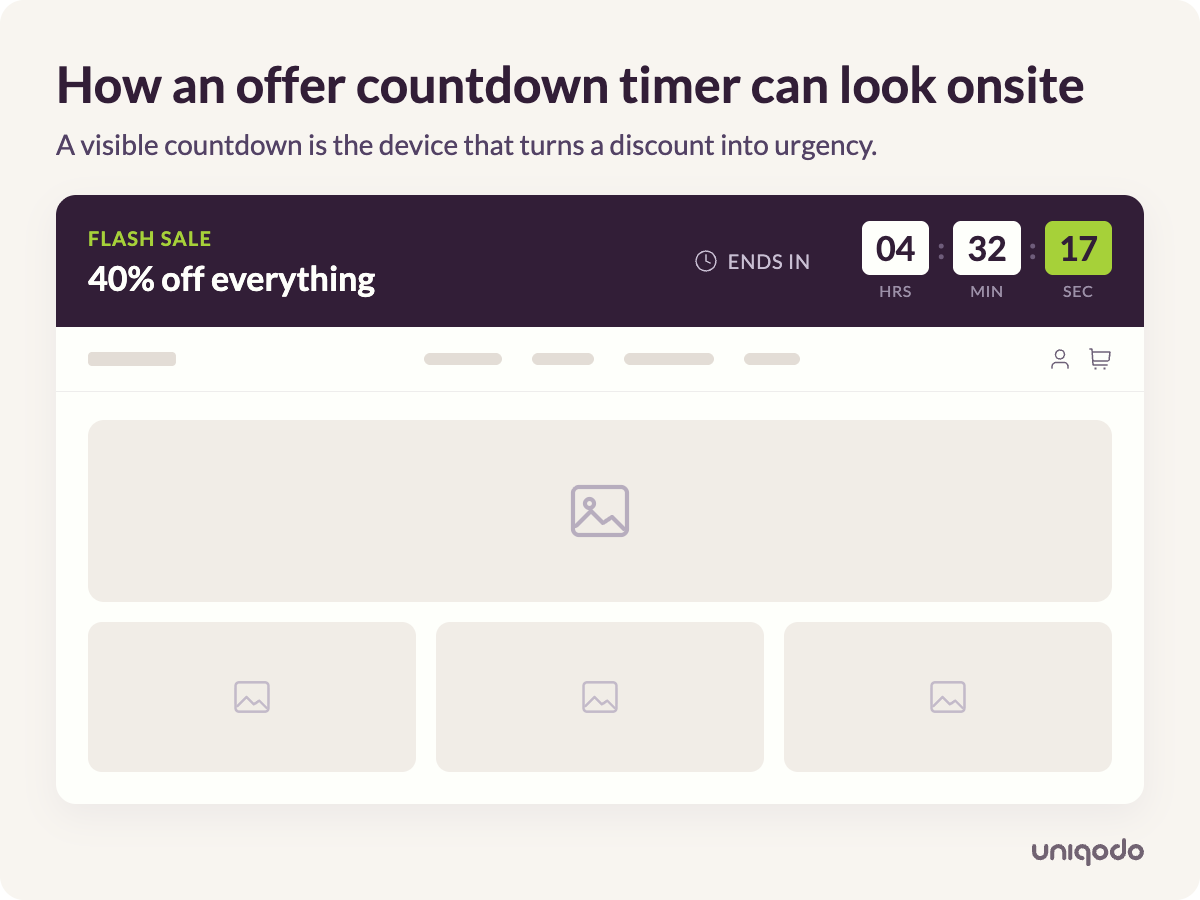
A countdown timer attached to a genuine expiry, whether on a flash sale landing page or an individual code, converts stated urgency into felt urgency. When the expiry is real and the timer reflects it accurately, the combination of a visible deadline and a worthwhile offer consistently shortens the gap between consideration and checkout.
Use exit-intent offers to recover revenue before the shopper leaves
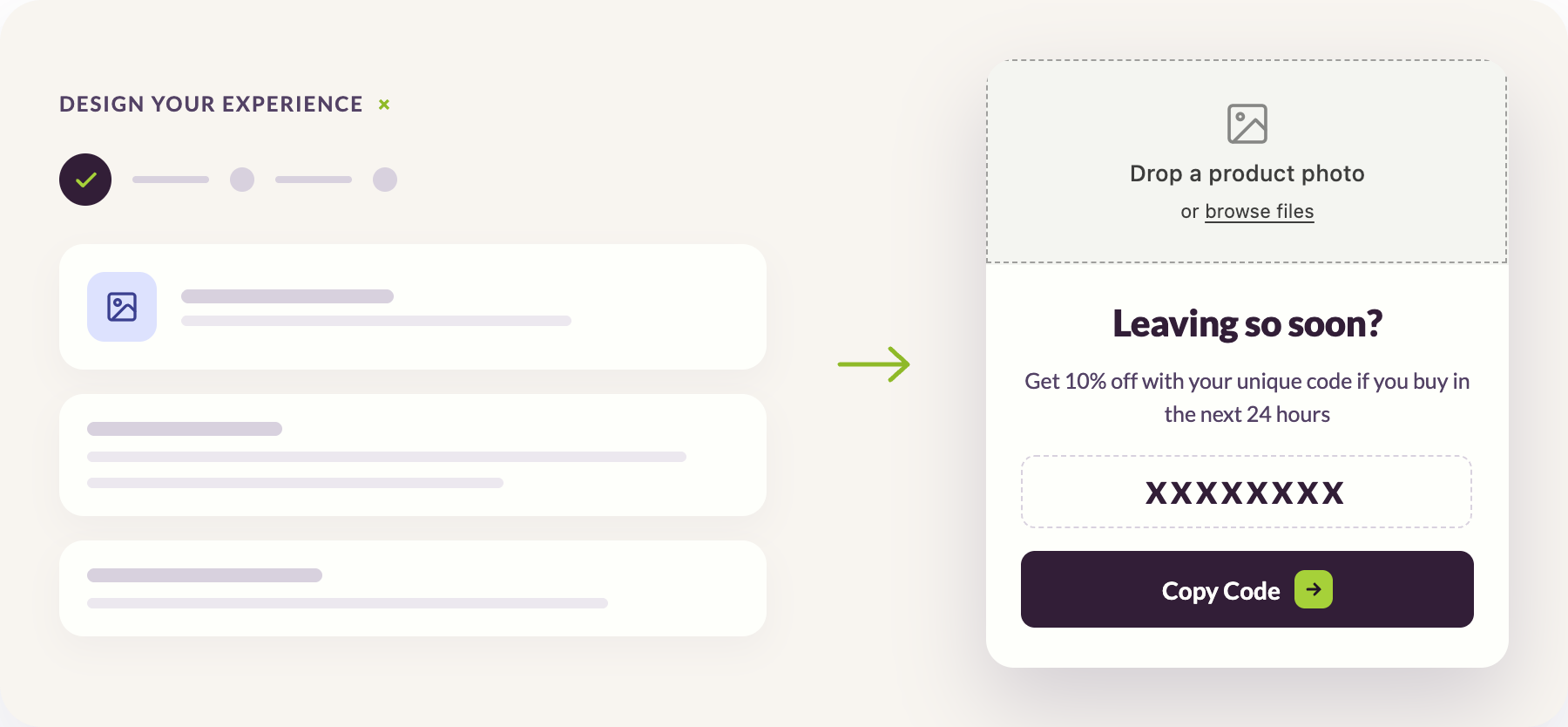
An exit-intent offer serves a targeted discount at the moment a shopper moves to leave, or reminds them of an unredeemed code they already hold, recovering revenue that was walking out the door. In the same H1 2026 data, 18.60% of validated retail codes delivered onsite were redeemed, against 7.67% for retail codes sent by email, based on the 49.1% of retail redemptions where the channel was recorded.
Onsite overlays and code reminders deployed at these moments also solve the empty-coupon-field problem, because the shopper never needs to leave the checkout to go code-hunting. Segmentation matters here: showing exit-intent overlays to every visitor on every page will dilute their effectiveness. Restrict them to shoppers with items in their basket who have not already seen the offer in the current session.
Use collect-and-save mechanics to spread engagement across multiple purchases
A collect-and-save campaign gives customers progress towards a reward that accumulates across multiple purchases rather than completing in a single transaction. The mechanic extends the engagement horizon beyond one order and pairs well with retention goals, because the shopper has a reason to come back that is not simply another discount. For more formats and examples, see our roundup of gamification campaigns.
How to prevent coupon campaigns from leaking margin
You prevent coupon leakage at the code level, not the campaign level. Four controls close the gaps that generic-code campaigns leave open.
Use unique, single-use codes to eliminate the aggregator problem
A generic code is a public asset the moment one recipient shares it. A unique code is issued to one recipient, redeems once, and then ceases to exist. That single change removes the aggregator-site problem for owned channels, keeps attribution clean, and makes redemption data trustworthy, because every redemption maps to a known recipient. Our guide to the best tools for creating unique promo codes covers the generation side in depth.
Validate rules at redemption to stop codes being used outside their intended conditions
A shopper applies a new-customer code to an existing account. Another uses a code on a basket full of sale items the promotion was never meant to discount. A third stacks two offers that should have been mutually exclusive. In each case, the discount applies because the rules were stated but never checked.
The fix is validation at the point of redemption: every condition evaluated in real time when the code hits the checkout, before the discount applies. Is this customer eligible? Does the basket meet the minimum spend? Has the code already been used? Is the campaign still live? Does the stacking policy allow it?
Uniqodo's Promotion Engine handles this qualification logic at the point of redemption, so a code used outside its intended conditions simply fails to validate rather than quietly discounting an order it was never meant to touch.
Gate partner and affiliate distribution to protect attribution
Partner channels are the most common leakage source, because the brand hands codes to a third party and loses visibility from that point on. Gated delivery flips the model: each partner, publisher, or influencer receives their own allocation of unique codes, issued through a controlled journey rather than published openly.
Uniqodo's Code Distribution automates this partner delivery, so you measure each affiliate's performance on codes only their audience could have received, and there is no generic code for a coupon site to scrape. Influencer campaigns get honest attribution; the brand gets discounts that reach the intended audience and nobody else.
Defend against browser extensions that apply codes automatically
Coupon-testing extensions automatically try known codes at checkout, applying discounts to shoppers who never engaged with any campaign. This is one of the most common forms of discount abuse. Unique single-use codes are inherently resistant, because there is no reusable code for an extension to hold, and real-time validation rejects anything presented outside its issued context. For the broader abuse picture, including multi-account exploitation of new-customer offers, see our guide to preventing promotion abuse.
Measuring coupon marketing ROI
Measure coupon marketing ROI by comparing the incremental profit a campaign generated against its full discount cost, not by counting redemptions. Three metrics form the core framework:
Incremental revenue. Revenue from customers who would not have transacted, or would have transacted for less, without the offer. The practical method is a holdout: withhold the offer from a matched segment and compare. The gap between the two groups is the campaign's real contribution; everything else is subsidised behaviour you already had.
AOV impact. For threshold-based campaigns, compare average order value between redeemers and the baseline for the same segment. A £15-off-£100 code that lifts the average basket from £70 to £105 has done its job; one redeemed almost entirely on baskets that were already over £100 has not.
Margin per campaign. The complete accounting: incremental gross profit, minus total discount cost, minus fulfilment and campaign costs. This is the number that decides whether the campaign runs again, and it is only calculable when redemption data is clean, which loops back to unique codes and validated redemptions. You cannot measure a campaign honestly once its codes leak, because you cannot separate intended redemptions from opportunistic ones.
Supporting metrics such as redemption rate, new-versus-existing redeemer split, and repeat purchase rate among redeemers add diagnostic detail, but the three above answer the commercial question. Track them per campaign and per segment, and feed the results back into offer depth decisions for the next cycle.
Every metric here depends on clean redemption data, which is only possible when codes are unique, validation is enforced at checkout, and distribution is controlled.
Building a coupon marketing strategy that lasts
The difference between a coupon programme that drives growth and one that quietly erodes margin is not the size of the discount or the number of campaigns. It is whether every code that leaves your hands has a goal attached to it, rules enforcing it, and data measuring whether it worked.
Start with the area where your current programme leaks the most value. For most brands, that is either uncontrolled generic codes reaching coupon aggregator sites, or a measurement gap that makes it impossible to separate incremental revenue from subsidised sales. Fix the biggest leak first, measure the impact, and use that result to build the case for tightening the next one.
Coupon marketing strategy FAQs
What is a coupon marketing strategy?
A coupon marketing strategy is a structured plan for using discount codes and promotional offers to drive a specific customer behaviour. Each campaign is tied to one goal, one audience segment, and a set of qualification rules that control who qualifies, what products are included, and how many times the code can be used.
How do you measure coupon marketing ROI?
Measure incremental profit, not redemptions. Use a holdout group to isolate revenue the campaign genuinely created, track AOV lift among redeemers against a segment baseline, and calculate margin per campaign: incremental gross profit minus total discount, fulfilment, and campaign costs. Redemption rate alone shows offer appeal, not commercial return.
What is the difference between coupon marketing and discount marketing?
Discount marketing reduces prices for everyone, typically through sitewide sales or markdowns. Coupon marketing delivers a conditional discount through a code, so it applies only to the customers, products, and basket conditions the brand chooses. Coupons are targetable and attributable; blanket discounts are neither, which is why coupons protect margin more effectively.
How do you prevent coupon code abuse?
Issue unique, single-use codes rather than generic ones, so each code redeems once and maps to a known recipient. Enforce eligibility, product scope, usage limits, and stacking rules in real time at checkout, and distribute partner and affiliate codes through gated journeys so they cannot be scraped by coupon aggregator sites or browser extensions.
About Uniqodo
Uniqodo is the Intelligent Promotion Experience Platform. It sits above your existing e-commerce stack, so enterprise commercial and marketing teams can build, distribute and validate promotions with unique single-use codes, qualification rules checked at redemption and partner code distribution. Founded in 2014, Uniqodo has generated more than 1 billion codes for brands including Samsung, BT, EE and Avis. To see how these controls would apply to your coupon programme, book a demo.

Chris Roye
CEO